


Indian American Community and Trump’s Trade Policies: A Complex Political Landscape

- Many have not collectively abandoned their support for Trump based solely on trade disputes.
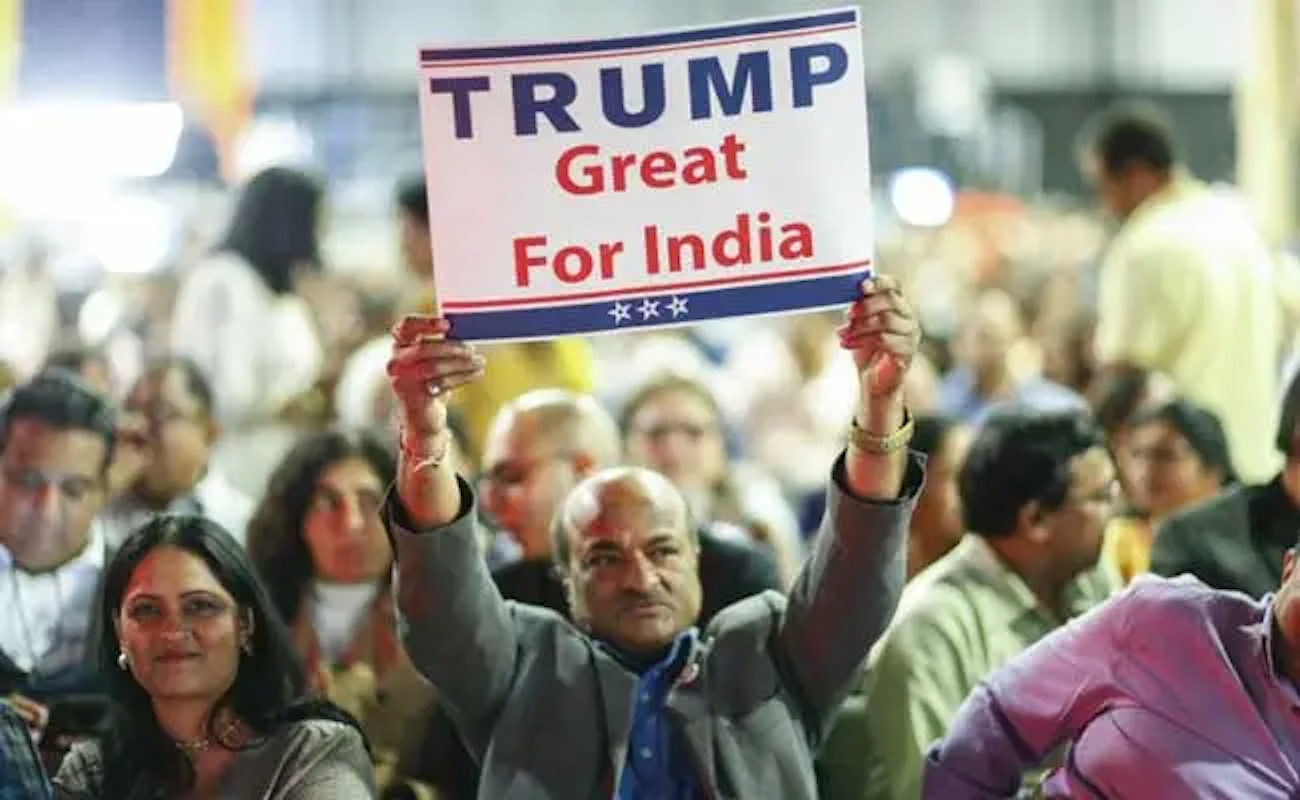

Recent polling data and news coverage reveal a nuanced picture of Indian American political attitudes regarding Trump’s trade policies with India, complicated by the community’s religious, regional, and ideological diversity.
From 2020 to 2024, the percentage of Indian-Americans identifying as Democrats dropped from 56% to just 47%, while support for Trump surged from 22% to 31%, according to Fortune magazine’s analysis. This represents a significant political realignment within the community, occurring even as trade tensions between the U.S. and India have intensified.
The trade relationship between the two countries has become increasingly strained. As of 2024, total trade between the two countries amounted to an estimated $129.2 billion, according to U.S. government statistics. The US currently has a $45.7bn trade deficit with India, creating friction that Trump has repeatedly highlighted.
Most dramatically, President Trump on Wednesday said that the United States will begin imposing 25% tariffs on goods imported from India, representing a major escalation in trade tensions despite the previously warm relationship between Trump and Prime Minister Modi.
President-elect Donald Trump has nominated Indian Americans to key posts, including Kash Patel to lead the FBI and Vivek Ramaswamy to co-lead a government-efficiency task force. Indian Americans are the most represented minority in the Trump administration, reflecting a faction of the community’s shifting alignment with Trump’s values on economic and social issues.
This represents a significant political development. President-elect Donald Trump’s nominations of Indian Americans to high-profile roles underscores a rightward shift among this voting group, as noted by The Christian Science Monitor.
The Mamdani Controversy
The Indian American community has shown deep political divisions that extend beyond trade policy, particularly around criticism of the Modi government. The case of Zohran Mamdani, a New York City mayoral candidate, illustrates these tensions within the broader South Asian American political landscape.
Zohran Mamdani, son of scholar Mahmood Mamdani and filmmaker Mira Nair, has drawn significant opposition from segments of the Hindu American community due to his criticism of Prime Minister Modi. Mamdani blames the Indian prime minister for the deaths of more than 1,000 Muslims in riots in the Indian state of Gujarat when Modi was its chief minister, according to The Washington Post.
A number of those attacks have fixated on Mamdani’s religion: The 33-year-old is Muslim. Some commenters have accused the mayoral hopeful of being a “jihadi” and “Islamist”. Others have called him anti-Hindu and anti-India.
The remarks have sparked outrage among Indian American leaders and community representatives as they accused Mamdani of promoting hate and deepening religious divides, as reported by OpIndia. Indian-origin American leaders and activists have accused Mamdani of using communal rhetoric after he condemned Prime Minister Narendra Modi and compared him with Israeli PM Benjamin Netanyahu over the 2002 Gujarat riots, according to the New York Post.
This has enraged Modi’s supporters. They have labelled Mamdani an Islamic fundamentalist. Some have criticized him for being anti-India, as noted by The Diplomat. One viral post labelled Mamdani a “Jehadi mayor” and accused him of fostering hatred against Hindus and Jews, claiming his parents embody “duplicity,” according to TRT Global.
A number of those attacks have fixated on Mamdani’s religion: The 33-year-old is Muslim. Some commenters have accused the mayoral hopeful of being a “jihadi” and “Islamist”. Others have called him anti-Hindu and anti-India, Al Jazeera reported.
The Modi-Trump Dynamic
The relationship between the two leaders has been characterized as personally warm despite policy disagreements. India’s Prime Minister Narendra Modi, a nationalist criticized over India’s democratic backsliding, has welcomed President Trump’s return to the White House, according to NPR reporting.
However, tariffs and Trump’s anti-immigrant rhetoric could hurt India. The Modi-Trump friendship could be a savior, as noted by Al Jazeera’s analysis of the complex dynamics at play.
Indian Americans believe the Biden administration ably managed U.S.-India ties during its tenure. They offer a more mixed assessment of what relations under Trump might entail, according to Carnegie Endowment research. This suggests the community recognizes potential challenges ahead despite some members’ support for Trump domestically.
The chances of a trade war that raise inflation and reduce India’s economic growth are much higher under a Trump presidency, as noted by analysis in The Print. Trump announces 25% tariffs on Indian goods from August 1, dealing a blow to Indian economy with exports, markets and diplomatic trust as trade talks stall, according to India Weekly.


The Indian American community encompasses significant religious diversity, and political preferences vary considerably across these lines. Among Indian Americans, Christians are actually the religious community most supportive of Trump at 45%, according to The Juggernaut’s analysis of survey data. This challenges assumptions that Hindu Americans are Trump’s primary Indian American constituency.
The community’s religious composition includes Hindus, Muslims, Christians, Sikhs, Jains, Buddhists, and others, each bringing distinct perspectives on both U.S. domestic policy and India relations. The impact of Trump 2.0 on minority communities varies significantly, with different challenges and opportunities facing Hindus, Sikhs, and Muslims within the Indian American diaspora.
Despite these economic pressures, the evidence suggests that Indian Americans have not uniformly broken with Trump over trade policy. The community’s political preferences appear to be driven by a complex mix of factors beyond just U.S.-India trade relations, including domestic economic issues, social values, support for or opposition to the Modi government, religious identity, and individual political philosophies.
Community Fragmentation
South Asian Americans, especially in New York City, are not a homogeneous lot. The community is now more globally connected than ever, never separated from old connections in home countries via WhatsApp chat groups and Facebook and Instagram posts where everyone has an opinion and where fact and fiction merge in creative ways in echo chambers.
This fragmentation is evident in how different segments of the Hindu American community respond to both Trump’s trade policies and criticism of the Modi government, with some maintaining strong support for Modi while others are more critical.
The available evidence indicates that while Trump’s trade policies with India have created significant economic tensions and diplomatic challenges, Indian Americans have not collectively abandoned their support for Trump based solely on these trade disputes. Instead, the community shows signs of continued political diversification, with political loyalties influenced by a complex interplay of factors including attitudes toward the Modi government, domestic U.S. politics, religious identity, and individual experiences.
The intense opposition to critics of the Modi government like Zohran Mamdani within segments of the Hindu American community suggests that support for Modi may actually strengthen some Indian Americans’ alignment with Trump, despite trade tensions. However, this dynamic varies significantly across religious lines, with Indian American Christians showing the highest Trump support rates, while Muslim Indian Americans likely have different concerns about both Trump’s domestic policies and his approach to India.
The relationship between trade policy, Modi government support, religious identity, and voting behavior within this diverse community appears more complex than simple economic interests would suggest. As one analysis noted, the community is experiencing a broader rightward shift that transcends trade policy concerns.