



Tubman of Our Time: Indian American Elora Mukherjee’s Uncompromising Fight for Immigrant Rights

- For the Columbia law professor, whose immigrant parents hailed from Patna in Bihar, her relentless advocacy for asylum seekers is both professional calling and personal mission.
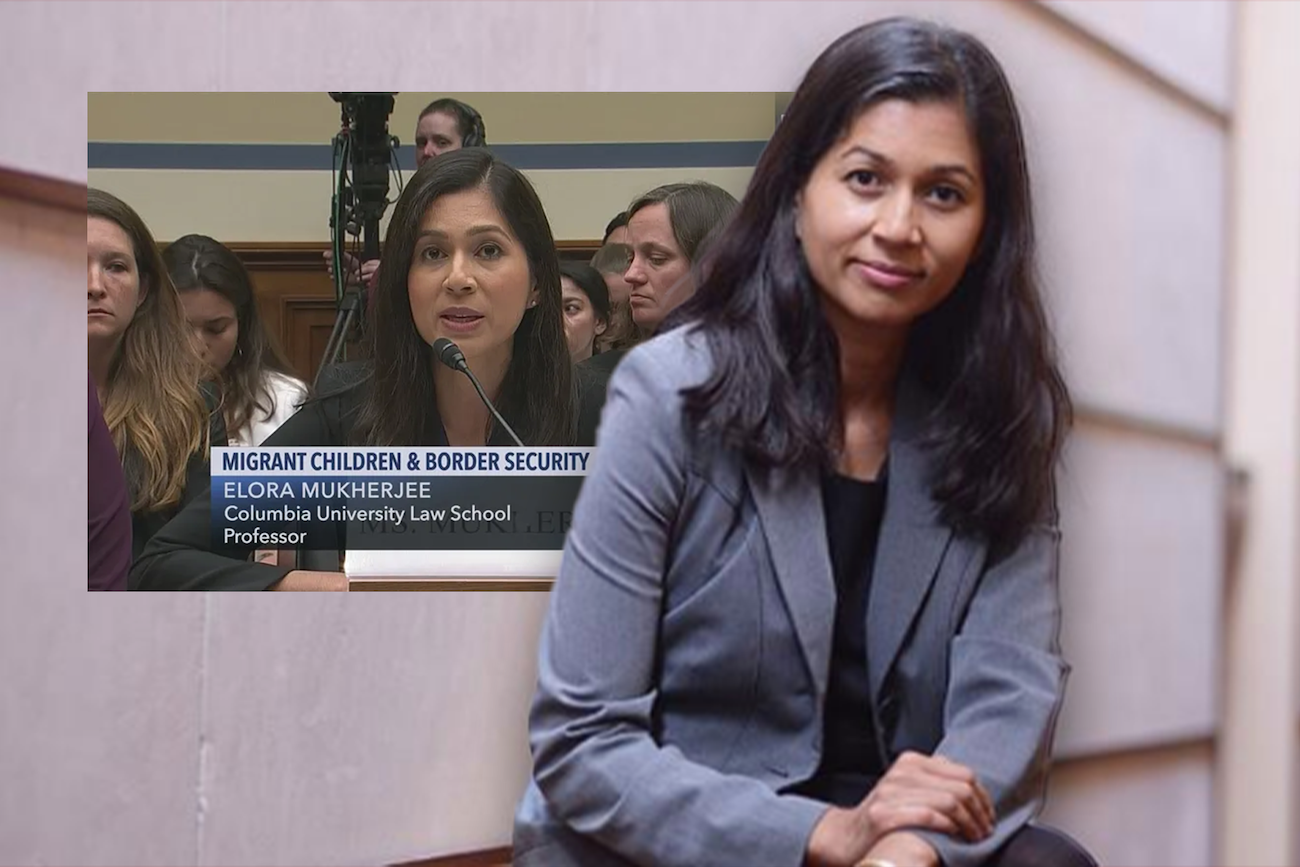

When Columbia Law School’s Elora Mukherjee testified before Congress in July 2019 about conditions at the Clint, Texas border detention facility, her voice broke as she described a six-year-old girl who could only repeat, “I’m scared. I’m scared. I’m scared,” over and over again. According to Columbia Law School’s official account, Mukherjee told the House Committee on Oversight and Reform that the child couldn’t even say her own name, adding, “I couldn’t help her. I had to return her to the guards. Not being able to do anything for her broke my heart.”
It was a rare moment of visible emotion from a legal advocate known for her fierce, methodical approach to fighting for some of America’s most vulnerable immigrants. But for Mukherjee, the Jerome L. Greene Clinical Professor of Law and director of Columbia Law School’s Immigrants’ Rights Clinic, the work has always been personal.
From Hate Crimes in Suburban New Jersey to Yale Law
According to a profile published by Columbia Law School, Mukherjee’s own experience growing up in suburban New Jersey as the daughter of Indian immigrants informs her career. “Our family was targeted with hate crimes—detonating devices that blew up our mailbox—and my father’s windshield was shot at and shattered,” she recalled. “There were hate crimes targeting South Asians in the 1980s, and my parents worked very hard to protect me and my sister from knowing about it.”
Columbia News reported that in 1970, Mukherjee’s father arrived in New York City from India on an engineering scholarship with seven dollars in his pocket. After her mother joined him six years later, the two worked multiple jobs and long hours in the hopes of providing their daughters with opportunities they never had. During childhood trips back to Patna, the capital of the Indian state of Bihar, Mukherjee began to see what it meant for her to grow up in America.
“Patna has just unbelievable poverty,” Mukherjee told Columbia News. “Growing up and seeing the very stark contrast between how people lived in Patna and how I lived in the U.S. made me realize at a young age that the world is unfair, and I should do what I could, as I got older, to make even a small difference in people’s lives.”
After graduating from Rutgers University in 2002, the Columbia Law School profile notes, Mukherjee enrolled at Yale Law School, where she participated in its Immigration Legal Services clinic for five semesters. During her 2L summer, she interned for Lee Gelernt, the deputy director of the ACLU Immigrants’ Rights Project. She clerked for Judge Jan E. DuBois of the U.S. District Court for the Eastern District of Pennsylvania for a year, then won a postgraduate fellowship with the ACLU Racial Justice Program.
Building a Career at the Intersection of Civil Rights
According to her Columbia Law School biography, Mukherjee worked at a civil rights law firm from 2007 to 2010, specializing in police misconduct, prisoners’ rights, housing, and employment discrimination, and then rejoined the ACLU Racial Justice Program as a staff attorney until 2013. Her pivot to academia was a logical move, she explained in the Columbia profile: “My clinical professors helped to transform my life, and I thought if I ever got lucky enough, I would become a clinical professor. It’s an amazing job: You get to teach, which I’ve always loved; you still get to be an advocate, and that is pretty much ingrained in me.”
The Dilley “Deportation Mill”
In January 2015, Mukherjee and eight Columbia Law School students made a trip that would establish her as a national voice for detained asylum seekers. According to a Columbia Law School news release from February 2015, they traveled to Dilley, Texas to represent women and children held in a newly opened government-run family detention center. Because Immigration and Customs Enforcement and its contractor, the Corrections Corporation of America, didn’t allow laptops or cell phones into the facility, the students had to take notes with pen and paper. The facility denied every request for legal phone calls with clients, leaving very limited preparation time for bond proceedings.
The Columbia release noted that asylum seekers had been held in cells known as hieleras (Spanish for freezer) and warehouse-like units called perreras (doghouses). They were stripped of all possessions—including wedding rings and rosaries—housed with strangers, and counted in their bunks multiple times a day. “We’re not talking about people who have been convicted of any crime,” Mukherjee said at a Law School discussion. “We’re talking about kids and their mothers who are seeking safety in the United States.”
In a documented testimony, she spent nearly an hour with a six-year-old boy caring for his younger brother, first trying to interview him and then just letting him sit on her lap while she rubbed his back. “He wept almost inconsolably for most of the time,” she said.
According to the Columbia profile, over five days, the group secured the release of 15 families after highly contested hearings held via videoconference with the faraway Denver Immigration Court. “Within two weeks of returning to New York, we prepared a white paper about what we witnessed, and circulated it to hundreds of immigrants’ rights advocates across the country saying we must do something,” Mukherjee said. Her call to action helped inspire the creation of the Dilley Pro Bono Project and introduced Mukherjee as a national voice for asylum seekers.
As Mukherjee told Columbia Law School, she described the Dilley facility as a “deportation mill.”
“I Have No Tolerance for Missed Deadlines”
Despite what the Columbia profile described as her gentle demeanor and easy laugh, Mukherjee is a taskmaster with students. “I have no patience for procrastinators,” she told Columbia Law School. “I have no tolerance for missed deadlines. Our clients’ lives are on the line, and I can’t let the quality of our work suffer because a student isn’t pulling her or his weight.”
In a single semester, she expects each student to oversee every detail of an asylum or deportation case, from the initial client interview to its adjudication or trial. Since she founded the clinic in 2014, according to her Columbia biography, Mukherjee and her students have successfully represented hundreds of migrants and refugees who have fled violence and persecution in their home countries.
Columbia Law School’s vice dean for experiential education, Brett Dignam, described Mukherjee as a force for good in the world in the Columbia profile. “She is a fierce and wildly successful lawyer who zealously advocates for her clients. Elora devotes her unparalleled energy to representing people, often families and young children, who are in desperate need of her talent and commitment. She models excellence and compassion for our students on a daily basis.”
The Congressional Testimony That Sparked Outrage
According to Columbia Law School, in 2019, Mukherjee’s firsthand reports of the inhumane conditions of confinement for children in a U.S. border detention station sparked national and international outrage as she gave extensive media interviews on what she had witnessed. In her congressional testimony, as reported by Columbia and covered by CBS News and NPR, Mukherjee described children, including babies without diapers, suffering from lice and the flu, wearing the same filthy clothes for weeks, and feeling frantic with fear for the family members they had been taken from.
Newsweek reported that Mukherjee was part of a 10-person team sent to inspect conditions at the holding centers to make sure they complied with court-ordered standards that the camps be “safe and sanitary.” Over three days, she interviewed 70 detained migrant children. They were so dirty they had a stench, and she was unable to be near them without feeling ill.
“I was and I remain shaken to my core by what I witnessed at Clint,” Mukherjee testified according to NPR’s coverage. “I do not have the words to explain to them [my own children] what is happening to children their age in America right now.”
According to Columbia Law School’s account of her testimony, Mukherjee told Congress: “Children were hungry. Children were traumatized. One 6-year-old girl, detained all alone, could only say, ‘I’m scared. I’m scared. I’m scared,’ over and over again.”
In testimony documented by Newsweek, she spent nearly an hour with a six-year-old boy caring for his younger brother, first trying to interview him and then just letting him sit on her lap while she rubbed his back. “He wept almost inconsolably for most of the time,” she said. Later, a guard came and attempted to bribe him with a lollipop so that he would return to his cell.
CBS News reported that Mukherjee teared up as she described the boy, saying, “Here was a child, the same age as my son, stuck in a hellhole.”
A Personal Commitment Beyond the Classroom
Columbia Magazine revealed another dimension of Mukherjee’s commitment: detained asylum seekers who have nowhere to go sometimes stay with her until suitable housing can be found. Her husband, Jamal Greene, Columbia Law School’s vice dean and a professor of constitutional law, is fully supportive of his wife’s extracurricular commitment, according to the magazine. He has grown used to his coats and jackets being donated to strangers who show up in the middle of the night.
The Elizabeth detention center in New Jersey, located in the middle of an industrial park, releases asylum seekers without offering any support or even giving them bus fare, Columbia Magazine reported. They are usually released wearing the clothes they were arrested in—even if this means a summer-thin African outfit in the middle of winter. Law students drive to New Jersey to fetch them.
According to Wikipedia, Mukherjee is married to Jamal Greene, whose own background brings another dimension to their shared commitment to justice. Wikipedia notes that Greene was raised in Park Slope, Brooklyn, and his brother is the rapper Talib Kweli.

The Flores Agreement and Enforcement
According to her Columbia Law School biography, for more than a decade, Mukherjee has worked on issues related to enforcing the Flores Settlement Agreement, which sets a limit on the length of time children can be detained in federal immigration custody, requires that they be held in the least restrictive area possible, and guarantees access to basic hygiene and adequate nutrition.
Capital & Main reported that Mukherjee has clocked hundreds of hours recording interviews of families and children detained at the U.S.-Mexico border. Her testimony before Congress was reinforced by their stories, which she collected a month prior with a team of lawyers and a doctor at the border detention centers at Clint and Ursula.
Recognition and Continuing Work
In 2021, according to the National Immigration Project, Mukherjee was selected as the inaugural recipient of the Elisabeth S. “Lisa” Brodyaga Award, recognizing her as a globally recognized advocate, practitioner, and voice for immigrant rights. The organization noted that her eyewitness accounts of the inhumane treatment of children along the Mexico-U.S. border in 2019 sparked national and international outrage, and since November 2020, she has been supporting and advocating for women who were subjected to non-consensual medical procedures and abuse while detained by U.S. Immigration and Customs Enforcement at the Irwin County Detention Center in Georgia.
According to Columbia Law School, Mukherjee’s groundbreaking work led to her being named the Jerome L. Greene Clinical Professor of Law, a new endowed chair made possible as part of a 15 million dollar gift in 2017 from the Jerome L. Greene Foundation. “The Jerome L. Greene Foundation has been a champion of the Law School’s clinical work from day one and it is an absolute honor to hold the inaugural Greene chair,” Mukherjee said.
Advocacy Across Administrations
Mukherjee’s advocacy has continued across multiple administrations. According to her Columbia faculty page, she has written extensively on immigration policy, with recent publications including “ICE Detained My 6-Year-Old Client With Cancer. Here’s What Freed Him” in Slate in July 2025, and “Biden has not done enough to end family separations at the border” in The Hill in February 2021.
Her work regularly appears in major media outlets. Time magazine has published her op-eds, including “Americans Aren’t Allowed to Donate to and Volunteer at Migrant Detention Centers. There’s No Good Reason for that Policy” in July 2019. She has been featured in The Guardian, NPR, The New York Times, the Los Angeles Times, and numerous other national and international publications.
As noted by Columbia Law School, Mukherjee regularly collaborates with other immigrants’ rights advocates on strategic litigation, legislative reform, grassroots activism, public education, and coalition building. She serves on the boards of the Asylum Seeker Advocacy Project, Project Amplify, and the Refugee Reunification Project.
The Price of Bearing Witness
The emotional toll of this work is evident. Columbia Magazine described asylum cases as matters of life and death, with clients including women fleeing sexual assault and murder threats, Christians targeted by Boko Haram and al-Shabaab, and unaccompanied children as young as eleven escaping gang violence.
Yet Mukherjee continues the work. As she told Columbia Law School in her profile, working on family detention issues has been a defining part of her professional career. As a fellow at the ACLU, she was part of a team whose work helped stop the flow of families into the first prison-like detention center outside Austin, Texas in 2009. “It seemed like an ugly chapter of American history was over,” she said. “But once more, law students are at the forefront of efforts to investigate family detention issues. This time they’re from Columbia Law School.”
For Mukherjee, the work remains both professional calling and personal mission—shaped by her parents’ immigrant journey, informed by the hate crimes her family endured, and driven by the conviction that, as she told Columbia News, the world is unfair and she should do what she can to make even a small difference in people’s lives. In the lives of hundreds of asylum seekers and detained children, that difference has been anything but small.
The story, conceptualized and edited by American Kahani’s News Desk, was aggregated by AI from several sources.