


Who Blinked? Questions Remain About What Was Actually Agreed in Trump’s ‘Trade Deal’ With India

- Bloomberg's reporting reveals is that India's negotiating posture—patient, firm, and willing to wait out political cycles—may have been more effective than Trump's bluster.
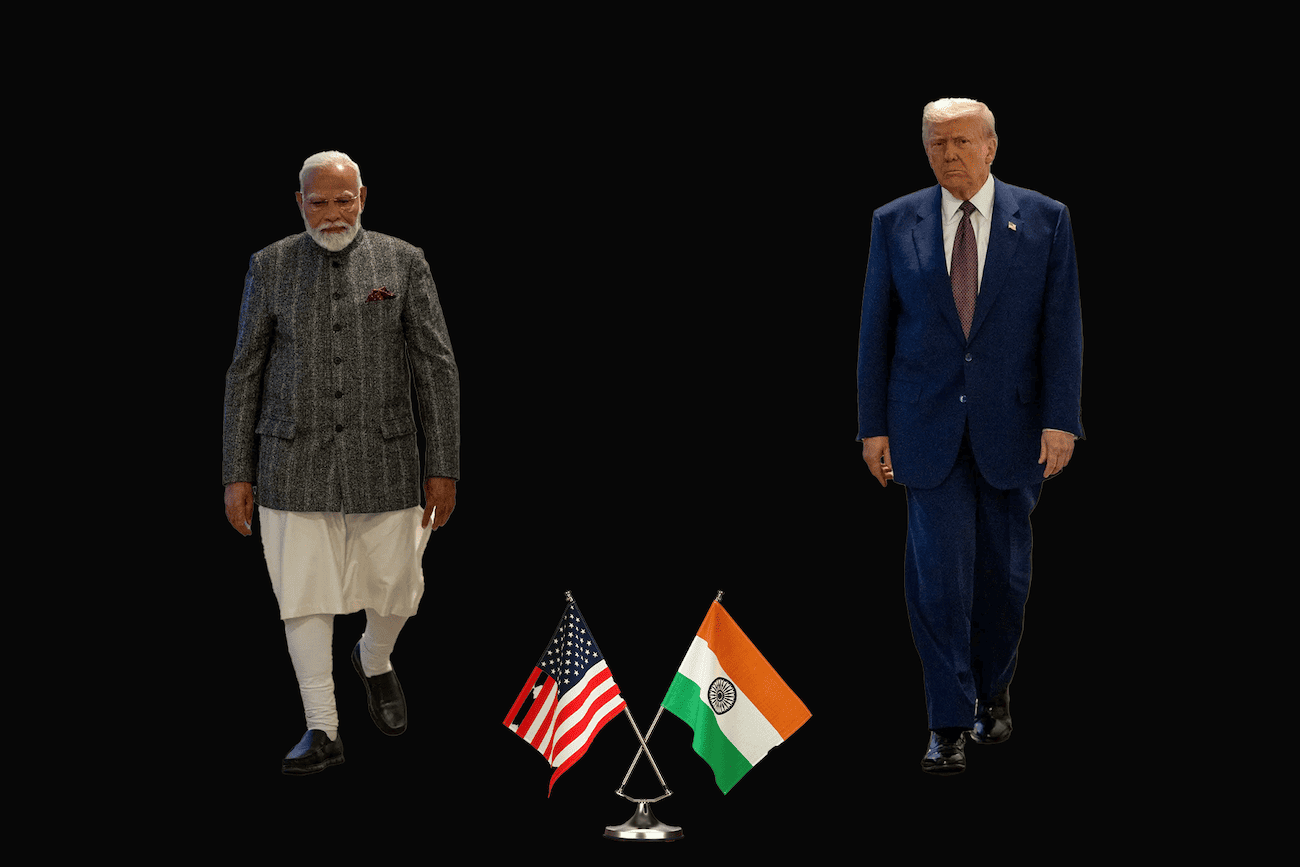

President Donald Trump announced a U.S.-India “trade deal” on Monday with characteristic fanfare, declaring victory in securing tariff reductions and massive Indian commitments. But Bloomberg reporting reveals a starkly different backstory: five months ago, India told the United States it was willing to wait out Trump’s entire presidential term rather than cave to his demands.
The contrast between Trump’s triumphant rhetoric and the tough negotiating stance India maintained behind closed doors raises fundamental questions about what, exactly, was agreed to—and whether this is the comprehensive trade pact the president claims or merely a tactical pause in an escalating trade war.
Trump’s Victory Lap
On Monday, February 3, Trump took to Truth Social to announce what he called a major trade breakthrough following a call with Indian Prime Minister Narendra Modi.
“Out of friendship and respect for Prime Minister Modi and, as per his request, effective immediately, we agreed to a Trade Deal between the United States and India, whereby the United States will charge a reduced Reciprocal Tariff, lowering it from 25% to 18%,” Trump wrote.
A White House official clarified to Reuters that the U.S. was also rescinding a punitive 25 percent duty on all imports from India over its purchases of Russian oil that had stacked on top of the 25 percent “reciprocal” tariff rate, bringing total tariffs down from 50 percent to 18 percent.
In return, Trump claimed that India agreed to reduce “their Tariffs and Non Tariff Barriers against the United States, to ZERO,” according to CNBC and multiple sources. He further asserted that Modi committed to buying more than $500 billion worth of U.S. energy, technology, agricultural and other products and agreed to “stop buying Russian Oil,” according to The Hill.
“Our amazing relationship with India will be even stronger going forward,” Trump wrote.
Modi’s Notably Different Version
Prime Minister Modi’s response, while cordial, was significantly more restrained and conspicuously avoided key claims made by Trump.
“Wonderful to speak with my dear friend President Trump today. Delighted that Made in India products will now have a reduced tariff of 18%. Big thanks to President Trump on behalf of the 1.4 billion people of India for this wonderful announcement,” Modi wrote on X.
Crucially, Modi made no mention of a trade deal, Russian oil commitments, or zero tariffs on U.S. goods, according to India TV News. He did not confirm the $500 billion purchase commitment.
Instead, Modi emphasized that “President Trump’s leadership is vital for global peace, stability, and prosperity. India fully supports his efforts for peace,” according to CNBC—a carefully diplomatic statement that avoided mentioning Russia.
India’s Commerce and Industry Minister Piyush Goyal later said negotiations had reached a “final form” and that the countries would sign a deal “shortly,” with a joint statement to be released when final details are agreed, according to Al Jazeera.
The Bloomberg Revelation: India’s Hardline Stance
The discrepancy between Trump’s and Modi’s characterizations takes on new significance in light of Bloomberg reporting published February 4 that revealed what happened behind closed doors five months earlier.
According to Bloomberg, citing officials in New Delhi familiar with the discussions, National Security Adviser Ajit Doval met with Secretary of State Marco Rubio in early September 2025—shortly after Modi held meetings with Vladimir Putin and Xi Jinping at the Shanghai Cooperation Organization summit in China.
Doval’s message to Rubio was blunt: “India wouldn’t be bullied by U.S. President Donald Trump and his top aides, and would be willing to wait out his term, having faced other hostile U.S. administrations in the past,” Bloomberg reported.
Both India’s Ministry of External Affairs and the U.S. State Department declined to comment on the discussions, which were private.
The Bloomberg report indicates that India was prepared to wait until the end of Trump’s term in 2029—potentially four more years—rather than compromise on its core interests.
Doval also made clear that India wanted Trump and his aides to dial down their public criticism of India to help reset bilateral ties, according to The Week.
A Tactical Shift, Not Capitulation
Shortly after the Doval-Rubio meeting, there were visible signs of a shift in tone. Trump called Modi on his birthday in September and said during a media interaction at the White House on September 6 that he would “always be friends” with Modi and called him “a great prime minister,” according to The Week.
“I’ll always be friends, but I just don’t like what he is doing at this particular moment. But India and the United States have a very special relationship,” Trump said.
The Bloomberg reporting suggests that what Trump is now portraying as India’s capitulation to U.S. demands was actually the result of India holding firm on its red lines while the U.S. moderated its approach.
What’s Actually in the “Deal”?
The announced agreement remains remarkably thin on details and rife with contradictions:
On Tariffs: The U.S. commitment to reduce tariffs from 50 percent to 18 percent appears concrete and has been confirmed by both sides. However, Trump’s claim that India will reduce tariffs on U.S. goods to “ZERO” has not been confirmed by India.
On Russian Oil: Trump claims Modi agreed to “stop buying Russian Oil.” Modi has made no such public commitment. CNBC reported that private refiners in India had already reduced purchases of Russian oil in January, and Indian state-run refiners signed their first long-term deal with the U.S. to import 2.2 million tons of liquefied petroleum gas in 2026—all before any deal was announced.
According to Al Jazeera, India’s Russian oil imports were already declining, down to around 1.2 million barrels per day in January, projected to decline to about 1 million bpd in February and 800,000 bpd in March.
A U.S. Trade Representative official, granted anonymity to provide details, warned that “the president of the U.S. can always put Russia oil tariff back on if they go back to buying Russian oil.”
On Agricultural Access: Bloomberg reported that agriculture and dairy have been sectors where India has drawn firm red lines. Indian opposition figures have raised concerns that Modi may have conceded on agricultural access, though details remain unclear.
On the $500 Billion Commitment: Multiple analysts have expressed extreme skepticism about this figure. U.S. goods exports to India in 2024 were $41.5 billion, and U.S. services exports to India in 2024 were $41.8 billion, according to Carnegie Endowment for International Peace.
“Analysts would be wise to ignore some of the numbers in the deal, or at least treat them as aspirational,” wrote Carnegie’s analysis. “How is India going to buy $500 billion of anything from the United States anytime soon?”
Is This Even a Binding Agreement?
Legal experts and Democratic lawmakers have questioned whether Trump can clinch any binding trade agreements without congressional approval, as he has done multiple times since retaking office, according to CNBC. Trump and his supporters argue Congress has ceded authority to the executive branch to secure such deals.
Lori Mullins, director of operations at Rogers & Brown Custom Brokers, told CNBC her industry has learned not to react prematurely to Trump’s public trade pronouncements. “It’s official once the Federal Register notice is posted with dates, times and applicable tariff codes,” Mullins said.
The evidence suggests that what Trump has announced is not the comprehensive trade deal he claims but rather a tactical de-escalation—one achieved not because India capitulated to U.S. pressure, but because both sides stepped back from an unsustainable confrontation.
The Diplomat noted that the EU’s recent deal with India “is a genuine trade agreement, while Washington’s, in keeping with the pattern of negotiations under President Donald Trump, is a trade ‘deal’—with all the flexibility and potential for reversal that the latter implies.”
Carnegie Endowment for International Peace put it bluntly: “The United States hasn’t done true bilateral or plurilateral agreements since what feels like the Jurassic period, so we should temper our enthusiasm by recognizing that one of these things is not like the other.”
Political Fallout in India
The announced deal has triggered fierce criticism from India’s opposition Congress party.
“The main thing is that our PM is compromised. The public needs to think about this. Narendra Modi ji has sold your hard work in this trade deal because he is compromised. He has sold the country,” said Rahul Gandhi, the leader of the opposition in the Indian parliament.
Congress questioned Trump’s claim that India would move to reduce tariff and non-tariff barriers against the United States to “zero,” according to Zee News. The party compared the announcement to Trump’s previous disputed claim that he brokered a ceasefire between India and Pakistan in May 2025—a characterization India rejected.
Strategic Context: The EU Deal and Timing


The announcement came just one week after India closed a major free trade agreement with the European Union after nearly two decades of negotiations—a deal Modi touted as the “mother of all deals,” according to CNBC.
Some analysts predicted that progress between Europe and India could “light a fire” under New Delhi and Washington in their pursuit of a bilateral deal, according to CNBC.
CNBC reported that the situation between Washington and New Delhi had become “utterly unsustainable,” making a deal “inevitable.” Carnegie’s Evan Feigenbaum noted: “If you care deeply about U.S.-India relations and are invested in them, then having the floor fall out—as it did—is bad news. This is the opposite, and we should celebrate it.”
However, Feigenbaum also expressed skepticism about specific commitments, expecting New Delhi to refrain from making any “explicit” Russian oil-related commitment and calling the $500 billion target “kind of a stretch.”
Expert Analysis: Framework, Not Final Deal
Mark Linscott, a senior fellow on India at the Atlantic Council and former U.S. trade official, told CNBC: “This trade deal is just what the doctor ordered: a confidence-building measure that can help the two sides work through their various issues — including all the trust that the Trump administration has squandered in New Delhi in recent months.”
But Linscott cautioned that implementation remains uncertain. “I hope to see the implementation of this deal. But beyond that, the two sides should be entering into the next phase of negotiations and taking up a broader set of issues,” he said, particularly on areas like economic security, technical barriers to trade, digital trade and intellectual property rights.
CNBC characterized the announcement as a “trade framework” rather than a comprehensive agreement, with “details and timeline remain[ing] unclear.”
Farwa Aamer, director of South Asia Initiatives at Asia Society, told CNBC that India’s ties with Russia will likely remain a thorny issue. “Even though it has and will change its oil import structure away from Russia, India would still want to keep relations steady,” Aamer said.
Chinese Perspective
Qian Feng, director of the research department at Tsinghua University’s National Strategy Institute, offered a mixed assessment to China Daily.
“In the short term, Indian exports to the U.S., including computers and other electronic products, pharmaceuticals, apparel and chemicals, are likely to become more competitive,” Qian said. “This would enable Indian companies to regain market share in the U.S., stimulate export growth and support a faster pace of economic recovery.”
However, Qian noted that “the U.S. aims to use India as a counterbalance to Russia, a position that does not fully align with India’s own stance. As a result, he said, substantial uncertainties remain regarding the alignment of their core interests.”
“The announcements by the two leaders do not indicate that India and the U.S. have resolved all their differences. Rather, they resemble a temporary trade truce than a definitive reconciliation between the two sides,” Qian told China Daily.
The Bottom Line: Deal or Détente?
The evidence suggests that what Trump has announced is not the comprehensive trade deal he claims but rather a tactical de-escalation—one achieved not because India capitulated to U.S. pressure, but because both sides stepped back from an unsustainable confrontation.
Bloomberg’s reporting makes clear that India entered these discussions from a position of strategic patience, willing to wait years if necessary rather than accept terms it viewed as unfavorable. The resulting agreement reduces immediate tariff pain for both sides while leaving fundamental issues unresolved.
Key questions remain unanswered:
- Will India actually commit to stopping Russian oil purchases, or will it continue diversifying as it was already doing?
- What specific tariff and non-tariff barriers will India actually eliminate?
- Is the $500 billion purchase commitment real or aspirational?
- Will agriculture and dairy sectors see meaningful changes?
- Is this legally binding, or can it be reversed as easily as it was announced?
Until a formal agreement is signed, published, and submitted to the Federal Register with specific tariff codes and dates, the “deal” remains what one expert called it: a framework for future negotiations, not a done deal.
As Carnegie Endowment noted, those who care about U.S.-India relations should be “happier than they were a few months ago.” But that’s a low bar, considering relations had “fallen to new lows” under Trump’s tariff pressure.
What Bloomberg’s reporting reveals is that India’s negotiating posture—patient, firm, and willing to wait out political cycles—may have been more effective than Trump’s bluster. The question now is whether this framework can evolve into a genuine trade agreement, or whether it will prove to be another in a long line of Trump “deals” that exist more in rhetoric than reality.
This story was aggregated by AI from several news reports and edited by American Kahani’s News Desk.