




‘The Creator’ is a Movie About a Lot More than A. I. It is About Something More Important and Ultimately Hopeful

- On a recent full-moon day, watching the armed flying-monster in the movie fall at last, that I learned that this day has been celebrated, for thousands of years and hundreds of generations perhaps, as Tripurari Purnima.
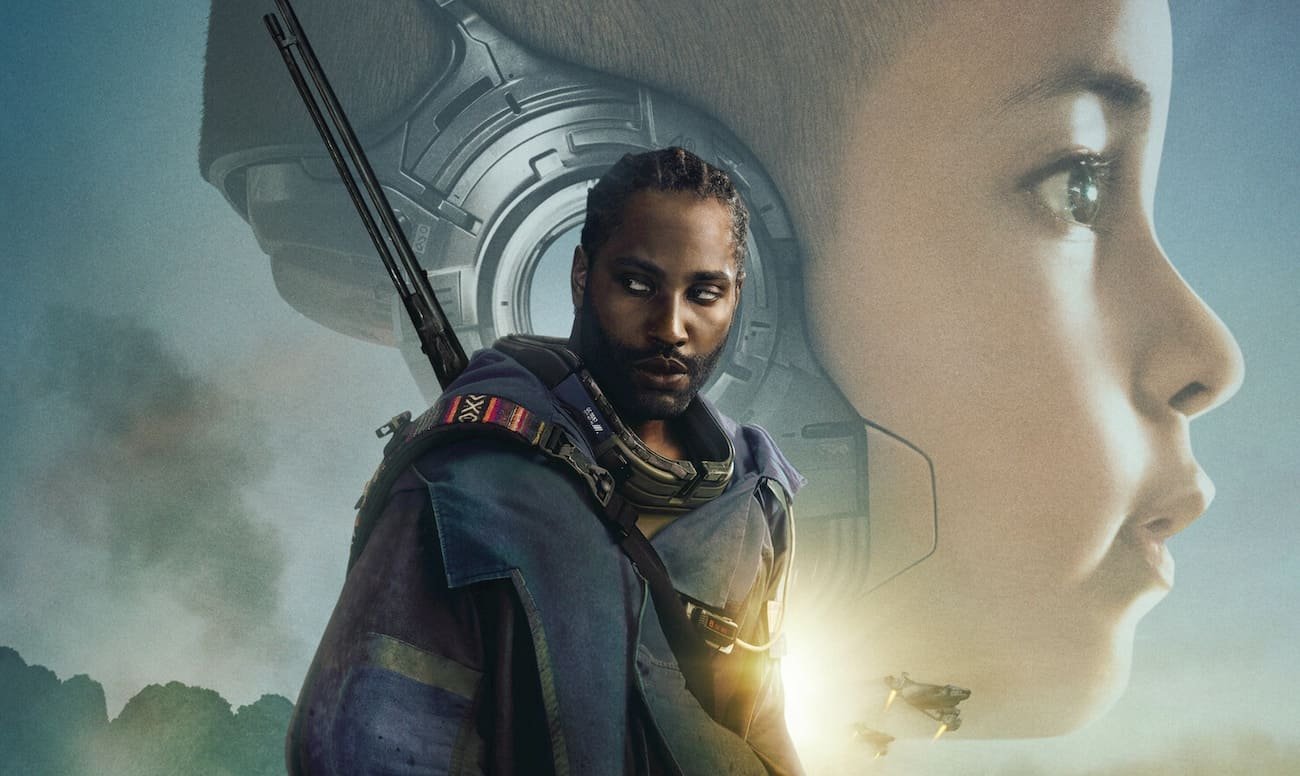

What are the odds that you watch a science fiction movie set in the future with robots and AI, say that the ending reminded you of a Shiva story, and learn the next morning that it is the day of the festival of the same Shiva Story!
On the eve of a radiant full-moon Kartika Purnima night in California, as we waited for floods and tides and storms, I watched the 2023 sci-fi movie The Creator (directed by Gareth Edwards, whose previous works include Rogue One and Godzilla).
It was my second shot at watching it, to be honest. The first time around, a few weeks ago, I paused the movie about ten minutes in and forgot to come back to it. Just too much dystopia and all. But on the persistent advice of a friend who couldn’t help raving about the wonderful child in the story who will save humanity and robots alike, and the savior-principle itself (or herself) being called “Nirmata,” I finally watched the movie completely, attentively, and as we might say, rasa-atmically. I liked it immensely. The scenery was beautiful to watch, the plot and the situation of the characters too painful and stupid to ignore, and overall, I felt touched, and moved.
AI and the War Movie Genre
The simple reason that this movie seemed not really about the usual dilemmas about whether robots are “alive” or A.I. is “evil” but about something far more important, concerning, and yet, ultimately hopeful. The “AI” in The Creator could just as well stand for a concept long-since abandoned in academia and even in progressive circles, and that would be simply “American Imperialism.” Whether it was the Indo-Chinese landscapes in the movie, or the sheer helplessness of the scale of the war-machines facing each other from opposite sides here, this was a movie that took me back to a whole genre of intensely-felt anti-war film-making, from Apocalypse Now and Full Metal Jacket to WarGames and even some episodes of Black Mirror.
It’s easy to view The Creator as a “Pro-AI” movie, or even an “Anti-Western” one, considering the basic premise that the West blames AI for blowing up one of its own cities, while “New Asia” on the other hand, decides to live side by side with the technology, grafting humans into machines and even yugas into each other in a manner of speaking. While the Bladerunner comparisons in terms of visuals and empathy-attempts are inevitable, what occurred to me while watching scenes of this robot-human Asian world is that it’s a representation of exactly how India (and Asia perhaps more broadly) looks like already.
Neocolonial Annihilation, Postcolonial “Adjustment”
Walk into any street, or village in India today, and observe the way technology, mannerisms, words, objects, compounds and chemicals, sounds, noises, dangers, pleasures, all hang together from thousands of years apart awkwardly. In my childhood, in the 1970s, an Indian village had almost nothing “modern” in it but for a few light bulbs and at most a tractor or motorcycle, a transistor radio on top of it perhaps. Today, giant advertising lights, plastic junk, freeways, stray animals, cell phone towers, cars, trucks, bulldozers, construction debris, everything is everywhere and in everyone else’s way. In real life, we survive it. In The Creator, we see it, this material manifestation of hybrid modernity, just like in India, but a little greener, and then a little grimmer too.
What would you do if on top of an already highly “adjusted” (“compromised”?) way of life that is postcolonial modernity you have to deal with a gigantic flying fortress looming over you and wrapping you with a laser-grid before bombing you to nothing?
Humans, animals, children, trees, AI thing-humans, companions, nothing stands in the way of progress, I mean, the plan, that is the American security-state in this movie. America has decided to rid itself of AI because of its own (human-caused) LA nuke fiasco. Fine. But then, it will not stop waging war until every last corner of earth where AI-humans exist, seemingly in peace, is exterminated for its own good. As you watch the monstrous appetite for totalitarian destruction spread in one spectacular scene after another, you are humbled by the recognition of references to reality again. This is not a movie. This is the Cold War. This is Vietnam. This is Cambodia. This is the way of life that the scholars and peace activists called the “Military-Industrial-Communications-Complex.” Or another movie once called “Naqoyqatsi.” A way of life that thrives by killing.
A “Flying Fortress.” I found myself considering the enormity of that phrase that had popped into my head while watching the “Nomad” lurking over hapless Indo-Chinese farmers and their kids again and again in the movie. That was the nickname for the Cold War bomber, wasn’t it? (“Stratofortress,” I am corrected by Wikipedia now, while the “Flying Fortress” was actually the World War 2 one… a detail that makes me feel like the kid in Eduardo Galeano’s story who is told his uncle is in the hospital after being hit by a Mercedes-Benz and his only words are: “Wow, a Mercedes Benz!”)
Insanity is Induced, Not Natural
The Creator’s story-telling magic lies in the fact that the enormity it asks us to see is almost obscured by the usual tropes and visual signatures of the genre which is what we expect to go along with the popcorn-munching, I suppose. The visuals are beautiful, and the story-telling, as fans of the director have said in numerous reviews and online commentaries, feels less than the sharpest version possible. And yet, despite the starting hesitations of the sort I felt on my first attempt, you see what is happening here, and you realize the great outrage that has been forgotten all along as social media and theatrical politics keep us distracted by obscenities and travails of a different kind. The danger they have been building is not AI or robots or any one thing, but the insane obsession with annihilating whatever they fear next.
And the obscenity of that fear, of that system or regime which is so loveless and blind and cold that it makes life-and-death, world-annihilating decisions based on irrational fear, is brought out in the movie in just one small line that recurs in the dialogues: it’s not a person, it’s just a thing. If the scale of the canvas is one part of the experience of totalitarian stupidity in the story, it is the detail, that phrase uttered by utterly brainwashed soldiers forcing themselves to trust orders over their instincts and feelings, brings the dangers of forgetting home. Like the darkly comical Joo-Dee in Avatar: The Last Airbender (ATLA) who repeatedly assures everyone that “There is No War in Ba Sing Se,” or the just dark predicament of the soldier who sees (through) the “roach” infestation in Black Mirror, the denial and dehumanization conveyed in that line hit hard for me.
The grief and fear of a father and the innocence of a child all explode in a key moment almost near the end when a soldier tells our hero that his child is not a person but a machine and he should just feel happy about her, I mean “it,” being captured at last. For a second, I was reminded not just of “sentient robot” genre movies, but a real-life story from Enlightenment history that is often cited by animal-rights and food-reform activists. Followers of Rene Descartes, so eager to convert others to their master’s philosophy that animals were just machines, used to beat dogs in the town square as a demonstration of science. When others, moved by the pitiful cries of the dogs, asked them to stop, they would smirk and insist that the animals weren’t crying, just making sounds like a door would when you slam it.
Life, Nature, Hope
The issue is not whether AI, or robots, are real or not. The issue is how, again and again, propaganda, brainwashing, mal-education, cult-control, are all used to distract us from things we see, feel, and know about life, nature, and each other, again and again.
On that note, there is of course the fact that there is hope in The Creator. The hope, of course, is her, the child they have feared and sought to defeat. Movie? Real-life and history? The borders blend and dissolve. Nir-Mata. Mother. Creator. Goddess-Mother, Goddess-Child. The colonizers and their propagandists like Katherine Mayo may call her Kali and “ugly,” but she is, and she is who she is…
The trope of the child-savior and the hero who protects her in their shared adventure is not uncommon in dystopian cinema. It is literally the mother of the first child to be born again in Children of Men. It is the evocation of nature and life in Kalki 2898. It is our hero searching for “Maya” in The Creator and finding something more (on a slightly different but relevant note, it is also the child-goddess who wins the heart of an elderly Texas biker facing family problems over religion in independent film-maker Trivikram Gajulapalli’s Chiquita).
Everyone seems to be in search of a goddess or golden child again.
Again, after what? That is the annihilation that we must think about. And the resistance. The resistance is not simply political. That is only the starting point. In The Creator, there is a disarming simplicity to its philosophy. The “New Asians” are happy to live and let live. The Armed Imperialists are out to exterminate every last thing they view as a threat. Tolerant vs. Intolerant. Mono-(a)-theists vs. Poly…theists?
There is no happy solution to this reality that is our world today, nor a completely happy one to the movie too. Spoilers aside, I will share that the Big Ugly Flying Fortress does get dismantled even as it (or a very Dr. Strangelove-ish coldly-paranoid General running it) unleashes a rain of missiles on barely armed Asian villagers and Himalayan temples. The golden-child has succeeded. There is a satisfaction to seeing that monstrosity in the sky implode which I have not felt in any other movie, not even Death Star in the old Star Wars, frankly.


Tripurari Shivashankara!
And that is when, to return to the Shiva-story I mentioned at the beginning, I uttered the word “Tripurantakam.” The three flying fortresses that the demons ruled the universe from, spreading terror and suffering, until one day, the mighty Shiva unfurled his arrow just when all three lined up. I remembered our visit to the mighty goddess in the village of Tripurantakam in Andhra Pradesh, two years ago. The deity is known as Bala Tripura Sundari. A goddess-child. A child-goddess. In some narrations, she becomes the arrow that Shiva launches against the impenetrable demon-fortresses. In some others, it is the cosmic serpent that’s the arrow.
Now, the landscape in rural Andhra looks just like any other place in that part of India. I recall a dried lake bed of sorts, flanked by villages, and dotted by political statues and graffiti. But it was here, the elders said, the Big Ugly Flying Fortresses were brought down. And of course, the goddess, our goddess, was still there, a mother, and a child, somehow.
And it was on this full-moon day, watching the armed flying-monster in the movie fall at last, that I learned that this day has been celebrated, for thousands of years and hundreds of generations perhaps, as Tripurari Purnima.
From Arms Race to Amma’s Grace
AI, AI, everywhere… AI is supposed to somehow make the world a better place and also make it all end catastrophically. Does “AI” stand for “Apocalyptic Insanity”? Or is it “Always Improving,” the exalted ideal of “Progress” that is invoked as the explanation for all of history, or technology and capitalism at least…
AI as “Artificial Intelligence” may or may not be the problem. AI as “Aggression and Invasion” is the real danger that we see in The Creator, and in real-life, thanks to The Creator.
But then, “AI” also lends itself to other interpretations, doesn’t it? Hindus (and ATLA fans) might agree that it might mean “Avatars-Inevitable.” Or, for those who can’t wait, for those who can’t look away or stop feeling the delight and joy that comes when you consider hope in the form of a child, maybe “AI” will stand for one thing only, and that is sufficient for existence: “Amma. Is.”
(A Postscript: Watch this interview with The Creator’s director Gareth Edwards at the Times of India here: https://www.youtube.com/watch?v=CpcIqVa3Ud0&themeRefresh=1; it is nice to see a film-maker express consideration for respecting local cultural traditions while shooting instead of treating sacred objects and symbols as mere “props”!)
Vamsee Juluri is Professor of Media Studies, University of San Francisco. He is the author of “Becoming a Global Audience: Longing and Belonging in Indian Music Television” (Peter Lang, 2003), “The Mythologist: A Novel” (Penguin India, 2010), and “Bollywood Nation: India through its Cinema (Penguin India,” 2013), “Rearming Hinduism: Nature, Hinduphobia and the Return of Indian Intelligence “ (BluOne Ink, 2024) and “The Guru Within” (in progress).