




The Return Ticket: Sonia Gandhi’s ‘Belonging’ Where Grief is Not Kept At the Distance of the Past Tense

- As a record of the Nehru-Gandhi household, and above all of Indira, the book is indispensable. As a political memoir it is deliberately incomplete, and for the same reason.
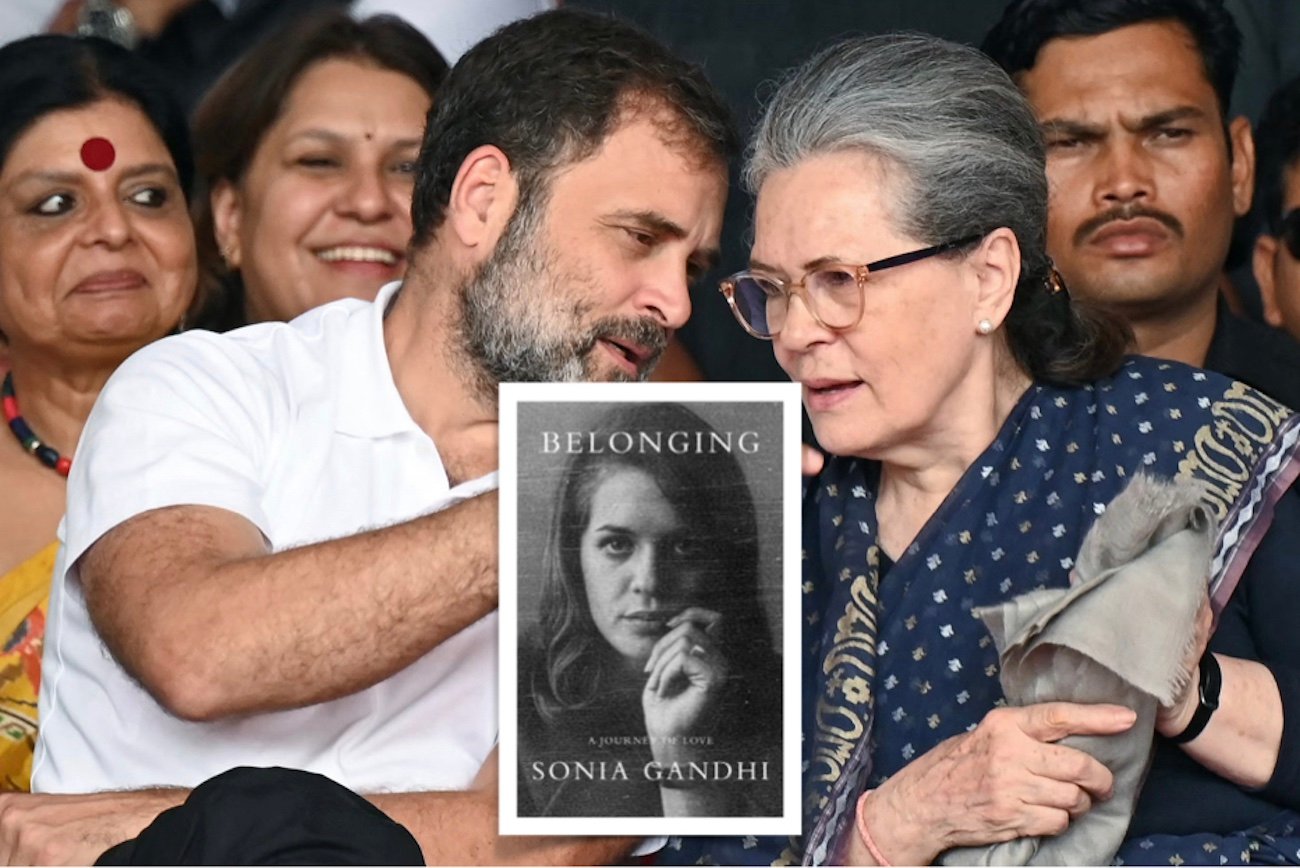

At 5:15 on the morning of January 13, 1968, a young woman from a small town in Piedmont landed in New Delhi with a return ticket in her luggage. Her father had bought it as a gift for her coming of age, against his own wishes about the marriage she was traveling to make. If she did not like the place, or if people were not kind to her, she was to fly straight back home.
He added a condition: she was to take no step with Rajiv without first consulting her parents. Within weeks the engagement was public before she had written home, and photographers were camped outside the family house in Orbassano. She records the breach plainly: “Father had given me a return ticket as a gift in trust. Why had I not kept my promise to him?”
She did use the ticket, months later, for a few weeks at home while Rajiv was away on a course, and then she came back. It is a small fact, but it sets the terms of the book better than any legend about her.
Belonging is an account of a woman who kept a way out open and kept choosing not to take it. Whether the country she chose was kind to her is the question her father packed in her bag, and the book is her answer to it.
The prologue is barely a page long and it states the rules. Some of the writing, she says, “required discretion,” because the stories of family and friends “were theirs to tell,” and “in the end I chose to write a personal memoir, one for which politics is the background, a kind of framework.” A reader looking for a record of ministries and elections will not find it here. What the book offers instead is the portrait of a code of conduct: learned in a Piedmontese household, recognized in the household of an Indian prime minister, carried into the leadership of the Congress Party.
A review that takes the book seriously has to ask two questions of that code. What did it make possible? And what did it prevent her, and the book, from seeing?
The weakest pages are the first. The book opens on Rajiv as “tall and handsome with deep black eyes,” and the Cambridge courtship stays in that register: the stolen glances across a restaurant, the pounding heart, the face on fire. It reads like a Mills & Boon romance, and nothing in these chapters complicates it. A writer this careful elsewhere seems to have decided that the love story, at least, would be told as she felt it rather than as she understands it now. The book’s real intelligence begins when the romance meets a family.
The code starts with her father. Stefano Maino was a sergeant major of the Bersaglieri who had fought in Greece and Russia and survived the winter retreat from the Russian front. He later moved his family from the Veneto to the Piedmontese village of Sangano, where the locals called people like them furesté, foreigners, and singher, gypsies. Readers of Natalia Ginzburg’s Family Lexicon will recognize the household: a Turin family organized around a father whose temper sets the weather.
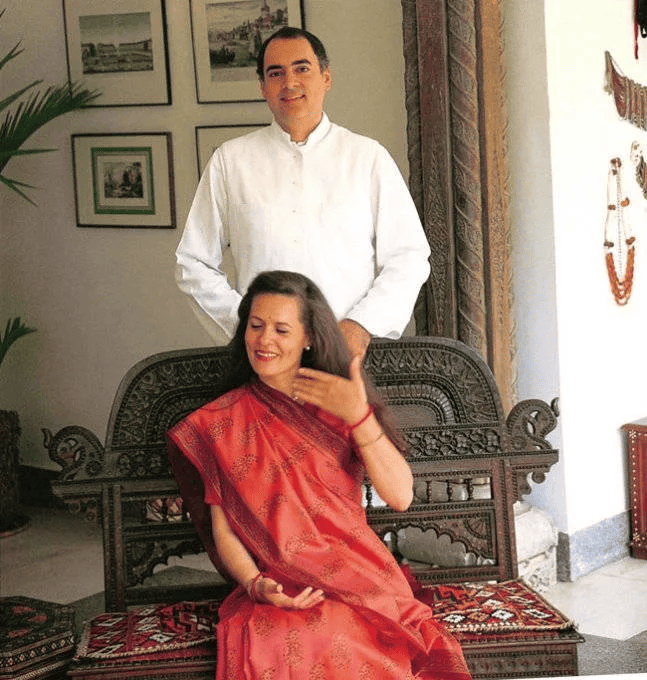
When Sonia, as a small child, took three walnuts from a neighbor’s basket and lied about it, he struck her hands until she wet herself, sent her to return the walnuts and apologize, and within hours lifted her up and held her to his heart. The book reports both acts and passes judgement on neither. That evenness is its first habit, and readers should notice it. It can read as fairness, or as the refusal of a daughter to judge her father.
The second habit concerns where affection goes. After childhood, she writes, her father never embraced his daughters; arrivals and departures were a handshake and a kiss on each cheek. Yet at the war memorial at Asiago he embraced the old veterans with tears in his eyes.
He named his first two daughters after two hungry Russian girls his battalion had fed near Dnepropetrovsk, and he fed the ragman Luigi at his own table in winter. His business ran sulla parola, on a given word. Her mother, whom the girls called Santa Paolina, acted as the go-between who interceded with him. Out of this the reader can assemble the code: loyalty shown in deeds rather than words, feeling held back in private and spent on duty, mediation conducted out of sight, and a long memory of what it means to be the outsider.
The book opens on Rajiv as “tall and handsome with deep black eyes,” and the Cambridge courtship stays in that register: the stolen glances across a restaurant, the pounding heart, the face on fire. It reads like a Mills & Boon romance, and nothing in these chapters complicates it.
Book’s Most Valuable Contribution
The portrait of Indira Gandhi is the book’s most valuable contribution, and it is valuable partly because of this code. Their first meeting, in London in 1965, has been told before in outline. Here it has its details: the frightened student in tears at the bedside, Indira speaking to her in French, and later the same day bending down with a travel sewing kit to mend the hem of her evening dress. The years under one roof add what no official biography could. Indira pushed her thali across the dining table after a bad day in Parliament. She never again dealt with a colleague who had betrayed her. Her staff and her physician asked the daughter-in-law each morning, “Mood theek hai?” To calm herself she sorted photographs by date and had the Anand Bhawan carpets sunned on the lawn.
The book is also funnier than its reputation will suggest, and the comedy is another form of its reserve. The Congressman Kalpnath Rai throws himself at Indira’s feet and cannot get up again, so she has to call for an attendant to haul him upright. Her bodyguard K.K. Sharma, a former wrestler, can only enter the corridor sideways, and on landing has to roll out of the helicopter while it tilts under him.
In Cambridge the young Sonia faces boiled cabbage and “the ultimate horror, tinned spaghetti on toast.” Her father, besieged by photographers after the engagement, shouts that the carnival outside his house must stop at once. She tells these stories deadpan and moves on. Humor lets her show the absurdities of power and the household without passing judgement on anyone, which is exactly what the rest of the book also declines to do.
The key sentence is one line long. Indira’s outbursts, Sonia writes, “would unsettle me, reminding me of my father’s explosions.” The household was strange to her, but its rules were not: order as a defense against anxiety, privacy as dignity, trust that is not given twice. That is why she could live in it when others could not, and why her account of Indira has an intimacy other accounts lack.
It is also why the account has a limit. She describes Indira as a daughter would describe a severe parent: candidly about temper, silently about judgement. We learn what Indira was like at the table; we learn little about what Sonia thought of what Indira did at the Cabinet table.
After Indira’s death she found an unfinished note among her papers, beginning “I am writing to you Sonia because I see some glimpses of myself in you.” Her comment is: “I wondered what the letter would have gone on to say.” She leaves it unfinished. It is the book’s method in a single gesture, admirable as tact and frustrating as testimony.
India comes to her through ordinary things: the spices she once held her breath to avoid in Cambridge, the Kashmiri haak and sweet rice of her first Nauroz, a wedding sari of khadi woven from thread Nehru had spun in prison. The contrast with Nehru’s An Autobiography is instructive. Nehru made himself the interpreter of a civilization and wrote India as an argument he intended to lead. Sonia writes as someone admitted to a family, learning its customs one at a time.
Sangam: Confluence at Allahabad
The clearest instance is the morning in September 1970 when Indira sent Rajiv, Sanjay and Sonia out on a battered motorboat to the confluence at Allahabad to scatter the preserved ashes of Motilal, Kamala and Jawaharlal Nehru. The river was in spate; Sanjay quizzed the boatman about his earnings; the marigolds, she notes, later gave her an allergy. She records her own unease and wonder at taking part, as an outsider, in “this sacred and intimate ritual,” and only later read Nehru’s will on the Ganga and understood what the morning meant.
The ritual came before the understanding. That order, belonging first and comprehension after, is the book’s real subject.
The deaths are written in a different register. In October 1984, when Rajiv reached the hospital where his mother lay dead and told Sonia he had been asked to become prime minister, she begged him with folded hands to refuse. “They will kill you,” she told him. He answered: “They will kill me anyway.” In May 1991, after Priyanka brings the news of the bomb at Sriperumbudur, the narration shifts into the present tense once Rajiv’s body comes home, and stays there through the cremation and the immersion of his ashes. This is the book’s most deliberate formal choice, and it works: grief is not kept at the distance of the past tense. The book also pairs the two journeys to the Sangam, the first in 1970 with Rajiv beside her, the second with her children and his ashes.
Then comes the travel bag he had packed himself, with the first photograph he took of her in Cambridge, and the clothes he had changed out of: “I bend over it, seeking to inhale the elusive scent of my beloved, gone forever.” Whatever one thinks of her politics, this is the strongest writing in the book, and it is strong because it refuses ornament.
Ambition and Greed, Hypocrisy and Treachery
Her entry into politics in 1998 is explained in the code’s own language. She describes revulsion at the “ambition and greed, hypocrisy and treachery” of politics, set against “the inner compulsions that had been drilled into me from my childhood—diligence in assigned tasks, respect towards elders, obedience to parents, fidelity to family norms.” The nearest companion in English is perhaps Katharine Graham’s Personal History, another memoir by a reticent woman who took command after a violent bereavement. The difference is instructive. Graham writes to understand what happened to her, including her own failures. Sonia writes to explain why she did her duty. The first kind of memoir invites judgement; the second asks for trust.
Here the book must face the strongest objection to its subject, and it does not. The code that carried her into politics was a code of fidelity to family. In a republic, that is not only a private virtue. She is candid about her qualification: “I had no right—except for the fact that I carried the family name.” She defends the name as standing for service and an inclusive idea of India, and she reports, correctly, that the party was breaking up and its leaders were pleading with her. But the critic’s charge is precisely that a national party which can only be held together by one family’s name has a problem, and that her leadership, whatever it saved in 1998, deepened it.
The book narrates the succession as family life. In 2004 Rahul contests Amethi, her old seat, while she moves next door to Rae Bareli. Two decades earlier she had begged Rajiv not to enter politics; “now it was my son’s turn, and this time I did not resist it.” By the epilogue Rahul holds Rae Bareli and Priyanka has taken Wayanad after he gave it up. None of this is presented as a question. Nor does the book place itself in the pattern it belongs to: across South Asia, power has repeatedly passed to the widows and daughters of murdered or fallen leaders, from Sirimavo Bandaranaike in Ceylon to Benazir Bhutto in Pakistan and Sheikh Hasina and Khaleda Zia in Bangladesh. Her story is personal, but it is also an instance of that regional habit, and the book never says so.
That is the code’s blind spot: a creed that measures virtue by loyalty to family cannot see family as the difficulty. A reader may still conclude that the name was the only glue available and that she used it with restraint. The book never makes that argument, because it never notices that an argument is needed.
The same loyalty governs the one family rupture the book describes, Maneka Gandhi’s departure from the prime minister’s house in 1982. Sonia admits she did not witness it: “Rajiv and I, though at home, were not present at the altercation,” which was “recounted to us by my mother-in-law.” She then adopts that account entirely and dismisses the other side’s as propaganda. The episode decided which branch of the family would inherit, and the book tells it as a daughter-in-law loyal to one parent, not as a witness.
The 2004 decision is where the code looks most persuasive, and the book treats it as its climax. With her coalition victorious, she walks into Central Hall, again narrated in the present tense, and tells her party that her “inner voice” says she must decline the prime ministership. Colleagues weep; she nearly faints. What followed is summed up in one plain sentence: “the government under Dr. Manmohan Singh, and the party under me.” It was her duty, she writes, to defer to him as prime minister. Through the National Advisory Council, which she chaired, the government passed the right to information, the rural employment guarantee and the right to food, the laws she counts as the work of her life.

Comparing her with Robert Caro’s Lyndon Johnson helps here. Caro’s method is to show power being made: the favors traded, the debts remembered, every relationship turned into leverage. Belonging never shows power being used at all. Its relationships are loyalties, never instruments. That is part of why the 2004 refusal can be called admirable: it is a rare case of a leader declining an office she had won. But it is also the book’s evasion. A woman who led the Congress for nearly two decades and held a ten-year coalition together must have bargained, rewarded and punished. Her opponents called her the government’s back-seat driver; she denies that she ever saw official files, and the denial may be true.
Her critics also make a sharper charge that the book does not engage: that the arrangement of 2004 separated authority from accountability. The prime minister answered to Parliament; the party president, chairing an advisory council that shaped legislation, answered to no one in particular. On this view the refusal of office kept the power and gave away the responsibility. The book records the arrangement as duty and does not consider the objection. Yet the reader is left with a puzzle the book will not solve: how she actually held power while appearing to stand outside it.
An episode from the second UPA government, recounted by someone who witnessed it, offers a glimpse of what the book leaves out. In the 1980s she had been barely a public figure, as her own account confirms. By then she was something else. A suggestion was put to her that a cabinet minister holding several portfolios should give one of them up, and two possible names were offered. She took a couple of minutes to decide. Within days one of the two was sworn in. The sequence does not show how the appointment was settled, or what passed between her and the prime minister in between, and it should be read as a glimpse rather than as proof.
Nothing in it was improper: in a coalition, who becomes a minister is always negotiated between the party and the prime minister. But it suggests a decisiveness the book never shows. Its self-portrait is of a reluctant, deferential leader. The woman in that episode made up her mind in minutes.
One resemblance is worth noting, though the essay cannot prove more than a likeness. Her way of leading, through consultation, deference to a prime minister of another temperament, and patient mediation within a coalition, looks more like the coalition politics of postwar Italy, where governments were assembled and held together by negotiation among parties, than like the plebiscitary style the Congress had known under Indira. Whether that reflects something she carried from Piedmont, or simply what coalition government demands of anyone who leads it, the book does not allow us to say.
The Human and Defensible Choices
Her own years at the helm show the code as statecraft and as concealment. In 2010, she writes, Pranab Mukherjee hinted that it might be “time for a change at the top,” which she took as a sign of his wish to be prime minister. “I gently changed the subject.” The sentence explains a great deal about how she managed a party of rivals. The same year she had surgery for suspected breast cancer in Milan, partly to keep it from the Indian press, and asks whether a public figure is to be allowed no privacy at all. These are human and defensible choices. But a reader who wants to understand the paralysis of the second UPA government and the defeat of 2014 will find little here, and the book’s discretion, so effective when applied to the dead, becomes harder to defend when applied to her own record.
On the earlier controversies the book is less silent than its critics will assume. On the Emergency she concedes that Sanjay “had a significant role in decision-making,” without a constitutional basis for some of it. She records that more than two thousand Sikhs were killed in the capital in November 1984. What she does not record is the one moment when that history fell within her own years: in 2005, after the Nanavati Commission reported, Manmohan Singh apologized in Parliament to the Sikh community, and a minister named in the report resigned. That was her party’s government, and the book passes it by.
She defends Rajiv on Bofors at length, citing his statement to Parliament and the Delhi High Court’s 2004 ruling quashing the charges, and she names the demolition of the Babri Masjid as the moment she understood the threat that later drew her into public life. What she will not do is sit in judgement on the people she loved. She lost her mother-in-law and her husband, both prime ministers, to assassins within seven years. It is reasonable for such a widow to give testimony rather than a prosecutor’s brief, and unreasonable to demand a commission of inquiry from a personal memoir. The reasonable demand is narrower: that she judge the years when she herself held power. On that, she says least.
The epilogue goes some way toward meeting it. She writes that she grew up “seeing things in black and white” and later saw how naive that was. She has no regrets about the life she chose; her doubts came with “political compromises. I ask myself now, did those compromises even serve their objectives? Not always. . . . They still don’t sit lightly on my conscience.” And she concedes that, despite her efforts, she did not defeat the forces she set out to fight.
These are real admissions, more than most political memoirs offer. They are also general. She tells us that compromises were made and that they trouble her; she does not tell us which. The code allows her to confess the burden but not to open the file.
As a record of the Nehru-Gandhi household, and above all of Indira, the book is indispensable. As a political memoir it is deliberately incomplete, and for the same reason.
Near the end, in a study where Rajiv’s pens and diaries are still arranged in his desk drawers, she answers her father’s question. She has been sustained, she writes, by her family and by “the people of my country, who so trustfully embraced me and made me their own.” It is the language of the code to the last: love received and returned, loyalty kept, the private and the public folded into one. The man who would not embrace his grown daughters had sent her off with a ticket home in case strangers were unkind.
Belonging is her account of why she never needed it, and, read with care, also an account of what that loyalty cost.
Satish Jha, former Editor, Indian Express Group and The Times of India Group writes on geopolitics, international affairs, and development.