




Blue is the Warmest Color: How the November Night Turned Out For Democrats and America

- Results like these restore a little faith in the democratic system. Nights like this come along maybe once a generation.
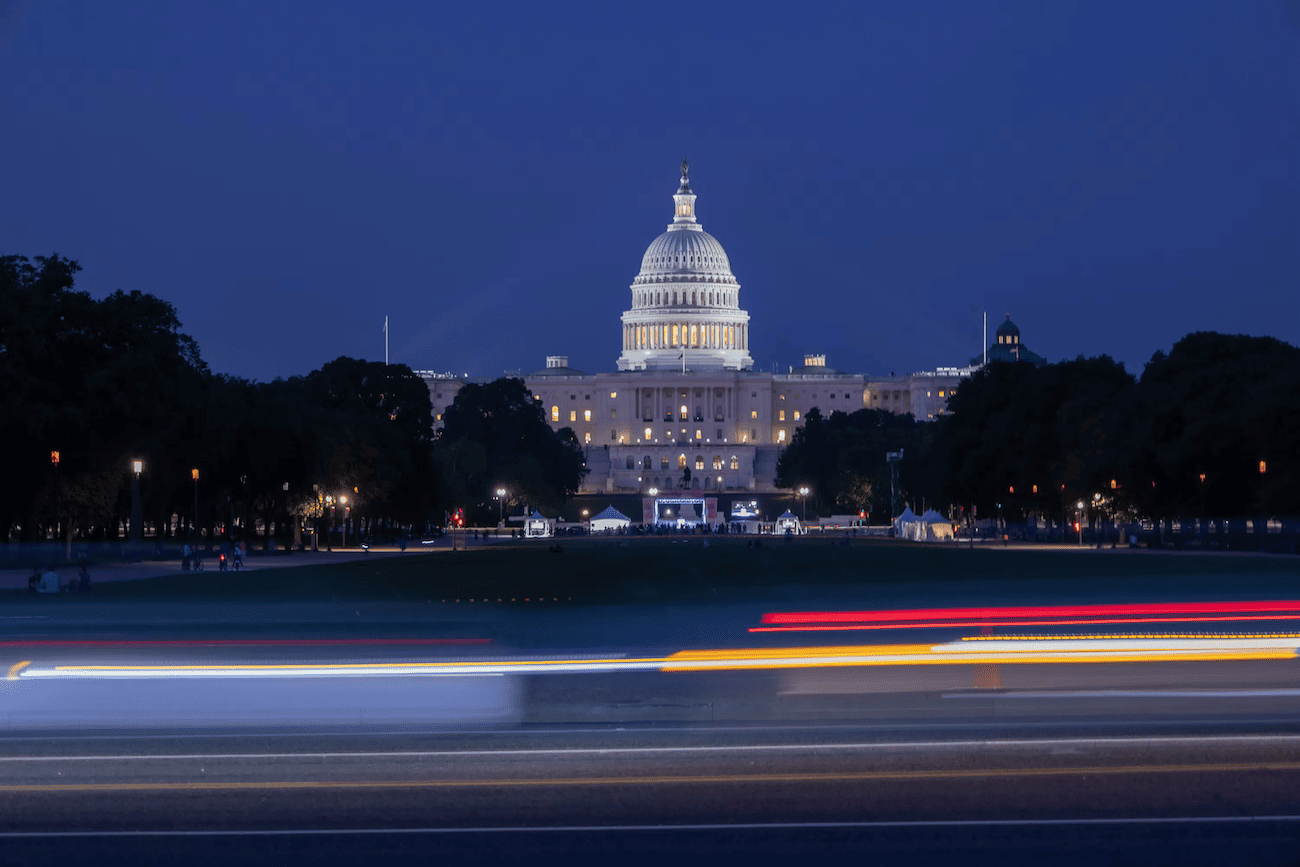
It may have been the warmest election day and night I have ever lived through. A high of 72 degrees on the first Tuesday of November in Michigan, and still in the low 60s at eight in the evening. El Niño, or whatever the cause was, it gave me an excuse for a long walk after supper. I don’t recall ever going out for a late-night stroll on an election night.
I am a nervous poll watcher. I know the rhythm by now: the count trickling in county by county, every network nudging its probability meter every few minutes. I have come to realize that the rhythm itself feeds my anxiety. Maybe that is the residue of November 8, 2016, a night I still haven’t fully recovered from.
So I made myself a rule: no live results, no coverage, nothing until 10 p.m. The rule lasted until my family messaging group started buzzing. We are a politically active bunch, and because our leanings are alike, that group is a safe zone. I stayed away from the other groups, the ones with friends who were also watching, where every early number would have led to discussions that I wouldn’t have been prepared for.
Of course, there was no way I was not going to open my family group messages. The rule lasted until about 8:35 p.m., when a message arrived with the first numbers from Oakland County. I felt nervous, but I told myself not to give in and open the map. So I came home and did chores to fill the time, chores I had planned to do tomorrow. Tomorrow’s chores got done tonight.
But this piece isn’t really about me, even if I’m not hiding my preferences. So, to the results.
The country went to the polls in a sour mood. Eight months into the war with Iran, which began with U.S. and Israeli strikes on February 28, gas was averaging about $4.15 a gallon in the final week of the campaign, more than a dollar higher than a year earlier, and diesel had topped $6. Trump called it a small price to pay. Voters disagreed: in the NBC News exit poll, 62% said he made the wrong decision in starting the war, and nearly eight in ten said inflation was causing their families hardship.
“I Wasn’t on the ballot”
The day began with the president calling into Fox News to announce a 99% approval rating in Israel, a number no poll supports, and to offer a contingency plan: “If people ever got tired of me in the U.S., I’ll move to Israel and become prime minister.” At home, a Reuters/Ipsos poll completed the day before had his approval at 32%. By nightfall, Americans had answered the first half of that sentence.
As the losses piled up, the president posted on Truth Social: “I wasn’t on the Ballot and if I was, we would have won IN A LANDSLIDE!” This from a man who had spent the campaign asking his supporters to pretend he was on the ballot. He used the same excuse after the 2018 midterms and again after the 2025 off-year losses. The line explains everything that happened tonight, though not in the way he means: he was on the ballot, in every race, and voters answered. By midnight, Democrats were projected to win the House, with NBC estimating around 252 seats, and the AP said they would gain at least the four Senate seats they needed for a majority.
Georgia
Georgia, the state that kept us up for days in 2020, settled its two biggest races almost as soon as its polls closed. The AP called Jon Ossoff’s re-election with only 38% of ballots counted. Georgia lets counties start processing mail ballots on Election Day morning, so Ossoff showed a large lead within moments of polls closing at 7 p.m. Keisha Lance Bottoms was called the winner of the governor’s race about an hour and a half after polls closed, with 75% counted.
Ossoff beat Rep. Mike Collins; he was the only Democratic senator seeking re-election in a state Trump won in 2024. Bottoms becomes the first Black woman elected governor anywhere in the country and the first Democrat to win Georgia’s governorship since 1998, and she did it even as billionaire Rick Jackson poured more than $200 million of his own money into the race.
Stacey Abrams deserves a large share of the credit, even though her name was nowhere on the ballot. She lost to Brian Kemp in 2018 by about 55,000 votes, lost again in 2022, and chose not to run a third time. Her organizations have had their troubles; the New Georgia Project, which she founded, shut down last year after a $300,000 fine for illegally backing her 2018 campaign. But the coalition she spent a decade building through voter registration, Fair Fight and relentless organizing is the foundation tonight’s wins stand on. It helped elect two Democratic senators in 2021 and turned Georgia into a state Democrats could win. Bottoms is the third Black woman in a row to lead Georgia’s Democratic ticket, and the first to finish the job.
Florida: the One That Got Away
Angie Nixon, a Jacksonville state representative and democratic socialist, lost to Sen. Ashley Moody roughly 50.7% to 48.2%, in a state Trump won by 13 points. Nixon beat the establishment favorite, Alexander Vindman, in the primary despite being heavily outraised, and the money gap never closed. Moody and her allies outspent Nixon’s side about two to one; American Bridge’s $2.5 million in ads was one of the few national lifelines she got. For perspective, Jon Ossoff’s campaign alone raised more than $110 million, while Nixon’s raised about $11 million. A race this close suggests what a little more help might have done.
Texas: Talarico
If there was one race outside Michigan I was emotionally invested in, it was James Talarico’s. Flipping Texas has been on my mind for a very long time, long enough that I wrote a whole book about the state, TEXIT: A STAR ALONE. A former middle school teacher and Presbyterian seminarian, Talarico beat Ken Paxton, the state’s attorney general, and became the first Democrat to win statewide office in Texas since 1994.
Trump had endorsed Paxton over Sen. John Cornyn in the primary, then spent the fall attacking Talarico at rallies across the country as a stand-in for all Democrats. It didn’t work. Talarico tied or led Paxton in most statewide polls from midsummer on, and his win ends a three-decade Republican monopoly on statewide office in Texas.
Florida’s 22nd: Pia Dandiya
Pia Dandiya, the daughter of Indian immigrants, won a House seat in a district Florida’s Republican legislature redrew this spring to favor the GOP. A former Harlem school principal and White House Fellow, she beat Republican Casey Askar roughly 51% to 48%. Her victory line is worth quoting: her parents came from India to Palm Beach County more than 40 years ago, “and tonight, one generation later, their daughter will become Congresswoman Dandiya.”
South Carolina: A Candidate Too Far
I was certain Darline Graham would win. South Carolina has not elected a Democratic senator this century, and Trump carried it by 18 points in 2024. But Graham had never run for anything. She was appointed to the seat after her brother, Sen. Lindsey Graham, died unexpectedly in July, then won a bruising August runoff with Trump’s recruitment and endorsement. Her main credential was her surname. Annie Andrews, a pediatrician, beat her 50.6% to 47.2% with 93% counted, becoming the first woman South Carolina has elected to the Senate and the first Democrat it has sent there since 1998. South Carolina showed Trump that even a deep-red state will reject a candidate who is that thin.
Mississippi: Too Close to Call
As I write this, the Mississippi Senate race is too close to call, with Democrat Scott Colom and Sen. Cindy Hyde-Smith each at about 48.9% and only a sliver of the vote left to count. Whoever ends up ahead, the closeness is the story. Mississippi has not sent a Democrat to the Senate since John Stennis in 1982, and Hyde-Smith won her last race by 10 points. A week ago Trump flew in to rally for her, warning voters against a “Marxist, radical-left, Soros district attorney.” Colom, a local district attorney, has made that race a coin flip in one of the reddest states in the country.
As the losses piled up, the president posted on Truth Social: “I wasn’t on the Ballot and if I was, we would have won IN A LANDSLIDE!” This from a man who had spent the campaign asking his supporters to pretend he was on the ballot.
The Familiar Names
Some familiar names had good nights. Cory Booker won a third term in New Jersey, and Amy Klobuchar traded the Senate for St. Paul, becoming Minnesota’s first woman governor. Two Native American women made history: Deb Haaland, a member of Laguna Pueblo, won New Mexico’s governorship, and Peggy Flanagan, a citizen of the White Earth Nation, became the first Native American woman elected to the Senate. And in Illinois, Juliana Stratton’s win means three Black women will serve in the Senate together for the first time.
Ohio: Seeing Through Vivek
My personal joy of the night was Vivek Ramaswamy’s defeat. Amy Acton, the former state health director, may not be the most charismatic politician in Ohio, and she ran a cautious campaign: no debates, no cameras at her rallies. But against him, caution was enough. Ramaswamy had Trump’s early endorsement and the president campaigning at his side, and Ohio, a state Trump carried three times, still chose Acton, about 50.7% to 46% when the AP called it. She is the first woman ever elected governor of Ohio.
The margin matters less than the method it rejected. Ramaswamy and his allies spent more than $100 million on ads attacking her, and in the final weeks he put $4 million behind an ad featuring her estranged mother. Ohioans saw through it. I won’t pretend to be neutral about this one. I have written twice about Ramaswamy: about the exploitative tactics he leaned on again and again, including that disgusting ad, and about why the Indian diaspora doesn’t owe him anything. Tonight, Ohio agreed.
Texas, Again: Abbott Falls
If Talarico’s win was a crack in Texas, Greg Abbott’s loss was the wall coming down. Gina Hinojosa, an Austin state representative and labor lawyer who entered the race with little name recognition and no big fundraising machine, unseated a three-term governor who was seeking a record fourth term and had beaten each of his three previous opponents by double digits. Abbott outspent her by tens of millions of dollars, and for most of the year he ignored her. He conceded around 10 p.m., trailing roughly 57% to 42%.
Hinojosa becomes the first Democrat elected governor of Texas since Ann Richards in 1990, the state’s first Latina governor, and only the third woman to hold the office. She and Talarico, both Austin Democrats, campaigned together to the end, including a joint rally the night before.
Further down the Texas ballot was a race most Americans have never heard of, and one Indian American families noticed. In September, Bo French, the Republican nominee for the Railroad Commission, which regulates the state’s oil and gas industry, posted a photo of University of Texas students, many of them of Indian descent, cheering at a football game. His caption suggested UT’s graduating class now looked like that, and he later called the students “foreigners.” Even Republicans recoiled: Sen. John Cornyn condemned the post as intolerance and racism, and House Speaker Dustin Burrows asked him to delete it. Texas voters answered too. French conceded to Democrat Jon Rosenthal, an oil-field engineer who becomes the first Democrat elected to the Railroad Commission since the 1990s.
Ohio, Again: Brown Comes Back
Two years after losing his seat, Sherrod Brown is going back to the Senate, beating appointed Sen. Jon Husted in a race that cost more than $500 million. On the same night Ohio rejected Ramaswamy, it handed Democrats a Senate pickup too.
Kansas: 94 Years
The last time Kansas elected a Democrat to the Senate, Franklin Roosevelt was winning his first term. That was 1932, and the winner, George McGill, had been born in 1879. Ninety-four years later, Adam Hamilton, a Methodist pastor and first-time candidate who founded the country’s largest United Methodist church, unseated Sen. Roger Marshall by nearly nine points. Trump and Vance made three stops in Kansas in the final two weeks to save Marshall. It didn’t work. Hamilton, a former Republican, drew real crossover support, and he joins Raphael Warnock as the second Democratic pastor in the Senate.
Maine: Collins Concedes
For years, Susan Collins was the Republican Democrats could never quite beat. She held the seat since 1997, survived every wave, and went into Tuesday as the only Republican senator from a state Trump lost in 2024. She lost to Troy Jackson, a fifth-generation logger and former president of the Maine Senate who became the Democratic nominee barely three months ago, after Graham Platner dropped out over sexual assault allegations he denies. Jackson ran on affordability, health care and workers’ rights, and argued that Collins had drifted too close to the Trump administration.
Georgia Statehouse: Jyot Singh
Further down the ballot, Jyot Singh won Georgia House District 97 in Gwinnett County with about 70% of the vote. He becomes the first Sikh ever elected to office in Georgia, and the first Indian American in the Georgia General Assembly.
TheExpected Wins
The rest went as expected. Kathy Hochul won a second full term in New York, Xavier Becerra became California’s first Latino governor since 1875, and Ro Khanna, Alexandria Ocasio-Cortez, and Ilhan Omar were re-elected easily.
Indiana: JD Ford
In Indiana’s 5th District, which no Democrat has held since 1990, state Sen. JD Ford unseated Republican Rep. Victoria Spartz. He becomes Indiana’s first openly gay member of Congress. It’s his second upset of this kind: in 2018 he beat a 13-year incumbent who had campaigned against same-sex marriage, and became the first openly gay member of the Indiana General Assembly. He says he decided to run because of Trump’s push to redraw Indiana’s map from 7–2 Republican to 9–0. That map never passed, and now one of the seats it was meant to lock down has flipped anyway, in a district the Cook Political Report rated Solid Republican earlier this year.
Iowa: A Double Flip
Iowa flipped. Rob Sand, the state auditor and the only Democrat holding statewide office in Iowa, beat Republican Zach Lahn for the open governorship, becoming the first Democrat elected governor since Chet Culver in 2006, in a state Trump won by 13 points. Lahn had knocked off the Trump-endorsed Randy Feenstra in the primary, and the two ran a strangely overlapping race, both campaigning on Iowa’s cancer rates and farm pollution. Sand also outspent Lahn, $28.9 million to $17.5 million.
Iowa flipped its open Senate seat too. Josh Turek, a state representative from Council Bluffs, beat Rep. Ashley Hinson for the seat Joni Ernst is leaving, becoming the first Democrat to win a Senate race in Iowa since 2008, and by the AP’s count his win sealed Democratic control of the chamber. Turek, who was born with spina bifida, won two Paralympic gold medals in wheelchair basketball. Hinson had launched her campaign promising to be Trump’s “top ally” in the Senate; Turek spent the fall tying her to the tariffs and the Iran war that were squeezing Iowa farmers.
Wisconsin: The Comeback Kid


David Crowley, the next governor of Wisconsin! The Milwaukee County executive beat Republican Rep. Tom Tiffany, a Trump ally, about 53.5% to 46.5%, in a state where five of the last seven presidential elections were decided by less than a point. He becomes the first Black governor in Wisconsin’s history. Four months ago his campaign was over: he had suspended it, then re-entered ten days later when the centrist frontrunner, Lt. Gov. Sara Rodriguez, dropped out. Tiffany conceded before 10 p.m.
Crowley grew up in 53206, one of the poorest ZIP codes in the country, and his family was evicted more than once. As a boy, his family nicknamed him “governor.” He won the most expensive governor’s race in Wisconsin history, against an opponent he said was working for Trump “and the billionaires who are funding his campaign.”
Pennsylvania: Shapiro, and 2028
Josh Shapiro cruised to a second term in Pennsylvania, beating Trump-endorsed Stacy Garrity by more than 20 points. His margin will only feed the 2028 talk, and he won’t be alone; Brown, Talarico and Ossoff all came out of tonight with national profiles too.
Michigan: Benson
Jocelyn Benson needs no introduction in Michigan. As secretary of state through both of Gretchen Whitmer’s terms, including the 2020 election and everything that came after it, she came across as a strong deputy to Whitmer with a leadership style that was clearly her own. She is also a serious marathoner, with more than two dozen finishes, Detroit’s among them, and a Boston Marathon she ran while eight months pregnant. That told me what I needed to know about her discipline and her commitment to delivering what she promises. She ran on lowering what families pay for health care, prescription drugs, auto insurance and housing, and her win breaks Michigan’s decades-long habit of switching parties in the governor’s office every eight years.
John James, by now, has run for almost every major office in Michigan: the Senate in 2018 and 2020, the House, and now governor. This is his third losing statewide bid, even with Trump’s endorsement. I’m not sure he has realized it yet, but he may be missing the X factor that turns a candidate into a winner.
Abdul El-Sayed
My last word goes to Abdul El-Sayed, who becomes the first Muslim American ever elected to the U.S. Senate. El-Sayed’s own story runs through Ann Arbor: he studied at the University of Michigan, where he met his wife, then went on to Oxford as a Rhodes Scholar, earned his medical degree at Columbia, and ran Detroit’s health department in his early thirties. For many Indian diaspora readers there is another thread. His wife, Dr. Sarah Jukaku, a psychiatrist, is the daughter of Indian immigrants whose family roots are in Bhatkal, Karnataka.
What won me over was how he handled interviews. He is charming and he communicates well, but he also had a knack for disarming hostile interviewers without taking the bait. He kept coming back to one message: money in your pocket, and money out of politics.
And he fought through a campaign of attacks on his faith that should shame everyone who took part. Trump called him a “jihadist.” At a debate, Rogers invoked Al-Qaeda, the Muslim Brotherhood, Hamas and Hezbollah to tie his campaign to terrorism, and a Rogers ad called him a threat to national security. Rogers and his allies outspent him by roughly three to two. In the last few days, the whole country saw the Haley Stevens drama. But Abdul El-Sayed remained unfazed and he kept talking about health care and the cost of living.
The Stickers
On October 19, the first day of early voting in Texas, Ronaldo Salgado cast his ballot and then walked to a plywood memorial on Canal Street in Houston, the spot where an ICE agent shot and killed his father, Lorenzo Salgado Araujo, a 52-year-old construction contractor, during a traffic stop in July. ICE says the agent fired in self-defense. Ronaldo stuck his “I Voted” sticker on the memorial. By late October, more than a thousand strangers had done the same, many adding a few words in marker: “I voted for you.” “Por usted.”
On Tuesday it happened in Minneapolis too, at the memorials for Renee Good and Alex Pretti, two U.S. citizens killed by federal agents in January during the administration’s Operation Metro Surge. Good was a 37-year-old mother of three. Pretti, also 37, was an ICU nurse at the Minneapolis VA. By evening, their memorials were covered in stickers.
No one organized this, and no campaign paid for it. People simply decided their vote belonged there. The administration bet that fear of immigrants would carry this election. Voters, it seems, were more afraid of what was being done in their name: in the NBC News exit poll, 57% said Trump’s immigration enforcement had gone too far. [Your own line, if you want one: what those stickers meant to you.]
The Billionaires Lost Too
One of my favorite outcomes tonight is that voters repudiated the billionaires who thought they could buy the result. Rick Jackson put more than $200 million of his own money into the Georgia governor’s race and lost to Keisha Lance Bottoms. Vivek Ramaswamy and his allies spent more than $100 million attacking Amy Acton, and Elon Musk gave money to both Ramaswamy and Greg Abbott. All three lost.
Most of this money flowed in one direction. By late August, 170 billionaire families had spent more than $1.7 billion on the midterms, and 69% of it backed Republicans, according to Americans for Tax Fairness. A CNBC analysis of federal filings found the same tilt: 14 of the 20 largest donor groups were backing Republicans almost exclusively. Democrats have their megadonors too, and the Soros family alone accounts for more than a fifth of the billionaire money on their side. That is exactly the point. It is obnoxious, whichever side it lands on. An election should not need a billionaire’s permission. Tonight’s results are a reminder of why this has to stop, not proof that it already has.
1994, In Reverse
As I write this, NBC News is projecting a House of roughly 255 Democrats to 180 Republicans, a 75-seat majority and the party’s largest in nearly two decades. In the Senate, Democrats have flipped seven seats and hold at least 53, with Alaska and Mississippi still counting. Numbers like these are the kind you only dream of. The last time a midterm reshaped Washington this completely was 1994, when Newt Gingrich’s Republicans gained 54 House seats and eight in the Senate. This was that night, in reverse.
There will be time in January to talk about what comes next: conservatives rediscovering the national debt, the oversight hearings, and how many bills Trump is willing to veto.
Tonight, I am just going to enjoy it. Results like these restore a little faith in the democratic system. Nights like this come along maybe once a generation.
One Last Thing
A word of caution or a PSA if you will. If you have kids in school tomorrow, keep an eye on them. According to the ads I’ve been watching for months, now that the Democrats have won, gender reassignment surgery will be fully operational in every school by January, probably squeezed in somewhere between recess and the fire drill. Pack them a lunch and a signed permission slip, just in case. I am kidding, of course.
The Cheesecake Factory, I’m happy to report, survived the night. A week ago, Obama said Trump had the White House looking like “Saddam Hussein opened a Cheesecake Factory.” The president let the Saddam part go but was deeply wounded on behalf of the cheesecake. Come January, House Democrats will have subpoena power. My guess is that the first oversight hearing will be about the gold trim.
Ganpy Nataraj is an entrepreneur, author of “TEXIT – A Star Alone” (thriller) and short stories. He is a moody writer writing “stuff” — Politics, Movies, Music, Sports, Satire, Food, etc.