




Pia Dandiya, the Harvard-Educated Daughter of Indian Immigrants, Headed to U.S. Congress

- She will be the first Indian American elected to the House from Florida and the 10th Indian American elected to Congress.
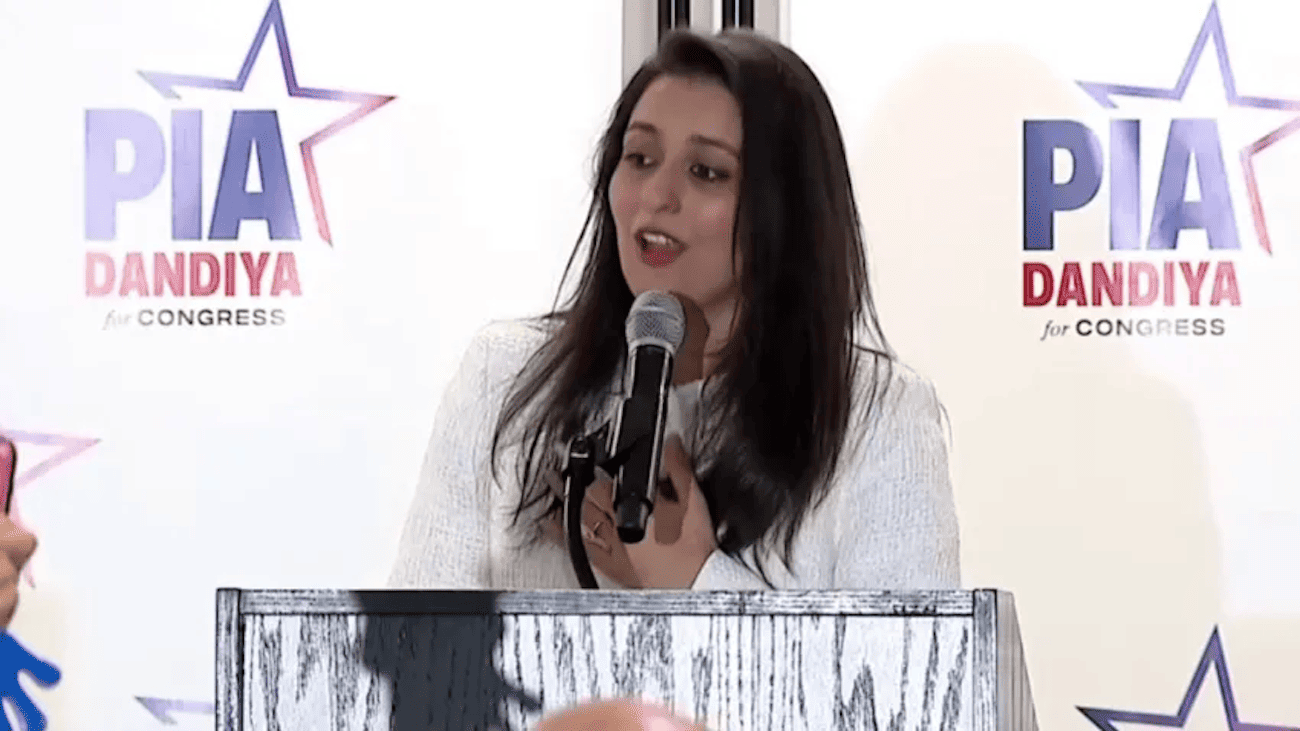

Pia Dandiya, a Democrat and former Harlem high school principal raised in Palm Beach County by parents from India, has won the race for Florida’s newly redrawn 22nd Congressional District.
She defeated Republican Casey Askar, a Naples businessman and Marine Corps veteran. She is set to become the first South Asian American to represent Florida in Congress.
Dandiya was born and raised in Palm Beach County to parents who emigrated from India. Her campaign biography says they came in pursuit of the American Dream. She is a first-generation American who grew up in Jupiter, within the district she now represents. She is raising her own family in nearby Palm Beach Gardens.
She made that history the center of her victory speech. In a statement Tuesday night, she said her parents arrived from India more than 40 years ago. ”Tonight, one generation later, their daughter is about to become Congresswoman Dandiya,” she told supporters.
Her ties to India also shaped her career. As a college student, she taught English to children in New Delhi, an experience she has said pushed her toward teaching, according to her Wikipedia biography.
Her win carries weight for Indian Americans in politics. She will be the first Indian American elected to the House from Florida and the 10th Indian American elected to Congress. It noted that she is the only newly elected Indian American in the next House, while two current members, Raja Krishnamoorthi and Shri Thanedar, will not return. Her campaign drew support from Indian American Impact and the AAPI Victory Fund.
Dandiya graduated from Harvard with a degree in government and taught in underserved schools through Teach For America. She later earned a master’s in education from Boston University. She was a founding math teacher at a Brooklyn charter school. In 2014 she founded Democracy Prep Endurance High School in Harlem, taking the job as principal at 28, according to her Wikipedia biography. Her campaign says every one of the school’s more than 300 students received a college acceptance under her leadership.
In 2020 she was named a White House Fellow, serving at the U.S. Department of Education. Her campaign says she served under both Democratic and Republican administrations. She then joined Apple. Her campaign describes the role as leading public-sector work on education and health care systems, while her Wikipedia biography describe it as lobbying.
A Campaign Reshaped by a New Map
Dandiya first entered the 2026 cycle in June 2025 to challenge Republican Rep. Brian Mast in the 21st District. In May 2026, Florida’s Republican-led Legislature approved a mid-decade map pushed by Gov. Ron DeSantis that reshaped the 22nd District into an open seat. She moved her campaign there. Rep. Lois Frankel, the Democrat who had held the old 22nd, ran in the new 23rd instead, according to WPTV.
The new district runs nearly coast to coast, from western Palm Beach and Broward counties through Hendry County farmland and the Everglades to Marco Island on the Gulf Coast. The district has about 473,000 registered voters: roughly 182,000 Republicans, 143,700 Democrats and 148,000 unaffiliated or minor-party voters. Donald Trump carried the district by more than 10 points in 2024, The Hill reported.
Dandiya won the Aug. 18 Democratic primary with 68.6% of the vote over attorney Kaysia Earley. Her Republican opponent, Askar, was born in Iraq, served in the Marines and built a business career in restaurant franchising and investments. He emerged from a crowded, well-funded primary and campaigned in support of Trump’s agenda, including immigration enforcement and conservative economic policy, according to CBS News.
Both candidates made affordability their main theme. Dandiya backed letting Medicare negotiate drug prices, restoring Affordable Care Act subsidies and raising the income cap on Social Security payroll taxes. Askar’s ads described that last proposal as higher taxes on Social Security; WPTV noted her plan concerns the payroll-tax cap, not taxes on benefits. Both supported banning members of Congress from trading individual stocks.


How She Won
Full returns and exit data are still coming in, so any explanation is early. Pre-election reporting and night-of coverage point to several factors.
A new district with no incumbent. Neither candidate was well known across the reshaped seat, the Naples Press reported. No sitting member wanted to run there, according to Florida Politics. The Cook Political Report moved the race from leaning Republican to toss-up during the fall. A late-August poll showed Dandiya up 2 points.
More donors and more visibility. Askar’s campaign was largely self-funded: $6.69 million of his $7.42 million came from a candidate loan through mid-October. Dandiya raised $4.62 million, almost all from contributions, Florida Politics reported. The Washington Sun reported that she out-raised him through traditional fundraising in the third quarter and held many more public events.
National party and outside support. The DCCC put her in its Red to Blue program, and the NRCC placed Askar on its MAGA Majority roster. The DCCC also ran a six-figure bilingual ad campaign aimed at Hispanic voters, about 31% of the district’s voting-age population, according to Florida Politics. Everytown for Gun Safety’s Victory Fund spent $1.12 million for her. Republican-aligned groups spent heavily too: the Conservative Leadership Fund put $2.37 million into ads attacking her. Total spending reached about $34 million, CBS News reported.
A cost-of-living message. WPTV reported that she campaigned on lowering costs, strengthening public schools and fighting corruption, including a stock-trading ban. On election night, she framed the result as voters rejecting the redistricting and pledged to work across party lines. “I’m going to fight for people,” she said in her victory statement.