




Fly Hanuman: Bhakthi and the Miraculous Story of Flydubai Captain Smit Machchhar

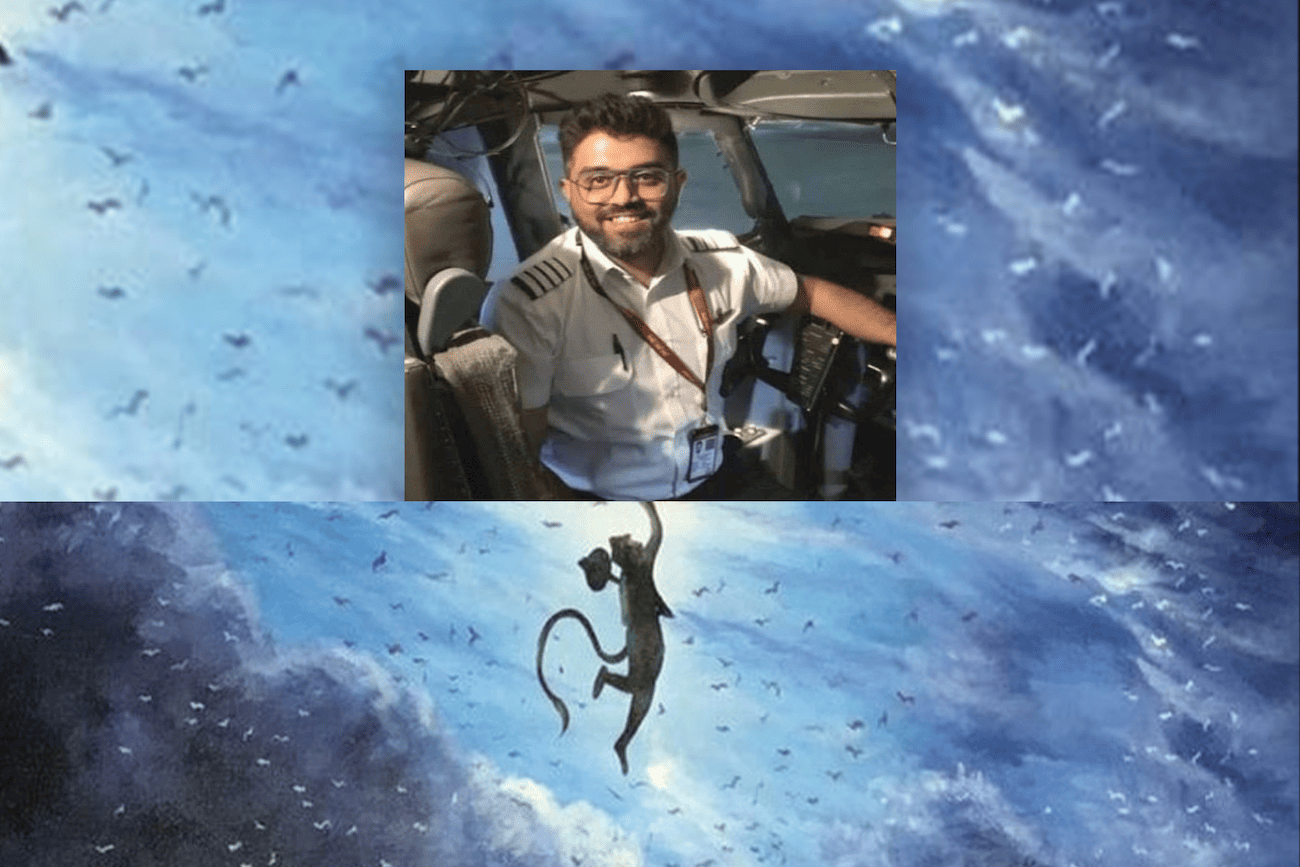
- There is something so hopeful in hearing that Hanuman stayed in Captain Machchhar’s life and hands because of how he used to chant the Hanuman Chalisa to his little son on his lap.

A few years ago, one of my childhood friends from school whom I had not met in a long time messaged me. He had just read my novel Saraswati’s Intelligence and wanted to talk. He said he was an ardent devotee of Hanuman. I said, so was I. He asked me if my book was based on some unknown or obscure scriptures which revealed Hanuman’s “back story” so to speak before the events of the Ramayana. I said, not really, my book was just a novel, a bit of “fan fiction,” inspired by Hanuman but not necessarily about “the” Hanuman.
He heard me out politely, but perhaps a bit impatiently. Then, he told me his story.
My friend said that many years ago, long after we had passed out from school and lost touch, he was traveling on an overnight intercity bus. He was sleeping with his head resting on the window. Suddenly, in his sleep, or in his dream, or maybe something else, who is to say… Hanuman appeared like an explosion of energy and pulled him forcefully away from the window.
It is because of that sudden, forceful, act, my friend said, that he lived. Another bus had crashed into theirs, and the impact was right at the seat where my friend was sitting. My friend had suffered severe injuries, more than I could even imagine. Yet, he was alive. And he was absolutely sure that it was Hanuman who had appeared out of nowhere to pull him back from the window and save the rest of his body and his life.
“Jai Hanuman!” are the only words we could say. And whatever words I have since sought to write about my Hanuman, a heroic character in a fictional prehistoric adventure series, have remained inadequate. Sometimes, bhakthi just overwhelms creativity, demonstrating that imagination, endeavor, effort, action, everything is simply beyond what we might call our agency. But that is not necessarily a bad thing. Bhakthi is what is lurking unseen sometimes when we are forced to see a reality that is bigger than us and our plans for it. It is perhaps only in bhakthi that we glimpse something bigger than even the most inexorable of realities.
Hanuman Chalisa and the Heroic Captain Machchhar
Captain Smit Machchhar is now a household name in India and perhaps around the world. Over the span of just a few hours as the news spread, we watched a story that began as a couple of brisk headlines about intra-cockpit acrimony among two pilots turn into a staggering saga of sheer grit, intelligence, heroism, teamwork, and human decency. Ordinary passengers and crew may have saved the day, but from Captain Machchhar’s conversations with Prime Minister Modi and Prime Minister Netanyahu, it seems to many of us who swear by the power of bhakti alone that something extraordinary did happen.
To start with, one would imagine that a blow on your head with a metal axe should have been lethal. Yet, he took that first blow (delivered from behind by the co-pilot after he had allegedly excused himself for his prayers) and several more, and somehow stayed conscious and able enough to open the cockpit door so help could arrive. Captain Machchhar could have chosen to tell his story with just the surface points, but then, like my friend on the bus that fateful night, like so many of us who cannot help ourselves nor censor ourselves when faced with evidence of something like a miracle, he had to say the name that saved him. Hanuman.
For bhakthas, the “sravanam” or hearing of the name is enough. It makes us remember not only the stories we have heard of extraordinary incidents or coincidences, but also makes us open to the possibility that every day we live has passed perhaps because of extraordinary acts of nature or “good karma” or “mahima.” It is no surprise that Captain Machchhar’s story about teaching his son Hanuman Chalisa has led to a flurry of Hanuman Chalisa renditions and anecdotes, from grateful singers in Israel to, incredibly enough, a Chinese-American “Burner” mom in L.A. who heard about the song at Burning Man and now plays it for her baby (on a related note, generations of devotees who have grown up listening to M.S. Rama Rao’s beautiful Telugu version of the Hanuman Chalisa may be surprised to learn that there was an aircraft crisis behind that legendary performance too — the singer composed the song as an appeal to Hanuman after his Air Force pilot son was declared Missing in Action during the 1971 India-Pakistan war).
Beyond Hype, History– and Causality
On the one hand it is tempting to say that all the “Hanuman is back” hype is just that, pure hype, a little ephemeral fad induced by viral posts. In a few days, we will all be back to our mundane scrolling and this recent turn of events in a positive direction will be forgotten (until or unless someone’s movie or TV series about the plane comes along). The skeptical (or cynical) among us will perhaps remember that the whole thing seemed so over-hyped anyway, and that was that.
And yet, the fact remains.
In the larger flow of time, if not scheme of things, and things beyond even the most intermeshed webs of causes and effects and well into the far flung realms of mysteries and wonders, how is it that one name, one form, one being, and for lack of a better word, one god, seems to show up so steadily in our lives, generation after generation, and now, in this globalized world, nation after nation?
For those who approach Hanuman as cultural history, there is the number 732 that comes to mind. What is it that the Dvaita scholar and Vijayanagara-spiritual adviser Vyasa Tirtha (1447-1539) saw when he oversaw the installation of exactly 732 images of Hanuman in a protective, heroic pose across the Deccan and South India? Vijayanagara fell despite it, some might say. Sure. But did it, really? Names and forms may come and go, especially when it comes to the political. British India. India. South Asia. Bharath. But the names of gods, the forms of gods, the bhakthi that makes us know gods are gods, all these do not disappear easily. Not for lack of trying, of course, but those details are perhaps for another story, another context.
For those who approach Hanuman as devotees in this modern world, there is a more recent “pop culture” example right on hand. A few days before the miracle of Captain Machchhar and the FlyDubai plane, there was a movie. It was called Hanuman Ansh.
Hanuman Ansh
For those who approach Hanuman as devotees in this modern world, there is a more recent “pop culture” example right on hand. A few days before the miracle of Captain Machchhar and the FlyDubai plane, there was a movie. It was called Hanuman Ansh. It was almost written off after a seemingly tepid commercial opening. And then, somehow, call it virality, contagion, luck, or good karma, the movie turned into a box office hit. In that great mono-language of our time, which is of course, money, Hanuman Ansh was a roaring success. In the language of the heart, of emotions and sentiments, of bhaavas and rasas, the movie was sweetly triumphant. It made us feel like something we knew deeply was affirmed, represented, so to speak.
But feelings and art, cinema and business, are still only some among many ways to think of this story. In the great flow of causes and effects into which we read patterns or possibilities or coincidences or miracles, there is the fact that a god around whom enormous bhakthi has been suddenly and intensely ignited by a pleasant movie (and its songs) is somehow on our minds again in the wake of an incredible story. The “what-ifs” swirling around the FlyDubai hijacking attempt are ominous and humbling.
What Might Have Been
It is telling that it wasn’t simply social media observers but also India’s Prime Minister in his video call with Captain Machchhar who actually expressed the thought that was on many minds. Given all the xenophobia and racism and religious bigotry growing against Indians and Hinduism in particular, could the story that got spun afterwards been one of blame and even more hatred towards Indians everywhere; “Indian drivers” to “Indian pilots,” or “H1B,” or “saffron terror,” even?
Worse, what could have been the actual human cost if the pilot and passengers had failed–not only for everyone on the plane, and on the ground, but then afterwards? How many more wars? The domino-effect of what might have happened is indeed staggering to consider.
In the Dvaita tradition, Hanuman is called “Mukhyaprana Devaru.” It seems like we are being taught by the incredible nature of these recent incidents to stop viewing lives, or life itself, lightly. One hopes that such a message sinks in, and pervades our own deeds and words thoroughly in the days and months to come. I think that when we take delight or hope in stories of wonders and miracles, whether of the sort depicted around Neem Karoli Baba’s life in Hanuman Ansh, or in the possibility that nothing short of a miracle took place in terms of saving Captain Machchhar from his assailant’s blows, and then indeed, everything else that followed, we are really trying to renew our faith in life itself.
Life Flows On, Within You and Without You


The challenge of course is that for the most part we are overwhelmed by the challenges of going through life rather than existing in the supremely kind, nurturing, and joyous intensity of actually feeling it. At rare times, we still do, for instance, in the presence of new lives, of children. There is something so hopeful in hearing that Hanuman stayed in Captain Machchhar’s life and hands because of how he used to chant the Hanuman Chalisa to his little son on his lap. There is something so light and happy about the L.A. Burner Mom saying her baby calms down if Hanuman Chalisa is played. There is gratitude most of all in seeing photos of the passengers of the nearly-doomed plane reunited happily with their families and children once again.
Generations are coming into this world, even as generations are leaving it. Generations in the past had their own stories, theories, certainties, faiths if you will, in knowing how it all fits. We, or our generations today, live in an age of induced uncertainty, anxiety, forgetfulness. We believe in YOLO (and No More). Which is fine, and needn’t be a cause for everyone to be forced to think alike. Yet, we need to also know that our beliefs are also temporary, contextual, historical, political. There are things beyond these limits which our ancestors knew and perhaps our descendants will choose to know once again. For our part, when we are fortunate to have witnessed what some call grace, and others mahima, it is apt and liberating in a way to acknowledge it.
Don’t Mess with Texas… or Hanuman!
Just one week before the Hanuman and the hijacking story, I happened to recount a story about another plane, and another god (actually two), that took place right here in San Francisco. This story came up in the context of a lecture I was asked to give on Hinduism and global pop culture. We were in a music venue on the Haight, a neighborhood filled with examples of both. I showed the audience pictures of George Harrison with the hippies, and of Swami Prabhupada in San Francisco in the 1960s. But the story we ended with was a plane one.
After his much-photographed visit to Haight-Ashbury, Harrison got on a private plane to leave. Soon after take-off, the plane began to fall. Harrison saw the lights flashing in the cockpit and thought it was the end. But he remembered the chant he had learned recently. He began to chant “Hare Krishna” and “Om Christ Om.” We know how that plane story ended. In another pop culture-bhakthi coincidence, Peter Sellers also once told George Harrison that he had chanted the Hare Krishna mantra while on a plane that was in trouble.
Krishna. Christ. Hanuman.
Or, in the wake of that iconic image from a UAE hospital room this week, a Muslim Prince kissing a Hindu Pilot on the head for saving the lives of a plane full of Jewish passengers.
Consider these images of gods and devotees with that of the angry, radicalized man steeped in an ideology that abhorred the joy in images like this who actually used “prayer” as an excuse to betray his own co-pilot and nearly cause irreparable harm to hundreds, maybe thousands of human beings.
I think now about all the angry, confused, racialized politicians and their followers who have been screaming about the giant “monkey demon statues” in Texas. It seems so ironic that the one deity they called a demon was the one a heroic pilot remembered in a moment of crisis, allowing him to somehow save the day.
It has been a crazy time. It is tempting to put that phrase in the past tense, and avoid admitting that it is still a crazy time. That is the reality check, yes, even as I celebrate this rare sign of visible goodness and “unity” and grace all around. But as bhakti, and the nature of hopes that are of the bhaktas’ tend to go, the determination grows stronger. May Hanuman remain ever-victorious!
Vamsee Juluri is Professor of Media Studies, University of San Francisco. He is the author of “Becoming a Global Audience: Longing and Belonging in Indian Music Television” (Peter Lang, 2003), “The Mythologist: A Novel” (Penguin India, 2010), and “Bollywood Nation: India through its Cinema (Penguin India,” 2013), “Rearming Hinduism: Nature, Hinduphobia and the Return of Indian Intelligence “ (BluOne Ink, 2024) and “The Guru Within” (in progress).