




When Iranians Held Candlelight Vigils For 9/11 Victims: How Washington Rebuffed Tehran Even After It Helped Overthrow Taliban

- Twenty-five years later and amid a new war, my reflections on December 2001 trip to Iran, which, occurred at what might have been the most propitious time for a rudimentary détente between the two countries.
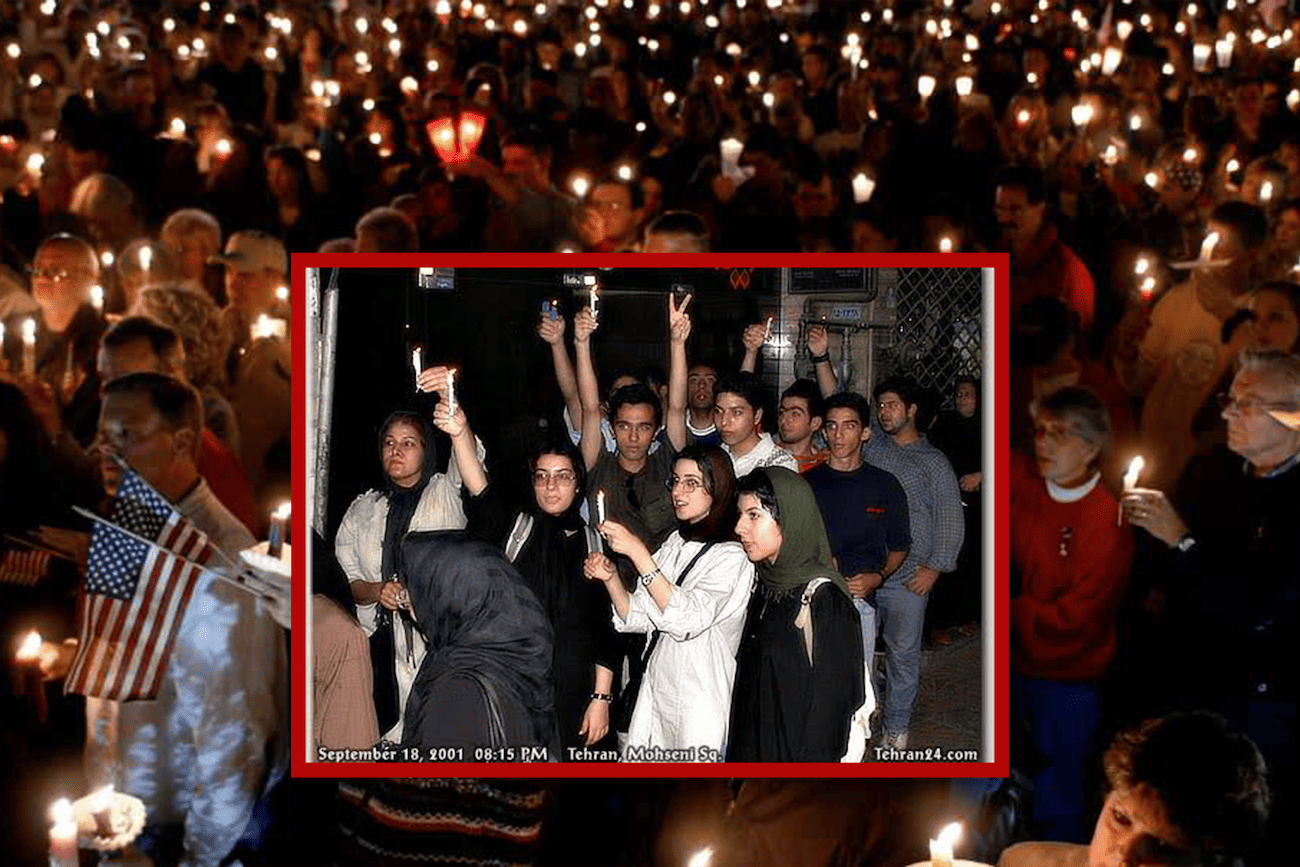

Twenty-five years after Al-Qaeda killed more than 3,000 Americans in stunning attacks that provoked the so-called War on Terrorism, the U.S. is embroiled in a bloody conflict with Iran that is rife with historical what ifs.
In the immediate aftermath of 9/11, Iran helped the Bush administration overthrow the Taliban regime that had harbored Al-Qaeda and replace it with a new government. Iran, a Shi’ite Muslim majority nation, had nearly gone to war with the Sunni fundamentalist Taliban in 1998 after it killed Iranian diplomats in the predominantly Shi’ite city of Mazar-e Sharif.
But neoconservatives in the Bush administration pushed for Iran’s inclusion in a so-called “Axis of Evil,” alongside Iraq and North Korea, in George W. Bush’s 2002 State of the Union address. The strong implication was that Iran would eventually have to pay for its many blows against Americans since the 1979 revolution, its support for groups the U.S. branded as terrorists, and for its newly revealed nuclear progress.
Yet before and after 9/11, there were opportunities to change the trajectory of U.S.-Iran enmity. There was even a 2015 agreement — the Joint Comprehensive Plan of Action (JCPOA) — that was negotiated by the U.S., Britain, France, Russia, China, and Germany, and blessed by the UN Security Council but abrogated unilaterally in the first Trump administration.
In this analyst’s view, however, the most propitious time to have achieved a rudimentary détente with Iran was in the first few years after 9/11 when even diehard opponents of the U.S. saw American military action against the Taliban as justified, and Iran’s Quds Force provided intelligence that helped U.S. forces take Kabul. At the time, the U.S. was still the world’s sole superpower; Russia was still recovering from the collapse of the Soviet Union and China had not yet become the economic juggernaut it is today. Iran had a reformist president, Mohammad Khatami, who sought better ties with what then looked like an ascendant West.
I visited Iran as a journalist in December 2001, a month after the Taliban fell to U.S. troops and the Iran-backed Northern Alliance. Among the nine trips I have taken to Iran over the past 30 years, that trip stands out. Iranians from all walks of life including members of parliament expressed sympathy for the victims of 9/11 and talked about improving ties. Coca-Cola had just resumed bottling the “real thing” in Mashhad for the first time since the revolution, and Iranians were ostentatiously slugging it down with their kebabs.
Iran had been alone among Muslim-majority states in popular backing for the U.S. after 9/11. As I wrote in December 2001:
“For three days after Sept. 11, scores of young Iranians held spontaneous candlelight vigils on Mirdamad Boulevard in northern Tehran to show solidarity with the U.S. victims of the terrorist attacks… Many here also watched with envy as the Bush administration lifted economic sanctions on Pakistan … and hoisted the American flag over the old U.S. embassy in Kabul last month.”
The U.S. and Iran also conducted quiet direct talks in Geneva and Paris for 18 months after 9-11 on issues related to Afghanistan, fleeing Al-Qaeda members, and what Iranians correctly saw as the impending U.S. invasion of Iraq.
The U.S. and Iran also conducted quiet direct talks in Geneva and Paris for 18 months after 9-11 on issues related to Afghanistan, fleeing Al-Qaeda members, and what Iranians correctly saw as the impending U.S. invasion of Iraq. In May 2003, as President Bush was prematurely declaring “Mission Accomplished” in the Iraq war, Iran transmitted to the State Department a proposal via the then Swiss ambassador to Tehran for comprehensive negotiations to resolve outstanding issues over the nuclear program, terrorism, and the Israeli-Palestinian conflict. As I wrote in my 2007 book, “Bitter Friends, Bosom Enemies,” the proposal was dismissed by the Bush administration as a trial balloon and got no response.
The U.S. rebuff further discredited the reformist camp in Iran that had pushed for talks. It encouraged the then Supreme Leader of the country, Ayatollah Ali Khamenei, to support hardliners in 2005 presidential elections. Yet, even within that camp, there were those who sought outreach to Washington two decades ago.
Mohsen Rezaie, a veteran commander of the Islamic Revolutionary Guards Corps (IRGC), is now Iran’s national security advisor and considered one of the most influential figures in the regime since Israel assassinated Iran’s top leadership at the beginning of the war.
In 2005, when Rezaie launched one of several bids to be elected president, his then media adviser sought me out for an email interview. Rezaie, who led the IRGC for 17 years and molded it into a force that fought Iraq to a stalemate during their 1980-88 war, spoke of Iran’s economic problems and called for more cooperation with the West. He said Iran was open to talks with the U.S. on restoring diplomatic relations. If the Bush administration were to make a “rational offer to Iran, I believe a real transformation will take place in relations between Iran and America,” he wrote.
In a subsequent in-person interview in Tehran in 2006 that I later learned was also attended by the then relatively unknown head of the Quds Force, Qasem Soleimani, Rezaie said this was “a golden time for the Americans” to resolve their differences with Iran. But if the U.S. “decides on harsh measures, everything will be changed overnight and there would be serious problems” for the U.S., he warned.

I am not naïve and recognized even then that the chances for a system built on rejection of the U.S. —and supporting multiple anti-U.S. and anti-Israel actors — doing a 180-degree turn were not overwhelming. But the Bush administration wisely decided in its second term — as the Iraq war turned into a quagmire in part because Iran was backing attacks on U.S. troops — not to declare war on the much larger and more entrenched regime in Iran.
Barack Obama made the calculation that diplomacy and a nuclear deal could buy time for Iran to change on its own as the Islamic Republic was forced to reckon with an increasingly young, well-educated, and Western-oriented population.
Donald Trump decided differently. In his first term, he quit the JCPOA, reimposed “maximum pressure” sanctions, and assassinated Soleimani with a drone as he arrived at Baghdad airport.
In his second term, Trump has twice gone to war with Iran — both times in the midst of negotiations. The first war was brief and successful in severely damaging Iran’s nuclear installations. The second has so far been a failure — for Iranians, the region, and hard-pressed consumers in the U.S. and around the world.
The U.S. had a choice after 9/11 — whether to pursue Al-Qaeda or go after all terrorism of global reach. Its decision to embrace the later path led to catastrophe in Iraq. Trump’s decision to take on the Islamic Republic has so far brought more misery and emboldened the hardest hardliners in Iran. As of this writing, neither he nor Iranian leaders seem capable of finding a face-saving exit from a conflict that might have been avoided if diplomacy had prevailed two decades ago.
This story was first published in Stimson.org and republished here with permission.
Barbara Slavin is a distinguished fellow at the Stimson Center in Washington and a lecturer in international affairs at George Washington University.