




Madison Square Garden Raised and Answered the Question: Are Hindu Americans Guests in America, Or are They Co-creators?

- As Dr. Mohan Bhagwat noted: America should not be viewed merely as the place where Indian-origin people have settled. It is our karmabhoomi—our field of action, responsibility and service.
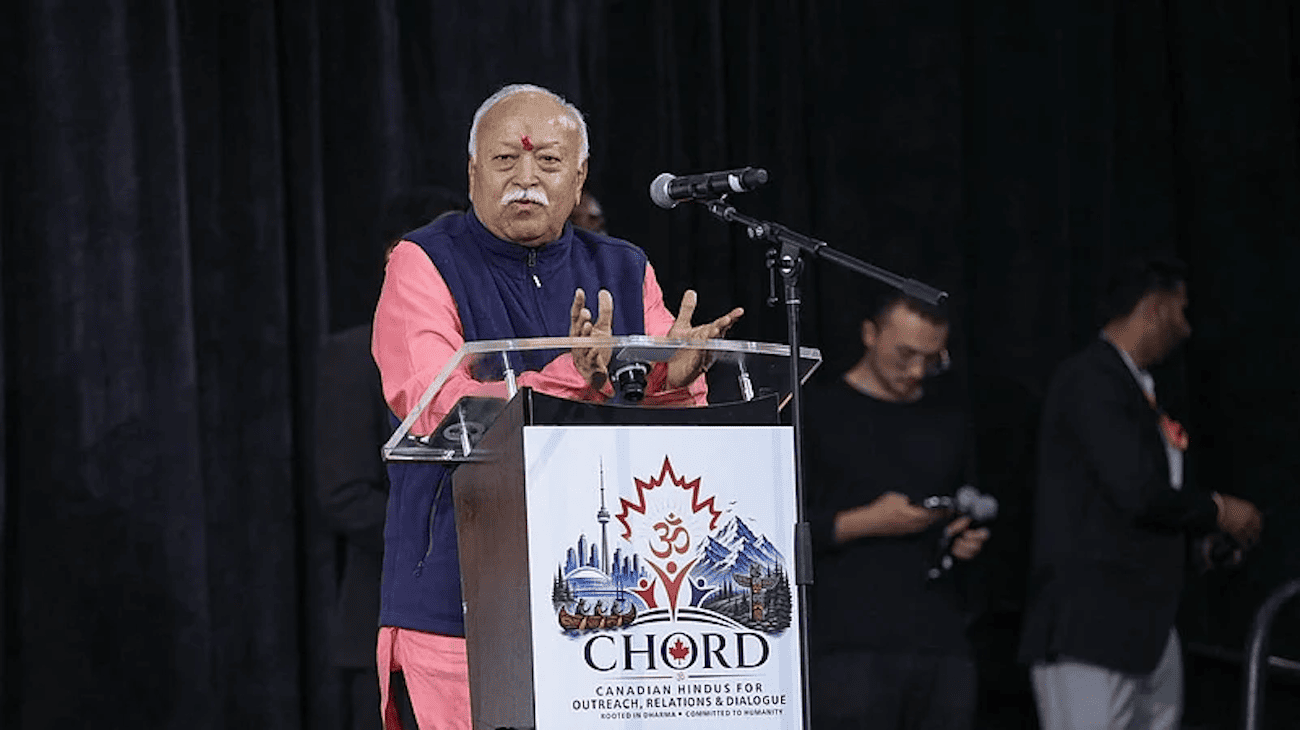

On August 29, 2026, I walked into Madison Square Garden as a Hindu American and walked out with a conviction: something important had happened—not simply for our community, but for America’s evolving understanding of itself.
The occasion was the Universal Oneness Celebration, a gathering centered on the Hindu civilizational ideal of Vasudhaiva Kutumbakam—the world is one family.
More than 5,000 Americans from 39 states and 850-plus cities gathered with more than 180 interfaith leaders from 30 countries and representatives of 250 supporting organizations. Outside, dozens of protesters voiced strong opposition to the RSS and its leader, Dr. Mohan Bhagwat.
Inside and outside the Garden, America was having a conversation. And that may be the most consequential part of what happened.
From Cultural Presence to Public Voice
For decades, Hindu Americans have largely approached American public life through the familiar language of immigration, achievement and cultural contribution.
We became engineers, physicians, entrepreneurs, academics and community leaders. We built temples and cultural institutions. We celebrated Diwali and Holi. We quietly became part of the American story.
But the next chapter is different.
It is not simply about being accepted into America. It is about contributing ideas to America. That is what made the symbolism of Madison Square Garden so powerful.
A Hindu civilizational concept was not being presented in a temple or community hall. Vasudhaiva Kutumbakam was being placed in the middle of Manhattan—one of the world’s most consequential public spaces—as an idea relevant to the human condition.
For Hindu Americans, that is a maturation. We are increasingly saying: our heritage is not merely something we preserve. It is something we can contribute.
The Hindu worldview has a particular contribution to make to America’s pluralistic experiment: unity without uniformity; respect without assimilation; diversity without division. That is a conversation America needs.
The American Dream is Evolving
The traditional American Dream was largely understood as an individual journey: work hard, pursue opportunity, build prosperity and leave the next generation better off. That dream remains powerful. But perhaps it is incomplete.
The next evolution of the American Dream may be less about “How far can I go?” and more about “What can we build together?” That is where the Hindu concept of Dharma and seva can enrich the American ideal.
Achievement carries responsibility. Freedom carries duty. Success carries an obligation to serve. And belonging carries a responsibility to contribute.
This was one of the most important messages directed at Hindu Americans by Dr. Bhagwat in his keynote: America should not be viewed merely as the place where Indian-origin people have settled. It is our karmabhoomi—our field of action, responsibility and service.
For Hindu Americans, the challenge now is to take that message beyond Madison Square Garden. Into our schools. Into our workplaces. Into our civic institutions. Into our neighborhoods. Into the American conversation.
That is a profound shift in perspective. We do not have to choose between being Hindu and being American. Our Hindu identity can make us better Americans if it inspires us to serve our neighbors, strengthen our communities and contribute to the common good. The American Dream, in this telling, is no longer only about individual prosperity. It becomes a shared aspiration for human flourishing.
The Protests Were Also Part of the American Story
The couple of hundred protesters outside Madison Square Garden cannot be ignored—and should not be. They came because they believe the RSS’s history and ideology warrant scrutiny and opposition. Their presence demonstrated that the Universal Oneness message was entering a public discourse that includes disagreement, skepticism and deeply held concerns.
That is democracy.
But what struck me was the contrast between the protest outside and the response from the organizers. There was no confrontation. Volunteers remained peaceful and cheerful. Some offered rakhis—oneness bands—to passersby, extending a gesture of friendship even amid disagreement. One need not agree with an organization or its leaders to recognize the significance of that response.
In an increasingly polarized America, how we disagree may matter almost as much as what we disagree about. The Hindu American community has an opportunity here: to demonstrate that confidence in one’s identity does not require hostility toward another’s identity. That is a valuable contribution to American public discourse.
Inside the Garden, diversity became something we could feel. The program itself made the central philosophy tangible. Artists from different cultures brought different music and dance traditions to the stage. The forms were diverse; the experience was unified. A Mayan leader offered an invocation. A Rabbi, Christian minister and Muslim Imam spoke about the shared responsibility of humanity.
And then came the rakhis. People tied them on their neighbors’ wrists! It was a simple act with a powerful message: I recognize you. I accept responsibility for you. We belong to one human family.
That message becomes especially meaningful when viewed against the world’s current landscape. Wars continue to divide nations. Religious communities face persecution and suspicion. Political identities increasingly define people as allies or enemies. Technology connects us instantly while algorithms often push us further into separate realities.
Against this backdrop, Vasudhaiva Kutumbakam is not merely a spiritual sentiment. It is a proposition for how humanity might survive its own divisions.
A Message for a Conflict-Ridden World
The world does not suffer from a shortage of diversity. It suffers from the inability to accommodate diversity without conflict. Hindu Dharma offers a different starting point. It does not require every person to believe the same thing before we can coexist. It begins with the possibility that truth is larger than any one person’s formulation of it.
That idea can help move the conversation from tolerance to respect, and from coexistence to shared responsibility.
The interfaith leaders’ call for action at Madison Square Garden gave this principle practical meaning. Oneness cannot remain a beautiful word. It must influence how we treat minorities, how nations resolve conflicts, how religions engage one another and how communities respond to people who are different from themselves.

The world needs a framework in which differences can flourish without becoming reasons for hatred.
The most important conversation may be the one beginning now. Dr. Bhagwat’s keynote was both thought-provoking and consequential. He acknowledged the protests, while calling for the destruction of the mentality of enmity—shatru buddhi vinashaya. His larger challenge was directed at Hindu Americans: accept your belonging to America and accept your responsibility toward it.
That message deserves to travel beyond the Hindu community. Every immigrant community eventually faces the same question: Are we guests in America, or are we co-creators of America? Hindu Americans should answer without hesitation. We are co-creators.
Our temples, businesses, laboratories, universities, farms, hospitals and neighborhoods are part of America’s present. Our children are part of America’s future. And our civilizational inheritance has something to contribute to that future.
From Madison Square Garden to theWorld
Perhaps the most consequential aspect of August 29 was the convergence of three realities.
A Hindu idea entered the American mainstream.
A Hindu American community demonstrated its confidence and responsibility as an integral part of America.
And a diverse gathering offered a message of human unity at a time when the world is desperately divided.
None of these require agreement on every historical, political or ideological question. It does require us to engage one another honestly—and to resist the temptation to reduce human beings to the labels we attach to them.
That, ultimately, is the promise of Vasudhaiva Kutumbakam. Not sameness. Not silence. Not the absence of disagreement. Oneness.
A recognition that beneath our many identities is a shared humanity—and that recognizing that humanity imposes a responsibility on all of us.
For Hindu Americans, the challenge now is to take that message beyond Madison Square Garden. Into our schools. Into our workplaces. Into our civic institutions. Into our neighborhoods. Into the American conversation. And, ultimately, into a world that desperately needs a way to disagree without destroying one another.
The American Dream has always been about building a better future. Perhaps its next chapter is about building that future together. And perhaps one of the oldest ideas in the Hindu tradition has something timely to say about how we get there: The world is one family.
Top image: X@RSSorg
Anil Kothari is an Oklahoma City-based mechanical engineer, yoga practitioner and teacher.