




Neha Bora’s Art of Biopolitics: How the Leader of Student Uprising Became AOC of India

- A PhD student, theatre artist, army daughter, and national president of a radical student group, she spent 23 days fasting in the heart of New Delhi and helped bring down a cabinet minister and rattled a powerful Prime Minister.

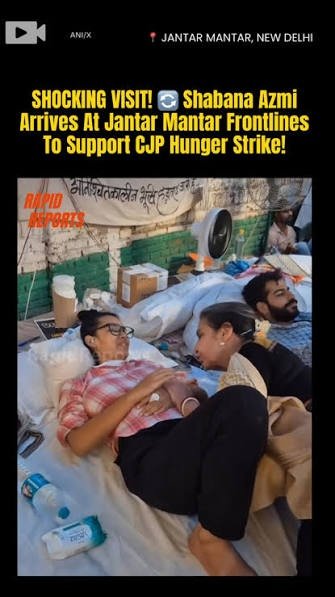
On the twenty-first day of her hunger strike at New Delhi’s Jantar Mantar, Neha Bora’s blood was being taken three and four times a day. Her blood sugar levels had dropped to dangerous points. Doctors monitored her continuously. The 29-year-old had begun the fast at 66 kilograms (145 pounds). By the time she ended it, she had lost significant body weight.
She was asked later, by openDemocracy, what sustained her through those three weeks. Her answer was characteristically precise — the answer of a theatre and performance studies scholar who understands that the body is, in the most political sense, a text.
“It was not so much about the body as it was about the mind. The body adapts, but the body sometimes tells you that it has had enough, and what is the point? It is the mind that keeps you going,” she said. “We read about biopolitics, about how an individual is reduced to their bodies. So that’s what happened to us.”
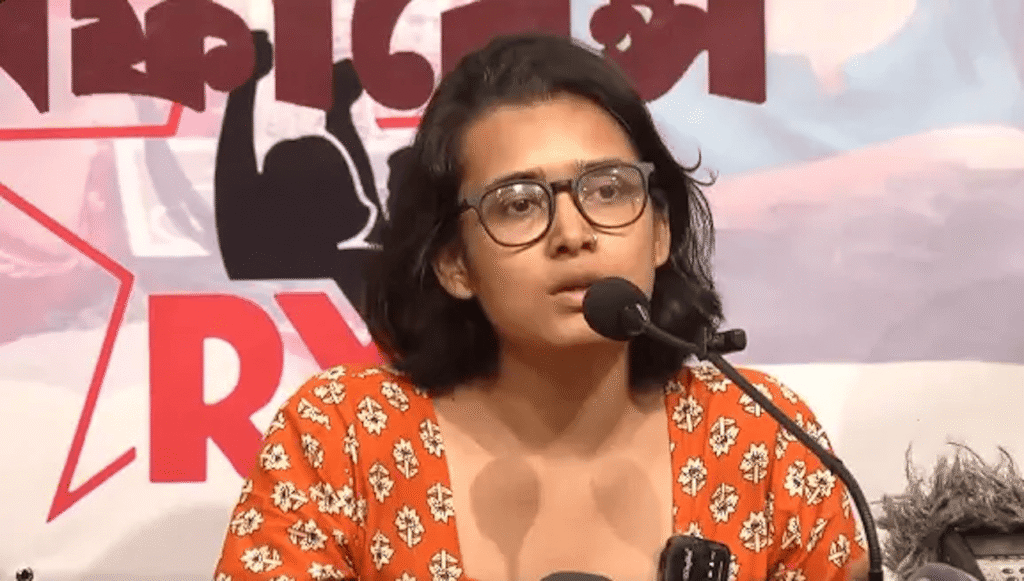
The remark captures something essential about Neha Bora — the way she moves, without self-consciousness, between the language of academic theory and the language of physical experience, between the seminar room and the protest ground, as if the distance between them has never struck her as particularly significant.
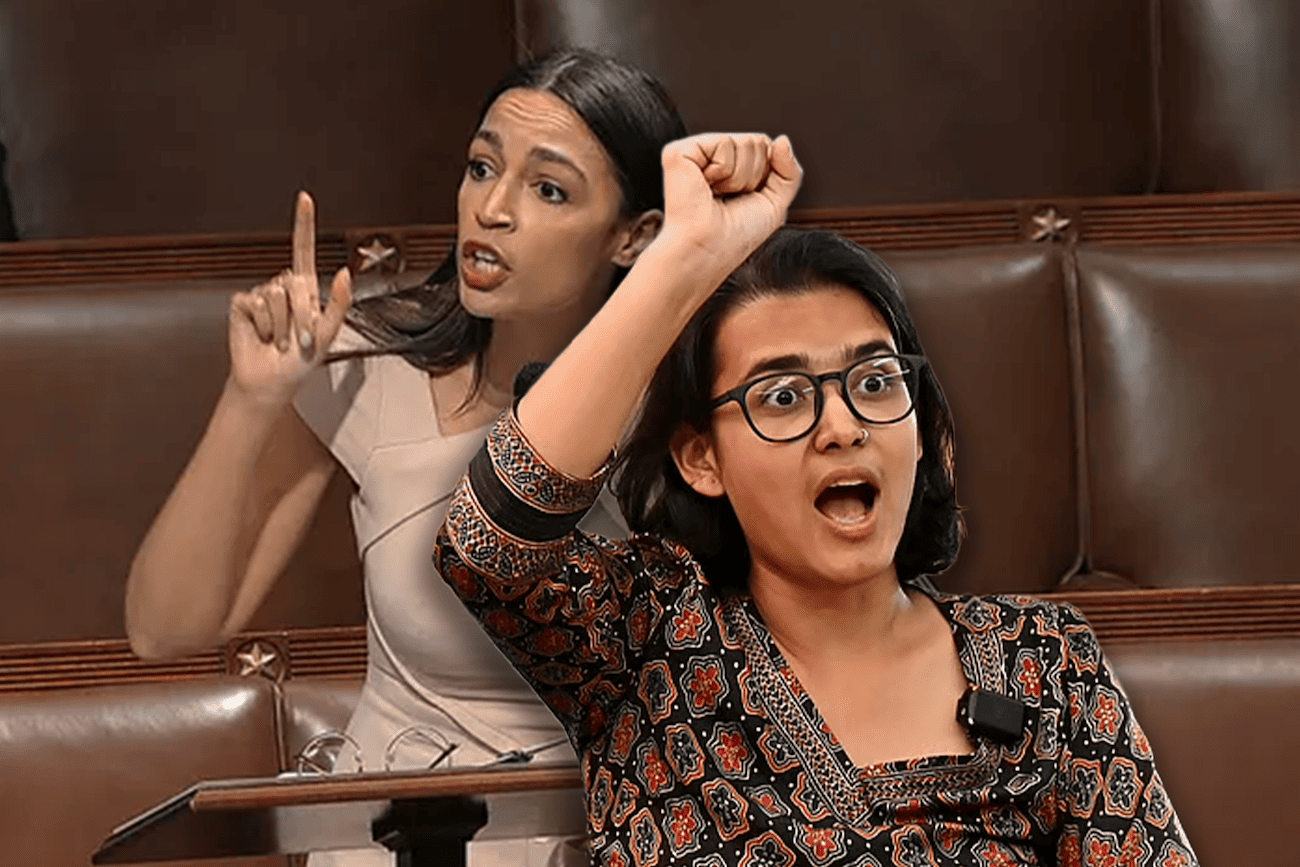
Her 23-day hunger strike gave her national visibility. Subsequent appearances in Jharkhand, Kolkata, Hyderabad, Andhra Pradesh and Mumbai have broadened that profile. It is in this context that some admirers have begun drawing a comparison between Bora and Alexandria Ocasio-Cortez, the American progressive politician popularly known as AOC. The comparison should not be taken literally: Bora is a student leader and activist, not an elected legislator, and India’s political and institutional landscape is very different from that of the United States. But the analogy captures something real about her emergence — a young woman with an ability to turn complicated political grievances into accessible language, command a crowd without sounding like a conventional politician, and use the energy of a younger generation to challenge established political assumptions.
The comparison with Alexandria Ocasio-Cortez is therefore less about ideology than political style. Ocasio-Cortez’s initial breakthrough came partly from her ability to speak in an idiom that did not resemble conventional congressional language. She could take policy questions and translate them into moral and personal questions about ordinary people’s lives.
Bora’s emerging appeal works in a comparable way.
She does not speak about examination irregularities merely as an administrative problem. She frames them through the aspirations and anxieties of young Indians who have spent years preparing for competitive examinations and see their futures tied to an unpredictable system.
She does not treat education policy as a technical subject. She presents education as a question of equality. At a recent Mumbai interaction organized by the Network of Women in Media, India, Bora argued that education is fundamental to reducing social disparities and criticized the growing role of privatization. EdexLive reported her contention that excluding large sections of society from education perpetuates inequality.
From Khatima to the National Stage: A Childhood in Transit
Neha Bora was born in Khatima — a small town in the Udham Singh Nagar district of Uttarakhand, in the lower Himalayas — to a family whose life was shaped by the Indian Army. Her father served as a soldier, which meant the family moved from posting to posting throughout her childhood, as Indian military families routinely do. She spent her formative school years in Siliguri, in the hills of north Bengal, attending Delhi Public School.
The Bengal years were politically formative in ways she has discussed publicly. She has spoken about encountering, during that period, the writings of Charu Majumdar — the Naxalite revolutionary who founded the Communist Party of India (Marxist-Leninist) in 1969 — alongside the poetry of Pablo Neruda and the essays of Arundhati Roy, as documented from her published interviews. The combination — an Indian revolutionary tradition, a Chilean communist poet, and one of India’s most prominent left intellectuals — gives a precise map of the intellectual landscape she was navigating as a teenager in north Bengal.
She became AISA’s national president — an elected position representing thousands of student members across Indian universities — making her, at 29, among the most prominent left student leaders in the country.
Her family’s political views, she has said, differ from her own. “She has said clearly that she stands firmly by her beliefs even when her family disagrees,” as BiographyKind documented. The sentence is understated but revealing: the daughter of an Indian Army soldier who has become the national president of a student organization affiliated with the Communist Party of India (Marxist-Leninist) Liberation has navigated a genuine ideological distance within her own household, and has done so without either hiding the distance or exploiting it for political effect.
After school, she came to Delhi for higher education. She studied sociology at the University of Delhi for her bachelor’s degree — an academic choice that gave her, as BiographyKind noted, “a strong academic base for understanding social systems and power.” She completed her master’s degree at Dr. B.R. Ambedkar University in Delhi. She is currently pursuing a doctorate in Theatre and Performance Studies at the Jawaharlal Nehru University School of Arts and Aesthetics — one of India’s most politically engaged campuses and, in the current political climate, one of its most watched.
The AISA and the Left Student Movement
The All India Students’ Association — AISA — is the student wing of the Communist Party of India (Marxist-Leninist) Liberation, one of the Naxal-origin parties that operates within India’s constitutional framework. It has been active on university campuses since the 1990s, focusing on issues of education access, campus democracy, caste discrimination, and democratic rights.
Bora rose within AISA through a combination of campus organizing, theatre-based public communication, and a willingness to be physically present at protests that carried real personal risk — including a demonstration in Lakhimpur Kheri in October 2021, when BJP-connected individuals allegedly ran over farmers and journalists who were protesting against the now-repealed farm law.
She became AISA’s national president — an elected position representing thousands of student members across Indian universities — making her, at 29, among the most prominent left student leaders in the country. Her relationship with JNU is significant in this context: JNU has been a consistent target of the BJP government’s hostility, subjected to sedition charges against its students, funding cuts, and sustained attempts to delegitimize its academic culture. For a student at JNU, the personal risks of visible political activity are not theoretical.
The Hunger Strike: 23 Days, a Cabinet Minister, and a Viral Dance
Bora joined the Jantar Mantar protests in mid-June 2026, when AISA committed its organizational resources to the Cockroach Janata Paarty-led agitation. Along with AISA comrades Ameen Amitoj and Manish Kumar, and an independent protester identified as Hamad, she launched an indefinite hunger strike that would last 23 days — running parallel to, and outlasting, the hunger strike by renowned civil rights activist Sonam Wangchuk, who was forcibly hospitalized by Delhi police on his 21st day.
The physical toll was extensively documented by medical staff at the site and by journalists who covered the protest continuously. Her blood sugar levels dropped to dangerous points, requiring monitoring three and four times daily, as she told openDemocracy. She lost significant body weight over the three weeks. At several points, according to published accounts, her condition was described as being at high risk.
Three of the AISA fasters ended their strike on July 20, according to NPR, as the Sansad Chalo march to Parliament was being organized. Bora’s position during the strike’s final days became the subject of some dispute, which she addressed publicly after it ended.
The strike concluded on July 25, when Dharmendra Pradhan tendered his resignation as India’s Education Minister — the first ministerial resignation attributed directly to sustained protest pressure during the twelve years of BJP governance.
The celebration that followed became the subject of a controversy that Bora navigated with characteristic directness. A video of her dancing at a Delhi hotel after Pradhan’s resignation went viral and divided the internet, as The Week documented. BJP leader and lawyer Mahesh Jethmalani criticized the celebrations. Others questioned whether someone who had claimed a 23-day hunger strike could dance with that energy. Bora addressed the contradiction publicly, defending her right to celebrate a victory she and her colleagues had earned.

The controversy is itself revealing about the specific expectations placed on women activists in India — that they must be perpetually suffering to be credible, that joy is suspect, that the body that was an instrument of political protest cannot also be a body that dances.
“We Want a Complete Rollback of NEP”
The hunger strike and Pradhan’s resignation were not, for Bora, a conclusion but a first installment. In her interview with The Caravan’s Shahid Tantray — conducted during and after the hunger strike — she was explicit about the movement’s larger ambitions.
“What was your first reaction when you heard Dharmendra Pradhan resigned?” Tantray asked her.
Her response, as The Caravan documented, was to place the resignation in the context of the structural demands that remained unmet: a complete rollback of the National Education Policy, which the BJP government introduced in 2020 and which AISA and allied organizations have argued would privatize education, undermine access for lower-caste and lower-income students, and concentrate institutional power in ways that serve the ruling party’s ideological agenda.
CJP spokesperson Ashutosh Ranka confirmed the movement’s intention to continue, stating that the organization planned to engage with the government on structural changes rather than ending its campaign altogether. Bora’s own continued advocacy — for examination reforms, accountability, student welfare, and the broader education policy reversal — has given her public presence a continuity beyond the single dramatic episode of the hunger strike.
She has also spoken publicly about the imprisonment of Umar Khalid — the former JNU student leader who has spent years in jail under India’s anti-terror laws for his alleged role in the 2020 Delhi riots — in an interview with Brut Media, which documented her views on Khalid, JNU, Left politics, and electoral politics. An incident in Ranchi, where ink was thrown at her during a student protest, brought additional attention to her and to the case of the accused, who reportedly cited her alleged support for Khalid. Bora addressed the incident and her position on Khalid publicly.
Theatre, Theory, and the Art of the Protest
What distinguishes Bora from many of her generation’s political figures is the integration of her academic and artistic practice with her political activism. She is not a politician who also studies theatre. She is a theatre and performance studies scholar whose understanding of the body, of public space, of spectacle and protest, directly informs how she shows up at Jantar Mantar.
The hunger strike is, among other things, a performance in the technical sense — a durational public action in which the body becomes a site of political meaning, observed, documented, and interpreted by audiences who cannot always be physically present. That Bora understands this in theoretical terms as well as experiential ones gives her a capacity to articulate what is happening to her and around her that most activists, operating on instinct alone, cannot match.
“We read about biopolitics,” she told openDemocracy. The sentence locates her simultaneously inside the academic tradition — Foucault’s analysis of how power operates through the management and control of bodies — and inside the lived experience of having her own body monitored, measured, and threatened by an institution trying to outlast her. Theory became experience. Experience became testimony.
She is 29 years old. She led a 23-day hunger strike that brought down a cabinet minister. She danced when it was over. She is still asking for more.