




Noble Cause of a Nobel Laureate: Rabindranath Tagore’s Pioneering Efforts to Protect the Environment are Still Relevant

- Tagore displayed his philosophy of protecting nature, through reforming education and emphasizing creativity and open mindedness over routine and closed mindedness.

According to the UN Environment Program, “Around 3.2 billion people, or 40 percent of the global population, are adversely affected by land degradation.”(UNEP) This destruction and disregard for nature has resulted in vast deforestation and significant loss of life throughout the world and history. The result of humans being in conflict with nature has caused millions of acres of land and ocean to be destroyed, and directly stems from a lack of knowledge about nature and the issues regarding it.
Throughout history, people have unknowingly harmed themselves by ruining the land they live on and continue to worsen their living conditions. Although, in the beginning of the early 20th century, many people started to notice these problems and decided to do something about this issue, one of those people was Rabindranath Tagore.
Although some people may claim that Rabindranath Tagore’s influence was limited due to being primarily regional, ultimately he left a legacy of environmental progress, through his influential literature, notable schools, and innovative thinking.
Rabindranath Tagore was born on May 7, 1861 he descended from the wealthy Jorsankore family. His father was the founder of the religion Brahmoism, and his grandfather was a successful industrialist. He grew up in a wealthy and with liberal influences that combined European education with Hindu wisdom. And as the youngest of 14 children, it was only natural that he pursued the arts as his elder siblings did before him.
His father sent him to an English school, but he did not want to be taught in a foreign language, ultimately withdrawing from school at the age of 14. At the age of 12 he had already started taking lessons from his father and later went to the notable University College in London.
When he went back to India, he published his first volume of poetry “Evening Songs” (Sandhya Sangeet). However, he first became highly respected when he published his poem the awakening of the fountain. His career continued to blossom, including him being awarded the Nobel Prize in 1913 for his iconic collection of poems, “Song of Offerings” (Gitanjali).
Tagore also wrote the novel “Fairfaced” (Gora), to portray Indian identity and the social struggles of 20th century India. Although perhaps the most notable of his accomplishments and contributions to South Asian literature and culture are the national anthems of India and Bangladesh, Jana Gana Mana and Amar Shona Bangla.
Tagore was influenced by other intellectuals he met during his international travels, and the natural world around him. Although he grew up a privileged life he sought to improve the world and help people that were less privileged than himself. He fell in love with nature when he was a child, and realized that the beauty of nature must be preserved for future generations and that it was more than simply a backdrop. His connections to nature are present throughout much of his work , including poems in “Gitanjali,” his paintings, and his articles like “Return to Earth.”
Tagore also founded a university, Visva Bharati to teach these ideals and blend together the different philosophies he believed in. Throughout history humans have been in conflict with nature, we have taken down entire forests, filled the oceans with garbage, and killed millions of animals. This path to self destruction has been primarily guided by a lack of environmental education and knowledge, and the viciousness of human greed.
This is a major issue, because it impacts everyone and everything on this planet. According to the World Wildlife Fund, “The latest edition of the Living Planet Report, which measures the average change in population sizes of more than 5,000 vertebrate species, shows a decline of 73% between 1970 and 2020”(Almond et al.) If this continues, the world could reach a global tipping point, in which the vast majority of the world will experience a complete environmental shutdown. The resulting impact would cause environmental catastrophe, complete economic downfall, and the death of millions of animals throughout the world.
Although that is not the only impact of vast environmental catastrophe, as expert Phillipe Lazaro of the nonprofit environmental organization Plant with a Purpose, found that “many farmers turn to strategies like deforestation, overgrazing, and pollution to make ends meet – even though these strategies all contribute to environmental degradation and can lead to decreased crop yields and water shortages.”
Thus showing that environmental destruction is directly connected to poverty, and becomes a cycle for many farmers. However, the consequences of losing farmland are even more dire, because it is also the loss of fertile land to grow food. If this path continues, it could result in entire countries losing their economies main source of production and eventually cause millions of people to lose their livelihoods and face risk of famine and starvation.
A farmer from the Democratic Republic of Congo, named Chanceline states “I was exclusively dependent on agriculture to support my family… Relying only on agriculture hindered my development. I also dreamed of starting some commerce, but I never had the financial resources to start my dream”
“For all of a sudden, I found my world vanishing from around me giving places to wooden benches and straight walls staring back at me with the blank stare of the blind.”
Chanceline experience is common throughout much of the world and shows how the cycle becomes impossible to break and becomes a necessity for people to survive. Another big factor that leads to the destruction of the environment is a lack of focus on environmental issues in schools, which in turn creates a parallel cycle to the one Chanceline’s experienced.
Many people throughout the world experience a worse education, due to insufficient money and resources to attend better schools, thus causing them to damage the environment, which leads to them losing money and resources, thus putting them in an inescapable cycle.
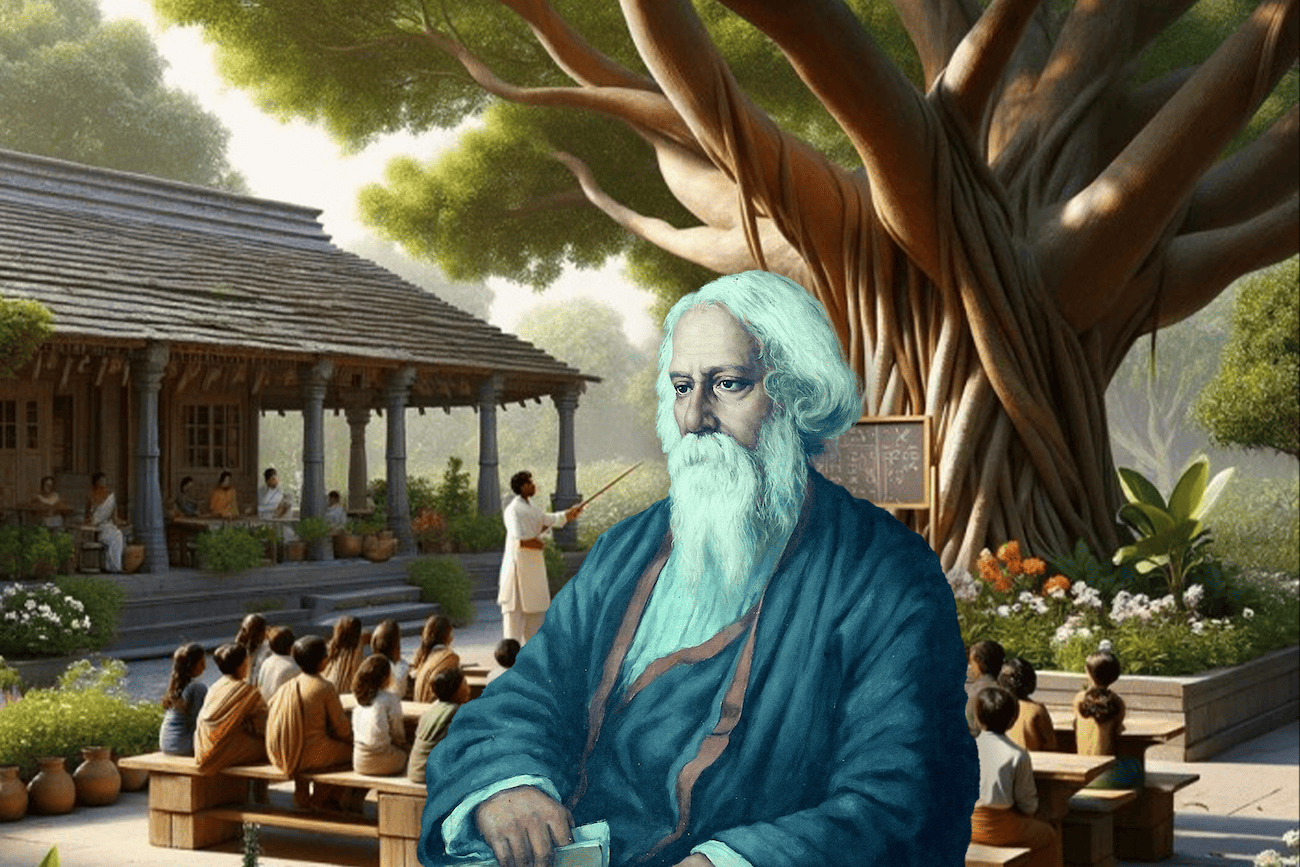
Although many people, like Rabindranath Tagore have set out to combat the negative effects of environmental degradation and break this cycle, he did it by creating schools and festivals that celebrated nature and educated the public on how to be in harmony with the environment and not in conflict with it.
He planted trees and wrote articles on how to take care of the environment and create harmony with it. Rabindranath Tagore utilized several elements and ideas in his writing to express his ubiquitous philosophy. He believed in the idea that in order for nature to be protected, people must learn about it and connect to it, further he believed the solution to accomplish this was to reform the traditional education system in which this was barely a focus.
He expressed his philosophy by using dynamic diction, eloquent imagery, and advanced syntax. He effectively used diction to show the intricacies of his philosophy. In his essay, Return to Earth, which he wrote in 1901, he states “The young mind should be saturated with the idea that it has been born in a human world which is in harmony with the world around it.”
Here, he uses words like “Saturated” and phrases like “human world” to express his idea that young people should be connected with nature and to emphasize the connection between the human world and the natural world. The connection between the “world around it” or nature, and humans is necessary for humans to fully understand the necessity of protecting nature. He utilizes effective diction to firmly express these key ideas throughout his writing.
He continues by stating “And this is what our regular type of school ignores, with an air of superior wisdom.” He emphasizes the arrogance of schools by using the diction, “superior wisdom” to create a sardonic tone. Here he uses that tone to criticize the education system’s lack of focus on the environment, that limits creativity and creates a disconnect with the environment.
The consequence that forms as a result of the disconnect with nature, is the eventual collapse of parts of the environmental world, because of a lack of appreciation. Tagore sought to replace this mindset, by creating a syncretic education system that would correct the errors of the previous system, and create a more open minded generation.
Another element Rabindranath Tagore implements is imagery, he uses imagery throughout much of his writing to elevate his ideas and thoroughly express his ideology. Tagore states, “For all of a sudden, I found my world vanishing from around me giving places to wooden benches and straight walls staring back at me with the blank stare of the blind.”
In his article “Return to Earth” Tagore effectively uses imagery to cause his reader to visualize how the disconnect with nature forms. He further illustrates this concept, by stating “my world vanishing from around me” to show the lack of familiarity with the new world that he was entering and to express the idea that he was slowly losing his relationship with nature. He also uses imagery to showcase the boredom and emptiness students are subjected to in classrooms, thus expanding on his ideas of how to reform schools.


Ultimately, communicating the overarching idea that traditional education was stealing the creativity that stems from a connection with nature from children. Tagore also states, “By the least touch, they know how far they can take liberty with branches, how to distribute their bodies weight as to make themselves least burdensome to branchlets.”
He utilizes imagery to form a depiction of children climbing a tree, thereby expressing the idea that a connection to nature improves and elevates the education of children. Tagore wanted children to understand that the concepts they learn in school are reality and not just in textbooks, intending to create a strong connection with the outside world and not an artificial connection.
He hoped that a strong connection with nature would lead children to take better care of nature and preserve it for future generations. The third major element Tagore employs is syntax. He states, “Therefore men’s children have to be banished from their paradise into a realm of death, dominated by the decency of a tailoring department.”
He uses the metaphor of the tailoring department to cruelly depict schools as meticulously snipping away the happiness of children, for the sake of making them knowledgeable. Tagore believes this is not necessary and that prioritizing memory and knowledge will worsen empathy and create an environment in which the ideas of children are heavily constricted.
Tagore instead believed in schools combining the outside world, or “paradise”, and education, or the “tailoring department”, to create a better system. Tagore also states, “From our very childhood, habits are formed and knowledge is imparted in such a manner that our life is weaned away from nature and our mind and the world are set in opposition from the beginning of our days.”
Here, he utilizes syntax to express the idea that children are taught to be in conflict with nature and view it as an obstacle, instead of trying to be in harmony with it. He creates juxtaposition and emphasizes the contrast between “our mind” and “the world,” effectively highlighting the problematic and unnecessary conflict between the two, as a result of the habits and knowledge pushed onto people from childhood. Tagore’s ideas are expressed thoroughly throughout his work, and are embodied through his usage of diction, imagery, and syntax.
Tagore displayed his philosophy of protecting nature, through reforming education and emphasizing creativity and open mindedness over routine and closed mindedness. Tagore built his career through influential writing that helped set forth a new style of thought in regards to how we perceive the connection between education and nature. His ideology became the center point of many schools today, and continues to have an impact on how people think about the relationship between education and nature.
The current lack of focus on nature has resulted in the natural world collapsing, forests being destroyed, and has exacerbated the disinterest in nature. Although, there are many organizations that focus on repairing this broken relationship, which are referred to as nature-based schools.
Tagore himself founded Visva Bharati University to focus on this connection and advocate for the protection of nature. He also started the tree planting festival (Briskha Ropan), and the ploughing festival (Halakarshan), to show people how and why they should take care of their surroundings.
Today, his philosophies are present throughout the world and provide students and universities with the knowledge how to take care of nature, thus advancing the wisdom of Tagore. Many nature-based schools exist throughout the world, with the goal of establishing a connection between humans and the outer world that surrounds us.
There are many ways to continue his legacy, like donating to charities like the World Wildlife Fund and learning more about nature from organizations like National Geographic.
Ayush Shah is a junior at Glenbard South High School, Glen Ellyn, IL