




Rām or Rāma? The Linguistic Story Behind a Sensationalized Debate Triggered By Amitabh Bachchan

- This is not to put blame on any specific linguistic group or even people with a specific opinion, but rather a mindset of anti-intellectualism and close-minded ignorance that is all too common in discussions of Indian linguistics.
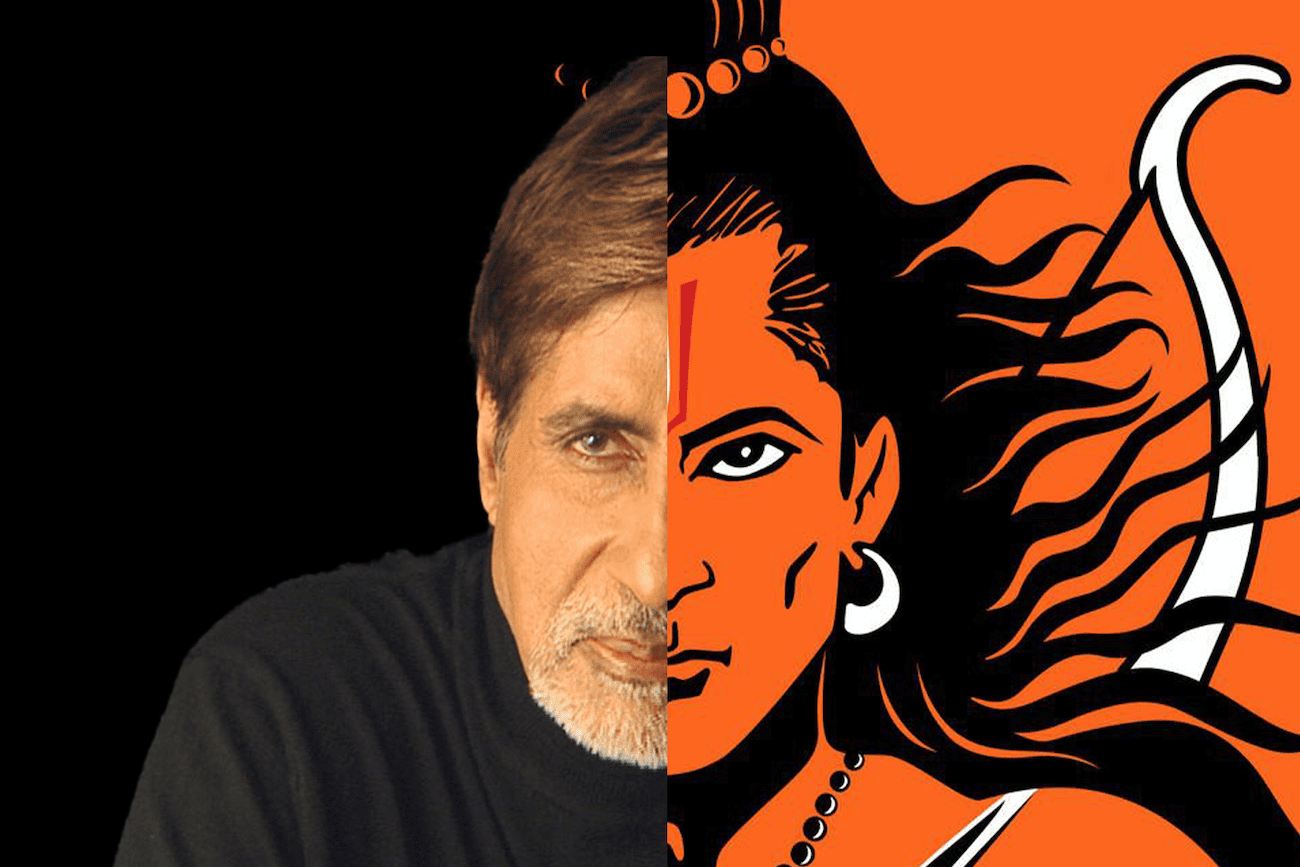

If you celebrated Sri Rāma Navami a few days ago, the name Rāma and some prayers or songs centered around it may be fresh in your mind. Indeed, a festival like this can be an opportune moment to observe the stories behind language and its role in culture. The festival of the birth of Rāma is no exception to this, with the name Rāma occupying a distinctly special role for a vast population of Hindus across the world, so much so that writing it is considered a distinct form of devotion.
Even Vālmīki, the legendary sage who became the first Sanskrit poet by narrating the story of Rāma through the Rāmāyaṇa, is often said to have become a sage by repeating his name for years. To be precise, this story usually says that Vālmīki, formerly a thief, initially mispronounced the name as Marā, but by saying it over and over, he ended up saying Rāma. Coming back to the present day, however, it’s possible you’ve heard claims that this name is currently being mispronounced and misspelt by millions of people. Some say it is Rām and not Rāma, while others believe the opposite. Depending on your own linguistic background, one of these answers may seem to clearly be correct, so what is this phenomenon and what explains it?
This is one example in a seemingly niche debate about Indian languages that resurfaces online quite often. It concerns one very simple sound, and specifically its absence or presence in some words in the hearts, minds and even names of millions of people, so it’s no wonder it often comes up in conversations among Indians of different linguistic backgrounds. One way this debate, or to be more accurate a linguistic difference, has been sensationalized online is through a clip of the legendary actor Amitabh Bachchan, a native speaker of Hindi. In the clip, originally from 2019, Bachchan says “Dharm means Dharm, not Dharma — like Karm means Karm, not Karma.” The assertion he’s making is that these two Sanskrit-derived words didn’t originally have an “a” sound at the end, and that including them is therefore an error.
To resolve this perceived discrepancy, we could look to the Sanskrit origins of these words. In Sanskrit, these words are indeed written and pronounced as Dharma and Karma — with a vowel sound at the end. In the case of Rām(a) and many other cases where this often comes up such as Buddh(a), the Sanskrit base words also include the a, with ḥ added at the end when used in the singular number and nominative case, that is as a name or the subject of a sentence. Since Sanskrit has eight cases with three different numbers, the name can appear in a variety of different forms such as Rāma (when the name is being called out), Rāmāya (often used when praying to a deity), or the most basic form, Rāmaḥ, which would be used in a list of names for example.
Since the question of what these words looked like in Sanskrit has a simple answer, we have to venture into some other languages to see where the confusion arises. The “a” sound is very common in Sanskrit, and this is reflected in the Brahmi script and most of its descendants, including Devanagari, the script now most associated with Sanskrit. These scripts are abugidas where vowels are indicated by diacritics on consonants, and a consonant with no diacritic indicates that it is accompanied by the vowel “a”, with separate diacritics that silence the vowel. This means the Sanskrit root word Rāma would be written as the consonant “r”, followed by a marker for the vowel “ā”, then the consonant “m”, with this signifying the presence of “a” after it.
Hindi and Other Languages
To understand why a Hindi speaker would read this differently even in the same script however, we have to look at a phonetic change in the Indo-Aryan languages, as writing is only a visual representation of sounds. Many Indo-Aryan languages which descended from Vedic Sanskrit underwent a sound change where the “a” sound became significantly more closed, turning into a sound known as the schwa. Produced with the mouth more closed than when making Sanskrit’s “a” sound, like the word “uh”, the schwa is also the most common vowel sound in English despite not being represented by a single letter, as many other vowels reduce to it in certain places when not stressed.
With various Indo-Aryan languages having reduced the “a” sound to a schwa, it’s not unusual that this sound completely disappeared in certain situations, and this is exactly what explains this phenomenon. This change affected different Indo-Aryan languages in different ways, but taking standard Hindi as an example, schwas get deleted in the middle of words sometimes, and almost always at the end of words – hence the Sanskrit word Rāma evolving into the Hindi word Rām. As for the script, this effectively means that a Devanagari consonant letter does not have an inherent vowel specifically when it’s at the end of a Hindi word, and this makes the vowel silencing diacritic in Sanskrit, the halanta, obsolete in Hindi. Of course, different languages and dialects have their own nuances, but this explains the phonetic processes at play without much complication, so to understand why this discourse is a topic of contention in the first place, we need to look at its sociolinguistic aspect as well.
Colonial Imposition or Native Change?
It is apparent that Bachchan believed the words Karma and Dharma are a result of colonial Anglicization of Indian-origin words. To be specific, he seems to interpret them as an alternate English pronunciation based on spelling and not the original pronunciation.
This is an appropriate time to look back at Bachchan’s clip to see why he brought up those words in the first place. Right after the statements about Dharm(a) and Karm(a), he says that “Rāmāyaṇ is Rāmāyaṇ, not Rāmayāna; it’s Himālay, not Himaleya”. About a minute later, he states that “this practice of distorting words which do not belong to the administration [presumably the colonial British government] is an old colonial practice.” He brings up examples such as Thiruvananthapuram and Thakur being Anglicized to Trivandrum and Tagore respectively, and condemns this practice as dishonest.
With this added context, it is apparent that Bachchan believed the words Karma and Dharma are a result of colonial Anglicization of Indian-origin words. To be specific, he seems to interpret them as an alternate English pronunciation based on spelling and not the original pronunciation. This is comparable to the cases of Himālaya and Rāmāyaṇa, where Bachchan presents a dichotomy between the Hindi pronunciation, mostly preserved from Sanskrit but with the schwa deleted (Himālay, Rāmāyaṇ), with the non-Indian English pronunciation, adding the -a at the end but changing the pronunciation of the word overall (Himaleya, Rāmayāna). This suggests that he believed that the schwa’s introduction was just another aspect of the English spelling-based pronunciation. This spelling can also be understood by Hindi speakers as a result of the final consonant being interpreted as including the vowel sound -a, since standalone consonants still include it in other positions in the language.
While Bachchan didn’t elaborate on this himself, this is a common train of logic, I see speakers of final-schwa-deleting languages following when this topic is discussed. So, to summarize this perspective, many speakers of schwa-deleting languages assume the schwa is not present at the end of these words in Sanskrit either and is only added in the English spelling as a misinterpretation of the Devanagari written form, and then mistakenly pronounced because of that spelling. In reality, the Sanskrit form does include the final vowel, and the English form has it as a result of being borrowed directly from Sanskrit.
Beyond Sanskrit and Hindi
Of course, students of Sanskrit aren’t the only linguistic group in the Indian subcontinent which tends to be more familiar with forms such as Rāma, as a few descendants of Sanskrit like Odia and Sinhala preserve the final vowel. The biggest linguistic group which this applies to however is the Dravidian language family of South India. Being genetically unrelated to Sanskrit, these languages usually either borrow Sanskrit words directly or with a native suffix attached. Two examples from Telugu are karma, which is spelt and pronounced essentially the same as the Sanskrit word, and rāmuḍu, which attaches the masculine suffix -uḍu to Sanskrit rāma, with the “a” disappearing through sandhi.
Since these languages do not reduce the vowel “a” in formal speech whatsoever, still using a halanta diacritic to indicate a deleted vowel, the Sanskrit words written in their scripts would be pronounced accurately by their native speakers due to this phonological similarity. While these languages are much closer to the older Sanskrit pronunciations in some cases, they are by no means more correct in general, as each linguistic variety’s own form is correct when speaking that language. I point this out since there’s also a kind of opposite misconception to the previous one which posits that deleting the final vowel is universally wrong, or even a product of foreign influence, when it is in reality a very common phonetic process worldwide that occurred independently in these Indo-Aryan languages.

Many people point out that the English pronunciation of the -a in Rāma is not accurate to Sanskrit either, and this is true in both Indian English and major native dialects. Most Indian English varieties lengthen “a” at the end of words, which means many people end up saying Rāmā while speaking Indian English. However, Rāmā would be a different word in Sanskrit since the two vowel lengths are distinguished, and would denote a female-gendered word and not a male one. While none of the non-schwa-deleting languages previously mentioned pronounced the word like this, many native speakers of those languages do pronounce it like that in English, making the inclusion of a vowel at the end seem like an even bigger mistake to those who don’t include it in their native language, as it changes the gender of the word entirely. This may also have been what Bachchan was addressing, as his pronunciations of karma and dharma were close to karmā and dharmā.
As for dialects like American English and British English, they reduce the -a to a schwa, making it more closed than in Sanskrit as opposed to more open as in Indian English. As mentioned at the beginning, one place the presence or absence of a final vowel is often noticed is in people’s names. Many Sanskrit names have a distinction between a masculine form ending in -aḥ and a feminine form ending in -ā, and this translates to the masculine form losing its final vowel and the feminine form maintaining it in schwa-deleting descendants. Thanks to the influence of schwa-deleting languages, it’s become common for men to have names without the final vowel across India, even if it isn’t deleted in their native language. For example, the Sanskrit root word Amita becomes Amitaḥ as a male name and Amitā as a female name, but is today mostly spelt as Amit for men and Amita for women.
An Antidote to Misinformation
If I’ve addressed the phonetic aspect of this phenomenon, and the sociolinguistic aspect that has caused confusion around it, I want to end by reflecting on why this confusion so often turns into assumptions and arguments rather than further knowledge and understanding. To be clear, this is not to put blame on any specific linguistic group or even people with a specific opinion, but rather a mindset of anti-intellectualism and close-minded ignorance that is all too common in discussions of Indian linguistics. This seems to be something proliferating in relation to many fields of study nowadays, and it’s quite sad that linguistics, a field generally considered to have its origins in the very linguistically diverse Indian subcontinent with Panini’s Ashtadhyayi, is now subject to so much misinformation, often redirecting actual curiosity and interest in the subject away from learning and towards conflict.
It’s completely understandable that language is intertwined with politics, and that people are curious where certain aspects of language come from, especially with so many influences from around the world having entered Indian languages, often as part of violent imperialism and colonialism, specifically linguistic suppression, which has led to varying ideologies of linguistic purity. It’s inevitable to see such opinions arise, and debates between them would probably venture from linguistics into politics and then philosophy, which can certainly be done civilly.
Focusing back on linguistics however, it’s crucial to remember that it is a descriptive field like any other science, simply observing how language exists and not making any judgment on it, and even though as a social science it is deeply entwined with cultural and social issues, it’s impossible to properly use linguistics as a lens for these subjects without a willingness to understand it properly and independently from any specific view or agenda. No matter how many different misconceptions proliferate about Indian linguistics, I think a lot of them have some roots in genuine curiosity and appreciation of the beauty of language and the stories behind it, and harnessing this curiosity while being aware of the fluidity and nuance of language is the antidote to this misinformation.
Varenya J. is a high school student in California interested in geography, linguistics, history, and politics.
Well articulated shows how certain controversies can be avoided and put to rest with knowledge.
Anyone watching Bachchan speak will be biased to see it through the lens of Indian vs colonial aspect but missing this aspect brought out by this author.