




My Conflicting Reflections On and Admiration For Arundhati Roy and Her Mother Mary

- Initially, the hype around her memoir put me off. And the whole tortuous mother-daughter relationship it was all about. I felt that she was dishonoring the memory of that amazing woman whom so many of us in Kerala admired deeply. But I finally picked it up.
The mother-daughter dynamic is one of life’s most complex bonds. It can be a source of deep love, unwavering support, and a sense of belonging. It can also be the source of deep conflict and a minefield of childhood wounds.
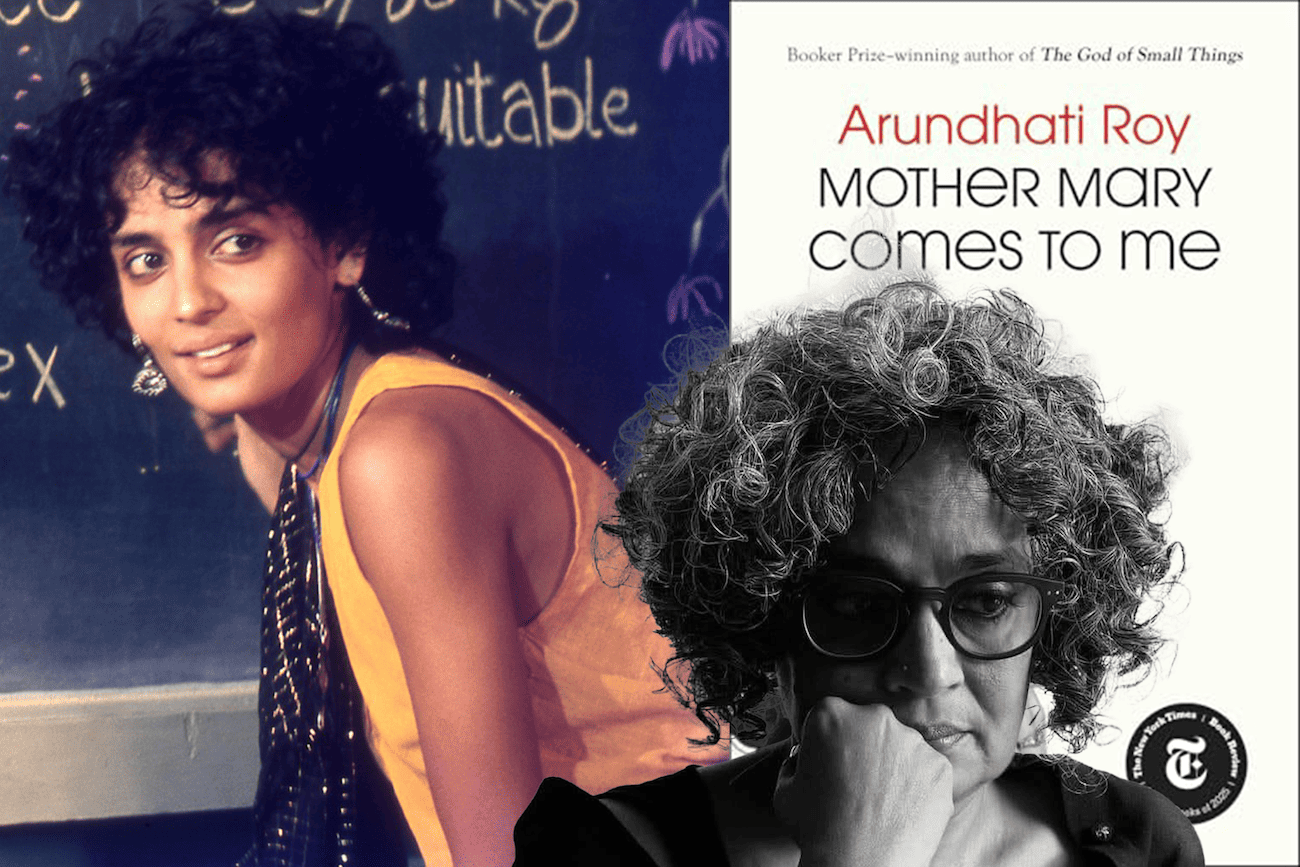
Arundhati Roy’s Memoir “Mother Mary Comes to Me” has received enormous accolades and now received the honor of the 2026 U.S. National Book Critics Circle Award in the autobiography category. Before that, she was honored by her own state of Kerala with an award deeply cherished by its journalists, the Mathrubhumi Book of the Year award. And even before that she was awarded the Navamalayali Cultural Prize at the Kerala Sahitya Academy in Thrissur, Kerala 3 years ago. I was delighted to be invited to that ceremony by my friend, renowned Malayali writer, J. Devika. I may not agree with all of Roy’s views, but none can deny the unwavering courage and intrepid spirit with which she wields her pen against injustice.
Roy’s memoir, written as her tribute to her mother, the renowned educationist Mary Roy who passed away in 2022, is a tribute as bizarre as their relationship, which was dysfunctional, to say the least. As she puts it herself, her mother was “both her her shelter and her storm,” a woman that she fled from at the age of 18, “not because I didn’t love her, but in order to be able to continue to love her.”
Most people who read it respond to it with a mixture of awe and horror. But then, most of the readers in the West did not grow up in our home state of Kerala and have never met her mother. Whereas I have met both the mother and the daughter. I had interviewed Mary Roy long ago when her state knew only the mother and not the daughter. For she was an amazing woman who had stood up to the powerful Syrian Christian Church to which she belonged and managed through sheer grit to win the Supreme Court case that would change the law of inheritance for Christian women forever. And then she on to found one of the most extraordinary schools in the country in the 1960s, Corpus Christi School, now known as Pallikoodam in Kottayam, Kerala. A school which she had invited the renowned architect of sustainable development, Laurie Baker to design. The school was imbued with a holistic pedagogy designed to inculcate creativity and independent thought in its students.
So to me, as to many Keralites back in the day, Arundhati Roy was only Mary Roy’s daughter. Which is why I could understand why her mother was stunned when she became known to the country in general only as Arundhati Roy’s mother. Her epitaph on her gravestone describes her to as: “Mary Roy, Dreamer, Warrior, Teacher.”
I have had a strange, almost visceral response to this book. It is one that I did not expect. But then, I have a different response to the author herself. It is a mixture of respect, for her work and for her courage, and annoyance with the reverence given to her by 99% of my fellow academics. I have witnessed it firsthand at huge feminist conferences in the U.S., where she received standing ovations and accepted it as her due. And refused to accept any criticism. When I stood up in that audience of acolytes and dared to disagree with her stance on Mahatma Gandhi in her book “The Doctor and the Saint,” I was met with outrage. How dare I dissent from their Goddess? Even those who agreed with me did so privately, not publicly. But I admired Roy too, for her unflinching courage.
Her award-winning novel “The God of Small Things” was published in 1997 when she was in her mid 30s. But I first met her in the early 1990s at the Narmada Bachao Andolan satyagraha that I was covering for Indian national television, Doordarshan. This was a dynamic, nonviolent movement that highlighted issues with rehabilitation and ecological damage. This meeting was in a remote village in Manibeli, Maharashtra that was the eye of the storm, she as a journalist for the Indian news magazine, Outlook India, and I for a short documentary feature for Doordarshan.
I respected her non-fiction deeply and read all her essays that were published in major Indian news magazines, Sunday, Outlook, et al. I preferred it in fact to her fiction.
But when her work was published, it annoyed me that Roy, the journalist who was covering the story was accorded the respect that, in my opinion, should have gone to the unassuming figure behind the movement, the renowned activist, Medha Patkar. I should have realized that, after all, Roy was the winner of the coveted Booker Prize, so she would be accorded much respect by the international media. That was one part of it. Another was that I did not care much for that novel in the first place. I could not figure out why it was considered such an electrifying novel. Now, when I read the comment by the publisher in her memoir, I can understand. For the publisher, as he admits himself, had never been to India, had never been to my home state. So, of course, he was in a state of shock when he read her book, stating, “When I read the book, I felt as though somebody had shot some heroin up my arm.”
I was baffled. In my eyes it was a good book, but that’s about it. Not mind-blowing, and definitely not addictive. But after all, I am from that state and am familiar with much of its idiosyncrasies. However, I was deeply moved by what she did after she had won the Booker Prize. She shared the royalties with family and friends, and with the revolutionary organization, the Narmada Bachao Andolan. She continued that trajectory through her passionate essays in news magazines, standing with the oppressed, be it in Gaza or in Kashmir, and often reviled by many in her own country.
And I loved her scriptwriting. Her brilliant, irreverent film that was directed by her then husband, Pradip Krishen, “When Annie Gives It Those Ones,” and was thrilled to see her character, Radha, a beedi-smoking bohemian young woman appear at her graduation in a red sari and a felt hat, which of course had a huge impact on my sartorial choices in later years. We of that generation in India got to see that extraordinary film on TV in 1989. A brilliant, laid-back comedy in English, it was about final year students at a college of architecture, struggling to complete their final projects. As Roy admits it herself, “Since Doordarshan was the only TV channel in the country back then, a film screened on it was guaranteed a captive audience of millions.”
I respected her non-fiction deeply and read all her essays that were published in major Indian news magazines, Sunday, Outlook, et al. I preferred it in fact to her fiction. And now I balked at reading her memoir. The hype about it put me off. And the whole tortuous mother-daughter relationship it was all about. I felt in fact that she was dishonoring the memory of that amazing woman who so many of us in Kerala admired deeply. But I finally picked it up.

And now it was my turn to say now this is indeed a brilliant, poignant memoir. For it is in equal parts a tribute to her mother as a teacher, founder of her famous school, and survivor of a divorce that left her penniless with two small children. It is also an unflinching gaze at a mother who did not know how to mother her children. A mother who was mentally abusive to her children even while she developed their intellectual skills. A mother who launched her book at her school, introduced by the most famous female novelist of that time, the redoubtable Kamala Das. But who, alas, simultaneously, undermined her daughter too.
I grew up in an era where mothers did not fawn over their daughters. And my own mother was an intellectual who was far more interested in her own social and intellectual pursuits than hanging out with her daughters. She was an avid reader and enjoyed attending literary events and acting in plays with friends at the Kerala Club. She never once congratulated me for any of my achievements in college, although she made it a point to attend the annual events where I received numerous awards. When I asked her about it years later, she told me she did not want me to get a big head.
So I do not look down on Mary Roy for not praising her daughter when she was a child. But I was aghast to read of the emotional abuse that she subjected her children to, both her daughter and her son. Mary Roy comes across as a brilliant, courageous and determined educationist, but a nightmare as a mother. And the child Arundhati grew up running wild with her brother, mocked by her conservative Christian community as children who did not belong to a respectable family. This, of course, was before her intrepid mother forged her own path, forcing her conservative community to respect her.
The most poignant part of the book is her description of how she came unraveled with the death of her mother. The same woman who she would always think of not as ‘mother’ but as ‘Mrs. Roy.’ As she admits, “Even up to my last day with her, I never managed to get used to or anticipate the sudden shifts, the sunlight and shadow…… But I had learned to stand just outside the range of their clawing, lashing fury. Or so I thought. I often miscalculated. In truth I am constructed from its debris.”
Perhaps it is rising, time after time like a phoenix from that debris of her youth that Arundhati Roy became one of the most brilliant, fiery, passionate writers and activists of our times.
Shoba Sharad Rajgopal is a Professor at the Department of Ethnic & Gender Studies in Westfield State University, MA.