




Two Indian Literary Giants Claim New York Times Top 10: Kiran Desai and Arundhati Roy Define 2025’s Best Books

- A historic double achievement: Both fiction and nonfiction honor Indian women writers.
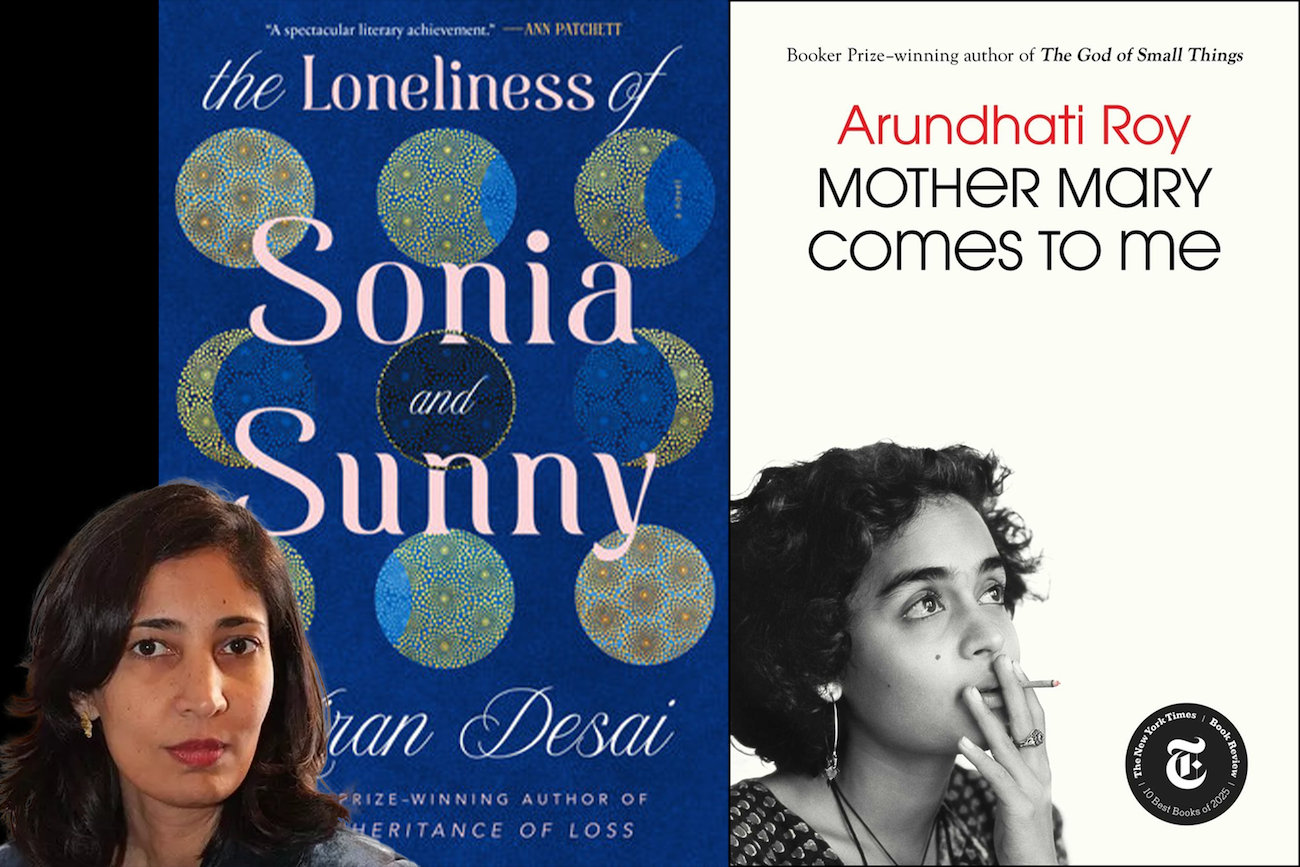

In a historic moment for Indian literature, two books by Indian women authors claimed spots on The New York Times’ prestigious Top 10 Books of 2025 list—announced on December 2, 2025. According to Kirkus Reviews, Kiran Desai’s sprawling novel The Loneliness of Sonia and Sunny earned a place in the fiction category, while Arundhati Roy’s powerful memoir Mother Mary Comes to Me was recognized in nonfiction.
The achievement is particularly remarkable because, according to Parade, only one book appeared on all three major year-end lists (The New York Times, Amazon, and Barnes & Noble): Desai’s The Loneliness of Sonia and Sunny. The novel’s universal critical acclaim cements Desai’s position as one of contemporary literature’s most significant voices.
For Indian literature on the global stage, 2025 represents a watershed year—with both a Booker Prize-winning novelist returning after nearly two decades and an acclaimed activist-writer venturing into memoir for the first time, both earning the highest American literary recognition.
Kiran Desai: Twenty Years in the Making, “Not So Much a Novel as a Marvel”
Published by Hamish Hamilton on September 23, 2025, The Loneliness of Sonia and Sunny marks Kiran Desai’s return to fiction after her 2006 Booker Prize-winning The Inheritance of Loss. According to The Irish Times, Desai spent nearly twenty years crafting this nearly 700-page epic, supported by “the steady counsel of her mother, the novelist Anita Desai.”
NPR perhaps best captured the achievement in October 2025: “It took Kiran Desai nearly 20 years to write her new novel, The Loneliness of Sonia and Sunny. I mean this as a sincere tribute when I say I’m amazed it only took her that long.”
According to Wikipedia, the novel takes place mostly between 1996 and 2002, following Sonia and Sunny, both Indian immigrants to the United States, who have a chance encounter on a train in India that leads to romance. Sonia is an aspiring novelist who recently completed her studies in Vermont but fears she is haunted by a dark spell cast by an artist to whom she had turned for intimacy and inspiration. Sunny is a struggling journalist in New York City attempting to flee his imperious mother and the violence of his warring clan.
Critical Acclaim: “Among Those Most Rarefied Books”
The New York Times Book Review’s Alexandra Jacobs wrote in what Book Marks characterized as a rave review: “Not so much a novel as a marvel…Here is sweet validation of the idea that to create something truly transcendent — a work of art depicting love, family, nature and culture in all their fullness — might take time…Where to begin analyzing these close-to-700 pages, not one extraneous or boring?”
Jacobs concluded her assessment with extraordinary praise, according to Book Marks: “Among those most rarefied books: better company than real-life people.”
The Washington Post called it “a magnificent saga,” describing the work as “as much question as it is narrative—an exploration of the way perspective alters perception, of the way reality itself may become malleable, shaped by dreams, stories and fears.”
Publishers Weekly, in a starred review, described it as “a sweeping page-turner” and “a kind of Romeo and Juliet story for a modern, globalized age.”
Kirkus Reviews declared it “a masterpiece” in a starred review, according to Penguin Random House.
The Boston Globe stated: “Lavish, funny, smart, and wise, this is a novel that will last.”
Pulitzer Prize-winning author Andrew Sean Greer provided perhaps the most personal endorsement, according to Penguin Random House: “The Loneliness of Sonia and Sunny achieves the ultimate of what a book should do: carry us away into other peoples’ lives, thinking as they think, feeling as they feel, until it comes around and shows us to ourselves. Grand, magnificent, intimate, more than wonderful, this is a novel you will hold close to your heart. I certainly did. I cannot recommend it enough.”
The simultaneous recognition of both Desai and Roy on The New York Times’ Top 10 list represents more than individual achievement—it marks a moment of global recognition for Indian women’s literary voices.
Arundhati Roy: Breaking Silence with “My Shelter and My Storm”
Arundhati Roy’s Mother Mary Comes to Me, published by Hamish Hamilton on August 28, 2025, marks the legendary novelist’s first foray into memoir. According to Simon & Schuster, the book traces Roy’s “complex relationship with her mother, Mary Roy, a fierce and formidable force who shaped Arundhati’s life both as a woman and a writer.”
According to Barnes & Noble and Simon & Schuster, Roy describes her mother as “my shelter and my storm.” The memoir was written after Mary Roy’s death in September 2022. Roy revealed she was “heart-smashed” by her mother’s death yet “puzzled and ‘more than a little ashamed’ by the intensity of her response,” which prompted her to write “to make sense of her feelings about the mother she ran from at age eighteen, ‘not because I didn’t love her, but in order to be able to continue to love her.'”
A Love-Hate Relationship with “Mrs. Roy”
According to New York Weekly Times, Roy and her brother came to call their mother “Mrs. Roy” far more often than any title resembling “mom.” Roy would later conclude she had grown up in “a cult, ‘a good cult, a fabulous one even,'” in which unquestioning obedience and displays of adoration of “the Mother-Guru” were required. “The only involuntary members, press-ganged into the ways of the cult, were my brother and I,” Roy writes.
Mary Roy fled her marriage to a man addicted to alcohol, took her young children to Kerala in southern India, and founded a school that was quite radical for its time. According to New York Weekly Times, Roy writes that her mother “was defiant in her belief that boys and girls should play and study and grow up together” and “made it her mission to disabuse boys of their seemingly God-given sense of entitlement.”
However, according to the same source, “beloved at the school, their mother was often demanding and abusive at home. In one searing account, Mrs. Roy beats her son bloody for his poor report card; Arundhati is praised for hers the next morning, causing complicated emotions in the young student.”
At age 18, Roy cut ties with her mother and didn’t see her again for years, according to New York Weekly Times.
Critical Reception: “A Masterpiece of Memoir Writing”

The Minneapolis Star Tribune, according to Barnes & Noble and Amazon, called it “cinematic…dense with the lyrical language, deep empathy and fierce social critique that have made Roy’s novels international bestsellers…a masterpiece of memoir writing, a rich tapestry of memory, reckoning and longing.”
The New York Times Book Review, praised Roy for channeling “warmth, moral clarity and a sweeping bird’s-eye view of modern India to tell her life story, which was shaped by poverty, violence, political upheaval and—most of all—the volatile single mother who raised her.”
NPR.org noted: “Roy turns inward to reflect on a complicated relationship with her late mother, herself an activist, whose barbed love of Roy and her brother could by turns sustain and devastate.”
Town & Country called it “the first memoir from legendary novelist Arundhati Roy [that] tackles her complicated, fascinating relationship with her mother and how it shaped almost every part of her life.”
According to Amazon: “In electrifying, intimate prose, Roy’s first memoir traces her complex relationship with her mother, Mary and how it shaped the person—and writer—she ultimately became.”
Awards and Recognition Beyond The New York Times
According to Simon & Schuster, Amazon, and Barnes & Noble, Mother Mary Comes to Me was:
- Named a New York Times Notable Book of 2025
- Finalist for the Kirkus Prize
- Longlisted for the National Book Critics Circle Award in Autobiography
- Finalist for the Barnes & Noble Book of the Year
- Named a Best Book of the Year by The New Yorker, Time Magazine, The Guardian, NPR, LitHub, The Economist, BookRiot, Mother Jones, BookPage, Booklist, Minnesota Star Tribune, Apple Books, Amazon, The Times (UK), and the Independent (UK)
A Shared Triumph: Indian Women Writers at the Pinnacle
The simultaneous recognition of both Desai and Roy on The New York Times’ Top 10 list represents more than individual achievement—it marks a moment of global recognition for Indian women’s literary voices tackling themes of identity, displacement, family complexity, and the immigrant experience.
Both authors share fascinating parallels: daughters of notable figures (Desai of novelist Anita Desai, Roy of educator Mary Roy), both grappling with complex maternal relationships, both exploring what it means to navigate between Indian and Western identities, and both taking extraordinary time to craft their 2025 releases—Desai spending nearly twenty years on her novel, Roy waiting decades to write memoir.
According to Book Riot and Parade, The New York Times’ selection process was rigorous, with editors Gilbert Cruz and colleagues narrowing down from 100 notable books to these ten titles. That two Indian women writers claimed spots among the five fiction and five nonfiction selections speaks to the extraordinary quality of their work and the hunger among readers for voices that capture the complexity of modern, globalized identities.
This story was aggregated by AI from several news reports and edited by American Kahani’s News Desk.