


What Does ‘Dhurandhar’ Mean? A Hanuman Jayanthi Reflection On a Lesser Known Epithet of Hanuman

- How do I make sense of this movie as a viewer, a student of media and pop culture, and of course, a Hanuman-bhaktha noticing some coincidences? I would say that it’s a phenomenon.
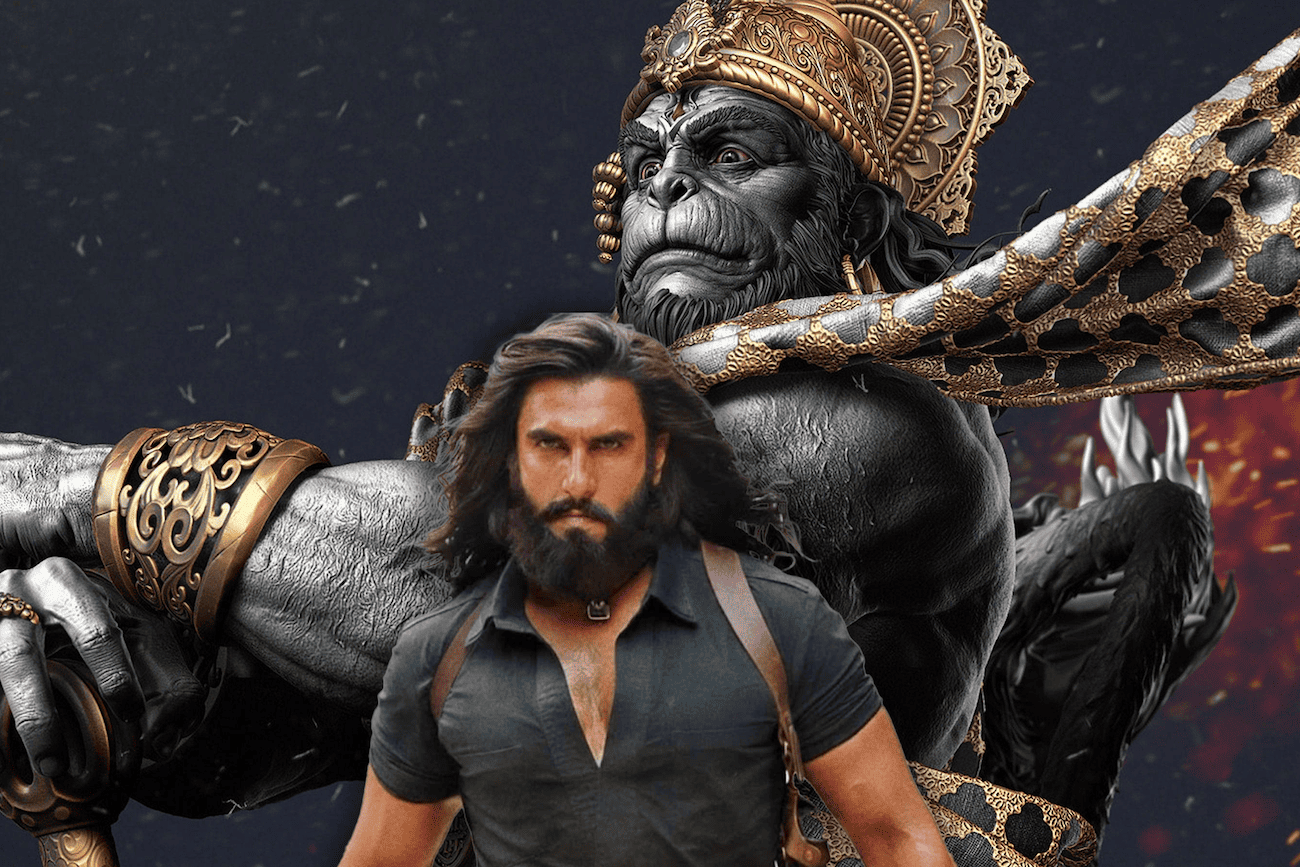

On this Hanuman Jayanthi (Chaitra Purnima), it seems befitting to note that the only time I had heard the word “Dhurandhar” before the cinematic spectacle came our way was in the 108th name of the Hanuman Ashtothara (108 names of Hanuman):
“Om Sita Sameta Sri Rama Pada Seva Dhurandharaaya Namaha.”
Before I talk about the movie or its reception by fans and critics, I would like to draw our attention to the form, substance, and indeed, the power of its name. “Dhurandhar” has newness going for it. It’s not a word you hear every day, as they say. Its form has evocative power; sonic shades of “thunder,” frankly, but landing even harder, just as the “dha” is struck slightly harder in our mouths than “tha” (a nod to phonetics and the anatomical nuances of the Sanskrit alphabet). Thousand times thunder, one might say; and it certainly feels that way after the experience of watching the movie.
The movie, as far as I recall, does not quite get into the meaning of the name, nor its association with Hanuman. It features well-placed quote-cards from the Bhagavad Gita, exhorting valor, sacrifice, and the like, and making for an interesting sensory experience. If war movies rested on vocalized war cries (like “Har Har Mahadev!” or “Jai Bhavani!”), it was unusual to see literacy being centered thus. But Hanuman, somehow, seems to be my gatekeeper as far as understanding this cinema-sensation goes. The hero is really not being compared to any deity in the movie, and at best one might extrapolate that he is the equivalent of Arjuna, given the Gita quote, and by extension, his genius-handler, the sutradhar, the spy-chief played by actor Madhavan, is his Krishna of sorts, exhorting him to duty, action, greatness.
Psycho-Political Thunderstorm
But what does Dhurandhar mean? The movie, the commercial and emotional and psycho-political thunderstorm around it — and of course, the name of a God, in these ungodly, anti-godly, times of crime and violence and terror in war – in cinema and reality?
Anglophone translations of the movie’s title have offered words like “expert” or “virtuoso” or “leader.” Sanskrit experts have explained it with more precision: “one who bears the weight, or burden, or yoke.” The character’s arc through the movie, his excruciating family losses, his vendettas, his redemption-opportunity and training, his heroic (and strategic) battles in the enemy’s heartland, his physical pain, and his inability to “come home” to either of his families in a way, all make the word’s onerous implications an appropriate choice. Patriotic Indian viewers won’t help feeling a sense of compassion and gratitude for all the real-life “dhurandhars” who take on the job of protecting the country, whether they are soldiers or spies.
There are also some humorous takes going around Telugu social media sites on the unintended bilingual pun in the title: “andar” is “inside” in Hindi, and “dur” is “sneak in” in Telugu; which is what the movie is all about, anyway.
Of course, there are also some humorous takes going around Telugu social media sites on the unintended bilingual pun in the title: “andar” is “inside” in Hindi, and “dur” is “sneak in” in Telugu; which is what the movie is all about, anyway. To quote the political slogan referenced in the movie, it’s the new Bharat, “ghar me ghusega, aur maarega.” “It’s a new India, we will force our way into your homes, and we will kill you” (a reference to the film’s historic-political premise that past Indian governments failed to act against Pakistan-based terrorists unlike the current one).
Hanuman devotees might of course see shades of another Ramayana episode here, with the hero’s ability to take on both “sukshma rupa” (invisible, undercover), and “vikata rupa” (extraordinary, terrifying) and setting fire to the whole city as it were. Of course, the streets and concrete sprawls of Karachi are not the beautiful landscapes of Ravana’s Lanka (though the mysterious “Bade Saab” who orders even the ISI around lives in an opulent mansion that could match the Sundara Kanda’s descriptions perhaps). Of course, there is no Sita, or Rama, or Ramayana here. There is a name from the garland we place at the feet of Hanuman, and there is a stupendous, stupefying, cinematic sensation around it.
Is It Propaganda?
So how do I make sense of this movie as a viewer, a student of media and pop culture, and of course, a Hanuman-bhaktha noticing some coincidences? I would say that it’s a phenomenon. It deserves all the commentary and attention (and box office rewards) it is getting. As for the criticism, that too is useful — as a media educator, I must say that I have never seen so many people argue about what the word “propaganda” means so passionately around any other movie in recent times. But that debate is a complex one, involving nations, religions, political parties, contested histories and claims and counterclaims about causalities (and of course the “casualties” of such histories). It deserves a different and longer discussion perhaps.
For now, I would like to conclude though with a question for all who are thinking about “Dhurandhar” and “Dhurandhar 2” in relation to that poetic, sweeping, 108th name of adoration for Hanuman. Sitasameta Ramapadaseva Dhurandharaya Namaha. Paintings and images of Hanuman sitting in Rama’ victorious court after their return to Ayodhya come to mind. Rama and Sita sit on the throne. Lakshmana, Bharata, Shatrughna, stand by their side. Hanuman sits by Rama’s feet, and holds one foot up in his palm. Dozens of courtiers, demigods, citizens, populate our vision of this happy, glorious ending. Like a thousand Indian movies, the word “Shubham,” comes to mind, a happy ending, with good things for all. A happy family reunited, a happy kingdom with peace and prosperity for all.


“Dhurandhar,” the movie, has Hanuman energy in a way for sure. The man is strong, fearless, righteous, capable of almost single-handedly entering the enemy’s lair and burning it all down (and doing a lot of this through mastery of breath, a thoughtful yogic detail indeed crafted carefully by the filmmakers). All of this makes for a great war movie of sorts, a peculiar onto-epistemology of “fantasy-revenge” for “reality-grievance” (and not to downplay that grievance at all, from 1993 to 2008 and most recently the Pahalgam massacre; that these mortal wounds haven’t fully proved fatal to all is maybe Hanuman’s sanjeevani mahima at play still). But then, the gap in this movie, and perhaps more so, the sensation around it, is best expressed by a Telugu saying which describes absences; “devudu leni gudi,” like a temple without a God.
Who is the Rama whose pada our “dhurandhar” serves? Sure, “country” and “leaders” is one sort of answer that seems to run its course in the story. But what would Hanuman see, what does Hanuman still see, the Chiranjeevi, the protector, the maha-dhurandhara, in a world of greed and violence, that keeps him, and us, still going?
To put it more succinctly, the question remains, for fans of cinema, for citizens of India and Pakistan, and indeed the world: how far do we run with what we have if we cannot see Rama’s, or to be precise, Sita and Rama’s feet? What is the vision, or ideal, or reality, even, that a billion vicarious-heroism-infused Jaskrit/Hamzas are fighting for, even if for now only in their keystrokes or thoughts?
Jai Hanuman, Jai Sita Rama. May the end of all bloody wars and “Dhurandhars” be peace and happiness only.
Vamsee Juluri is Professor of Media Studies, University of San Francisco. He is the author of “Becoming a Global Audience: Longing and Belonging in Indian Music Television” (Peter Lang, 2003), “The Mythologist: A Novel” (Penguin India, 2010), and “Bollywood Nation: India through its Cinema (Penguin India,” 2013), “Rearming Hinduism: Nature, Hinduphobia and the Return of Indian Intelligence “ (BluOne Ink, 2024) and “The Guru Within” (in progress).