


They are Not Just Bombing Nuclear and Missile Sites—They are Committing a Crime Against Civilization

- The same politicians who invoke “Western civilization” in their speeches cannot find a single word for what is being done to one of the oldest civilizations on earth.
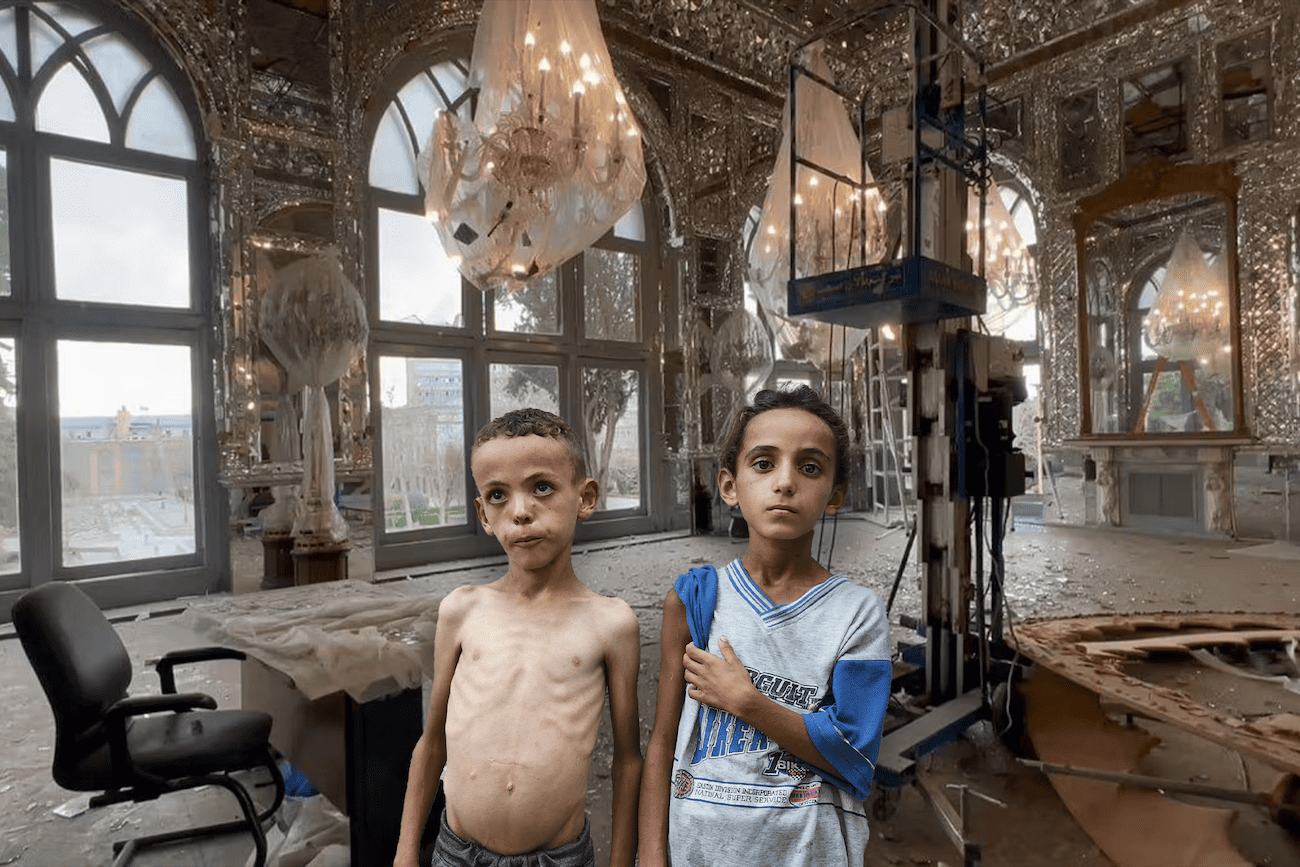

This piece had to be written. It has been waiting to be written — since November 2023. Maybe longer. Maybe for ten to fifteen years. I was not afraid of writing this for fear of labels. I was hesitant mostly because I had to make sure this doesn’t come across as a piece from the activist side in me. This is the first part of a two-part series. So be patient, and read until the end of part two, which will be published in the next few days. If you disagree with my presentation, I would like a healthy exchange in the comments section. — The Author
There is a sentence that changed how I think about power.
In March 2001, after the Taliban dynamited the Buddhas of Bamiyan — two towering sixth-century statues carved into the cliffs of Afghanistan — the Director-General of UNESCO called it “abominable to witness the cold and calculated destruction of cultural properties which were the heritage of the Afghan people, and, indeed, of the whole of humanity.” The world agreed. Editorials were written. The UN Security Council condemned it. The act was unanimously framed as what it was: a crime against civilization.
Twenty-five years later, the Chehel Sotoun Palace in Isfahan — a 17th-century monument whose frescoes depict Persian mythology and royal history, whose mirrored ceilings have reflected candlelight for four centuries — has had those mirrors shattered by shockwaves from American and Israeli bombs. The Golestan Palace in Tehran, a UNESCO World Heritage Site, has had its archways broken and its glass-mosaic walls blown out. The Masjed-e Jame, Iran’s oldest Friday mosque, reflecting over a millennium of Islamic architectural evolution, has had turquoise tiles shaken from its walls. The Khorramabad Valley — containing caves with evidence of human habitation dating to 63,000 BC — is in a combat zone.
UNESCO has verified all of this. They had even provided the geographical coordinates of these sites to all parties in advance, asking for precautions to be taken.
The IDF said it was “unfamiliar” with the claims of damage.
Where is the sentence? Where are the editorials? Where is the wall-to-wall coverage, the emergency Security Council session, the unanimous international condemnation? Where is the language — the word “abominable,” the phrase “crime against humanity’s shared heritage” — that came so readily in 2001?
It has not come. And that silence is the subject of this essay.
The Civilization the World Forgot to Defend
Let me be precise about what is being damaged, because precision is the antidote to abstraction.
Isfahan was made the capital of the Safavid Empire in 1598. At that moment, most of North America was uninhabited forest. The city’s bridges, palaces, cathedrals, bazaars, and the great Naqsh-e-Jahan Square — one of the largest public squares in the world — were built during what Iranians call their cultural golden age, a period of art, poetry, science, and architecture that rivaled the Italian Renaissance and predated it in several disciplines. The city has been called, by architects who have studied it across centuries, one of the most beautiful ever built by human hands.
Persepolis was constructed in 515 BC. To put that in context: it predates the Roman Republic by a generation, predates Athens’ golden age, predates Alexander the Great, whose armies eventually burned it down in 330 BC — an act Alexander himself later called his greatest regret. What survived that fire has survived 2,500 years. It is now within range of modern munitions.
Baalbek’s Temple of Jupiter, in the Bekaa Valley of Lebanon, is older than the Colosseum and, in the judgment of many archaeologists, more impressively engineered. Its stones are among the largest ever used in human construction. In October 2024, Israeli strikes fell hundreds of meters from its columns. The Palmyra Hotel, which stood directly opposite the Roman ruins, had never closed its doors in 150 years — through Lebanon’s civil war, through Ottoman collapse, through both World Wars. Albert Einstein had stayed there. Fairuz had sung there. The Declaration du Grand Liban establishing Lebanon’s modern borders was signed within its walls. An Israeli airstrike in November 2024 finally did what a century and a half of history could not: blew out its doors and forced it closed for the first time.
The silence is not neutral. Silence in the face of verified war crimes, documented cultural destruction, and institutional findings of genocide is itself a position. It is a choice about whose civilization counts, whose children’s deaths require urgent language, and whose do not.
On November 6, another strike destroyed an Ottoman-era building on the edge of the Baalbek temple complex — a structure Lebanon’s Ministry of Culture had planned to convert into a cultural centre. Lebanon’s caretaker Culture Minister Mohammad Mortada called the attacks on these sites “a war against culture and, by all means, a war crime.”
Now hold those images — the shattered mirrors of Isfahan, the closed doors of the Palmyra Hotel — and set them next to this: When ISIS destroyed Palmyra in Syria in 2015, emergency UN Security Council sessions were convened within days. Global op-eds ran for weeks. World leaders competed to express their horror. When Russia struck Ukrainian cultural sites after 2022, Western leaders named and condemned it within hours, in coordinated statements that treated cultural destruction as a war crime requiring immediate political response.
The same leaders who called Bamiyan “a crime against all humanity” have, at most, issued monitoring statements about Isfahan. The pattern is not subtle. When brown people destroy heritage, it is barbarism. When Western allies do it, it is collateral damage.
This double standard is not a feeling. It is a comparison of institutional records, dated and timestamped. And it demands an explanation — which I will attempt in Part 2. First, though, we have to look directly at what is being lost: not just the monuments, but the people.
Behind the Monuments
According to the Norwegian Refugee Council, within the first ten days of the current escalation in Lebanon, 816,000 people — one in every seven Lebanese — have been displaced. In a nation of five million. Ten days.
The people being killed are not who Western media’s reflexive shorthand implies. On March 9, 2026, Father Pierre al-Rahi — a Maronite Catholic priest in Qlayaa, a Christian village of 8,000 people in southern Lebanon — heard that a house in his village had been struck by an Israeli tank. He ran toward it to help the wounded. The tank fired again. Father al-Rahi died of his injuries.
Pope Leo XIV mourned him by name.
The village mayor told journalists: “They say there were fighters in the house, but that’s not true. These are lies. Inside, there were only the residents of the house and people from the village who came to help the wounded.”
The day before he was killed, Father al-Rahi had stood on the steps of his church and told France24: “We are forced to stay despite the danger, when we defend our land, and we do so peacefully. None of us carries weapons. All of us carry peace and goodness and love.”
This is a Maronite Christian priest. An ancient Christian village. The Pope mourning him by name. If the argument is that this military campaign is narrowly and surgically targeting Hezbollah militants, Father al-Rahi’s death — and the mayor’s three sentences — constitute its refutation.
He was not the only civilian killed that day. He will not be the last.
What Is Actually Happening to the Children
At some point, the abstraction has to stop. So let me give you the numbers as the UN recorded them.
As of February 2026, at least 75,000 Palestinians have been killed in Gaza, according to Gaza Health Ministry figures cited by the United Nations. Independent demographic researchers from the Max Planck Institute estimate this figure may undercount violent deaths by more than 40 percent, placing the real toll potentially between 100,000 and 126,000. Of officially documented deaths, roughly 30 percent are children. Scholars have estimated 80 percent of all Palestinian deaths were civilians. A study by the UN Office for Human Rights, cross-verifying fatalities from three independent sources, found that 70 percent of Palestinians killed in residential buildings were women and children.
Beyond the death counts are figures that are harder to hold in the mind.
According to UNRWA, by late 2024, more than 53,000 children in Gaza had lost one parent. Over 2,500 had lost both. These are children who will grow up — if they grow up — in a place where 88 percent of school buildings have been directly hit or severely damaged. Where 60 percent of hospitals are non-functional and the rest barely operational. Where, according to field reports from international doctors, a three-year-old girl was brought into an emergency ward with the left side of her forehead torn open by shrapnel and was treated with almost no painkillers because there are none. Where women undergo cesarean sections without anesthesia. Where, as the UN Security Council was told in late 2023, mothers in Gaza said they prayed for peace — but if peace did not come, they prayed for a quick death, in their sleep, with their children in their arms.
“It should shame us all,” the UNICEF Executive Director said at that briefing, “that any mother, anywhere, has such a prayer.”
The UNRWA Commissioner-General stated without euphemism: a man-made famine has been confirmed in Gaza Governorate. UNRWA’s warehouses in Egypt and Jordan are full — enough food, medicine, and hygiene supplies to fill 6,000 trucks. Israel has banned UNRWA from bringing any of it into Gaza since March 2025. Over 391 UNRWA staff have been killed since the war began. This is not a blockade failing to prevent aid from reaching people. It is a blockade succeeding at it.
Then there is what has continued after the ceasefire — the one that was announced with such fanfare in October 2025, photographed and praised and held up as evidence that diplomacy works.
According to OHCHR, in the first 44 days of that ceasefire, Israeli forces committed 497 violations and killed 342 Palestinians. By early March 2026, UNICEF reported that more than 100 children had been killed in Gaza since the ceasefire came into effect. In the West Bank, UN records show three Palestinians were shot and killed by Israeli settlers in a single day in early March 2026 — the sixth such settler killing of the year, in only ten weeks. Israeli settler violence in 2025 averaged five incidents per day — the highest level ever recorded — according to the UN Secretary-General’s own report. An average of two Palestinians were physically injured by settlers every single day throughout 2025.
Videos circulate daily — authenticated footage of settlers shooting Palestinians outside their homes, of men with their hands raised being shot, of families expelled from land their grandparents farmed. They are not exceptional moments captured by accident. They are, according to UN monitoring, the routine documentation of a routine system. To exist, in some of these villages, on some of these roads, in front of some of these people, appears to be treated as provocation enough.
Ceasefire. The word means something in international law. What it apparently means in practice in Gaza and the West Bank is a different tempo of the same violence — enough to escape the news cycle, not enough to stop the dying.
The youngest documented victim in Gaza in the first six months of the war was one day old.
The Record the World’s Institutions Have Already Written
I want to be precise about something before I close, because the most common response to everything above is: “But that’s your interpretation. That’s your politics.”
It is not.
Of officially documented deaths in Gaza, roughly 30 percent are children. Scholars have estimated 80 percent of all Palestinian deaths were civilians. A study by the UN Office for Human Rights, cross-verifying fatalities from three independent sources, found that 70 percent of Palestinians killed in residential buildings were women and children.
In November 2024, the International Criminal Court issued arrest warrants for Israeli Prime Minister Benjamin Netanyahu and former Defense Minister Yoav Gallant. The Pre-Trial Chamber found reasonable grounds to believe that both men intentionally deprived Gaza’s civilian population of food, water, medicine, and fuel — that these deprivations were calculated to destroy part of the civilian population — resulting in deaths from malnutrition and dehydration that constituted war crimes and crimes against humanity. All 125 ICC member states are legally obligated to arrest them if they enter their territory.
In September 2025, the United Nations Independent International Commission of Inquiry concluded that Israel’s actions in Gaza meet the legal definition of genocide, finding evidence of four of the five acts defined by the 1948 Genocide Convention.
In July 2024, the International Court of Justice ruled that Israel’s occupation of Palestinian territory is illegal, that the Israeli state is conducting a policy of apartheid, and that it must cease settlement activities and withdraw.


Human Rights Watch documented that strikes killing civilian relief workers and journalists in Lebanon used American-manufactured JDAM guidance kits, and stated plainly: “Israel’s assurances to the United States that it is abiding by the laws of war ring hollow.”
The ICC is not a protest organization. The UN Commission of Inquiry is not a blog. These are findings by the institutions the world built after World War II — specifically, explicitly, to prevent this kind of thing from happening again. They have now found that it is happening again.
What makes all of this harder to dismiss as overcaution is what the architects of these campaigns have said themselves, on camera, in prime time. Former Defense Minister Yoav Gallant — who holds an active ICC arrest warrant — told Israeli Channel 12 that the stated objective is total:
“We do not stop until Iran’s last military capability. Launchers, missiles, bases, headquarters, military leadership, political leadership, everything.”
On Lebanon, he called for strikes on Beirut, Baalbek, Tyre, Sidon, and Nabatieh — named civilian cities — and confirmed, on live television, that for every bomb Israel drops, American forces drop two or three.
Read that last sentence again.
A man holding an ICC arrest warrant, describing the complete elimination of a nation-state’s leadership as a war objective, and confirming that the United States is the majority partner in the bombing. Not a leaked document. A public statement, prime time, Israeli national television.
These are not allegations. They are findings, verdicts, casualty counts, and public declarations. They are a record.
The question that record raises — why do Western governments keep enabling this, regardless of what institutions find, what the public wants, or what the law requires — is what Part 2 attempts to answer.
The Silence Is Not Neutral
Let me end where I began: with the question of language, and who gets to use it.
When the Buddhas of Bamiyan fell, the world found words quickly. When ISIS destroyed Palmyra, the world found words quickly. When Russia struck Ukrainian cultural sites, the world found words quickly. There is no shortage of moral vocabulary when it comes to destruction — provided the destroyers are the right kind of enemy.
But Isfahan has stood since 1598. Baalbek’s temples have stood for two thousand years. Persepolis was built in 515 BC — before Rome was a republic, before Athens reached its golden age, before Alexander the Great was born. These are not Iran’s treasures or Lebanon’s treasures. They belong to all of us, to every human being who came after the people who built them, as evidence of what our species is capable of when it is not at war.
They are being damaged now, in 2026, by bombs manufactured in American factories, delivered by aircraft sold with American money, in campaigns that have received uninterrupted American political support. And the same politicians who invoke “Western civilization” in their speeches cannot find a single word for what is being done to one of the oldest civilizations on earth.
The silence is not neutral. Silence in the face of verified war crimes, documented cultural destruction, and institutional findings of genocide is itself a position. It is a choice about whose civilization counts, whose children’s deaths require urgent language, and whose do not.
A three-year-old girl. The wrong forehead. Almost no painkillers.
A priest on the steps of his church, the day before he died: “None of us carries weapons. All of us carry peace and goodness and love.”
One day old.
These are not statistics. They were people.
Part 2 — “When the Bombs Have American Flags” — asks the structural question this post leaves open: why do liberal democracies, across administrations and across decades, keep making these choices in defiance of their own stated values, their own public opinion, and the findings of their own international institutions? Drawing mostly on the documented history of American intervention in the region and the work of an economist, Part 2 argues that what looks like hypocrisy is actually something more consistent, and more troubling, than that.
(Top image: A composite photo of a shattered UNESCO World Heritate site in Iran, background, and children of war-torn Gaza,)
Ganpy Nataraj is an entrepreneur, author of “TEXIT – A Star Alone” (thriller) and short stories. He is a moody writer writing “stuff” — Politics, Movies, Music, Sports, Satire, Food, etc.