


The Violence of Uniformity: ‘Parasakthi’ Reminds Us Hindi Hegemony is Not a Historical Artifact But a Recurring Force

- Appearances by actors from other linguistic regions are brief but meaningful, suggesting that what unfolds in Parasakthi is not a regional dispute but an early confrontation with cultural centralization.
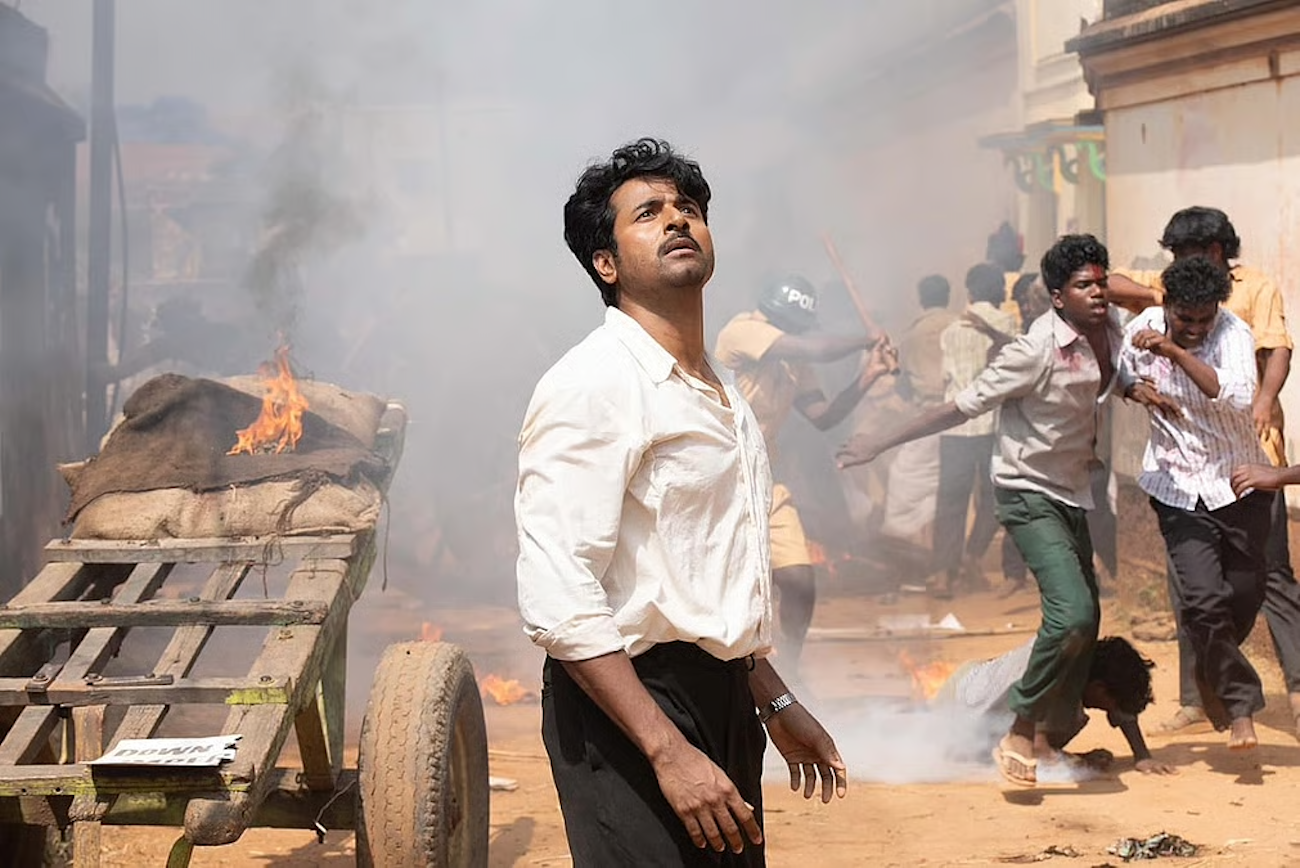

I walked into Parasakthi expecting a political period film. I walked out realizing I had watched many of the stories I grew up hearing finally acquire faces, voices, and consequences. Sudha Kongara’s film is rooted in history, but it refuses to stay there. It reaches into the present, insisting that the past it portrays is neither distant nor settled. This review looks at Parasakthi as political cinema, lived memory, and a film whose resonance clearly extends far beyond the screen.
History as Unfinished Business
Cinema, at its most potent, is not merely a reflection of reality but an interrogation of it. It functions as a repository of collective memory—a space where unresolved histories resurface to argue with the present. Parasakthi is precisely this kind of cinema. It refuses to be a passive chronicle of the anti-Hindi imposition movement in Tamil Nadu and instead emerges as a visceral, intellectual, and deeply emotional critique of cultural and political hegemony disguised as linguistic uniformity.
By rooting its narrative in the turbulence of the 1960s, the film feels uncannily contemporary. Its anxieties—about federalism, identity, and the violence of enforced sameness—echo loudly in present-day India. Parasakthi treats history as unfinished business, something that has a habit of returning when conditions repeat.
The title itself is a deliberate provocation. It recalls the landmark 1952 film written by M. Karunanidhi, a foundational work of Dravidian cinema that treated film as ideological intervention. By reclaiming the title, Sudha Kongara signals exactly where this film stands—politically, historically, and cinematically. She places her work within a lineage of political cinema that views art as resistance. Unlike the theatrical oratory of early Dravidian films, however, Parasakthi adopts a modern cinematic grammar, allowing images, sound, and rhythm to carry much of the ideological weight.
At the narrative center is Chezhiyan, portrayed with remarkable restraint by Sivakarthikeyan, leader of the Purananuru Squad. The name itself is inspired—an invocation of Purananuru, the ancient Tamil poetic corpus celebrating valor, ethics, and public life. Chezhiyan is no chest-thumping revolutionary. He is introspective, burdened, and acutely aware of the moral cost of leadership. When tragedy strikes and he dissolves the movement, the moment plays not as defeat, but as moral exhaustion.
The film’s most compelling inquiry begins after this retreat. Chezhiyan’s decision to work for the Indian Railways—a central government institution—functions as a potent metaphor for assimilation. Often romanticized as the veins of national unity, the Railways here represent the soft machinery of ideological absorption. Through Chezhiyan’s silence, Parasakthi critiques the middle-class instinct to trade resistance for stability. Yet the film resists easy judgment. Political quietude is treated as temporary—a hibernation waiting for the right spark.
That spark arrives in the form of Chinnadurai, Chezhiyan’s younger brother.
Played with combustible intensity by Atharva, Chinnadurai embodies the raw, unfiltered anger of the movement—what Chezhiyan once was. Their relationship mirrors generational cycles within political struggles, each wave inheriting both the trauma and unfinished business of the last. Chinnadurai’s fight unfolds against the charged atmosphere of Annamalai University in Chidambaram, portrayed as a space where ideas are sharpened, tested, and set on fire.
The historical killing of student Rajendran in 1965 is woven into the narrative with devastating precision. This is not a passing reference for the historically informed but a narrative hinge that transforms abstract ideology into irreversible loss. Rajendran’s death is staged not as remembrance, but as provocation—pushing both Chezhiyan and the viewer toward anger.
Power, Politics, and the Price of Uniformity
One of the film’s most electrifying sequences unfolds on the streets of Delhi, where Chezhiyan confronts Indira Gandhi, then the Information and Broadcasting Minister under Prime Minister Lal Bahadur Shastri. The scene takes creative liberties, but it functions as a crucial emotional and ideological bridge to the film’s climax. It is here that Chezhiyan articulates the film’s central idea: uniformity masquerading as unity.
This tension feels particularly resonant today. Uniformity is once again being positioned as a prerequisite for unity, often at the expense of federalism and cultural autonomy.
Crucially, the Delhi sequence is written not as moral triumph but as political negotiation. Indira listens. She probes. And then she offers the movement a chance—to prove the breadth of its support. The film is perceptive enough to suggest that her motivations are not entirely altruistic. Yet this ambiguity is precisely what gives the moment its power. Kongara refuses to sanctify politicians. Instead, she presents Indira as an intelligent political operator who understood that outright suppression could be riskier than controlled accommodation.
This exchange lifts Parasakthi above agitprop. It recognizes politics as chess rather than sermon—where ideology collides with pragmatism, and language becomes both weapon and leverage.
Opposing the movement is the antagonist played by Ravi Mohan, in one of his most unsettling performances. He is not driven by linguistic hatred, but by a bureaucratic belief in uniformity as a prerequisite for unity. This distinction matters. It transforms the conflict from a linguistic rivalry into a philosophical war. His worldview is chilling precisely because it is rationalized, procedural, and disturbingly familiar.
The Pollachi massacre—evoking the trauma of Jallianwala Bagh—is staged to provoke anger and moral disgust. Historically under-documented, the event gives Kongara narrative space to draw from collective memory. The violence is observed with restraint, forcing the audience to confront not just what happens, but why it is allowed to happen. Order must be maintained. Dissent must be silenced. The cost, the state tells itself, is regrettable but necessary.
Visually, cinematographer Ravi K. Chandran constructs a powerful emotional language. Early student-movement sequences glow with earthy warmth, rooting resistance in land and culture. Scenes involving central authority shift to sterile blues and grays, emphasizing institutional detachment. By the climax, these palettes collapse into fire and chaos—a visual rejection of imposed binaries.
G. V. Prakash Kumar’s score complements this restraint. While capable of anthemic power, the music frequently pulls back, allowing silence and slow-building tension to do the work. The result is a soundscape that amplifies emotion without dictating it.
The film’s period authenticity—through art direction and costume—grounds the narrative without romanticizing it. This is not sepia nostalgia. It is a volatile present.
Perhaps the film’s most quietly radical choice is Ratnamala, played by Sreeleela, a Telugu woman living in the neighborhood. By giving one of the film’s clearest articulations of resistance to a non-Tamil speaker, Kongara dismantles accusations of linguistic chauvinism. Her radio monologue becomes the film’s ideological keystone. This was never about refusing to learn a language; it was about refusing coercion. The fight was against imposition and loss of identity—not plurality.
Confrontation with Cultural Centralization
The ensemble and cameos reinforce this wider framing. Appearances by actors from other linguistic regions are brief but meaningful, suggesting that what unfolds in Parasakthi is not a regional dispute but an early confrontation with cultural centralization.
The film’s political sharpness is also evident in its depiction of Dravidian leadership and the Congress establishment of the time. Arignar Anna and Kalaignar Karunanidhi are portrayed not merely as orators, but as strategists who understood language as both weapon and shield. In contrast, the Congress government in Tamil Nadu appears reactive, its authority diluted by obedience to Delhi. K. Bhaktavatsalam emerges less as a villain than as a cautionary figure—history would later confirm that he would be the last Congress Chief Minister the state would ever have.
Structurally, Parasakthi mirrors the rhythm of protest itself—build-up, rupture, silence, return. Kongara resists the neatness of a conventional three-act arc, opting instead for something cyclical, appropriate for a historical narrative. Chezhiyan’s arc bends backward, drawn once again into leadership by circumstances he can no longer ignore.


Memory, Inheritance, and a Living Audience
For me, Parasakthi also lands as something deeply personal.
I grew up in a household shaped by a political ethos that viewed anything imposed—especially language—as inherently suspect. Ironically, that belief never translated into linguistic hostility. I learned Hindi not through compulsion but curiosity, earning my Visharadh certification from the Dakshin Bharat Hindi Prachar Sabha, encouraged by my parents—especially my father.
My late father studied engineering at Annamalai University between 1963 and 1969, during the peak of the agitation. Rajendran, the student martyr whose death the film references, was his neighbor in the hostel wing. Though my father never claimed a revolutionary mantle, he participated in the protests and lived through a time when ideology was not abstraction but daily reality. Many of the stories I grew up hearing were anti-Hindi imposition stories—of fear, conviction, confusion, and resolve.
Watching Parasakthi, those stories stopped being oral history. They acquired faces, voices, and blood.
What struck me most, however, was how the film moved beyond history and personal memory into the present moment of collective response. I watched Parasakthi on its first day, first show, in Michigan. Two screens were running simultaneously. The larger hall was half-full, which in itself said something. What mattered was what followed. As the credits rolled, the hall broke into applause. Cheers followed—not polite or obligatory, but instinctive. The kind that comes from recognition.
It became clear then that Parasakthi had escaped the confines of critical evaluation. This was not a film whose life would be determined solely by how craft was dissected or politics classified. It had touched something raw among those who care about linguistic dignity, and among those who recognize Hindi hegemony not as a historical artifact but as a recurring force in quieter, bureaucratic forms.
That response, thousands of miles away from Tamil Nadu, said something important. Parasakthi is not only about a past agitation; it speaks to an unresolved present. The applause was not for spectacle or heroism. It was for articulation—for a feeling that still lacks comfortable expression.
At its core, Parasakthi argues for the right to live without being reshaped by force. It does not argue against learning languages. It argues against forgetting how power speaks through them. It argues against Hindi hegemony—the very crux of the student movement that eventually prevailed.
The reaction in that theater made one thing unmistakably clear: this story is not finished.
The past does not stay buried. It waits. And when conditions repeat, it returns—not asking to be remembered, but demanding to be answered.
Ganpy Nataraj is an entrepreneur, author of “TEXIT – A Star Alone” (thriller) and short stories. He is a moody writer writing “stuff” — Politics, Movies, Music, Sports, Satire, Food, etc.