


Before the Model Minority: The Forgotten History of South Asian Migration to America

- We are in the month when America is asked to remember what it prefers to forget about Black history. South Asian America has its own forgetting to reckon with. The two are not separate acts.
Long before 1965 brought doctors and engineers, South Asians were sailors, farmers, and revolutionaries — erased by policy and memory alike.
Part One – The Erasure
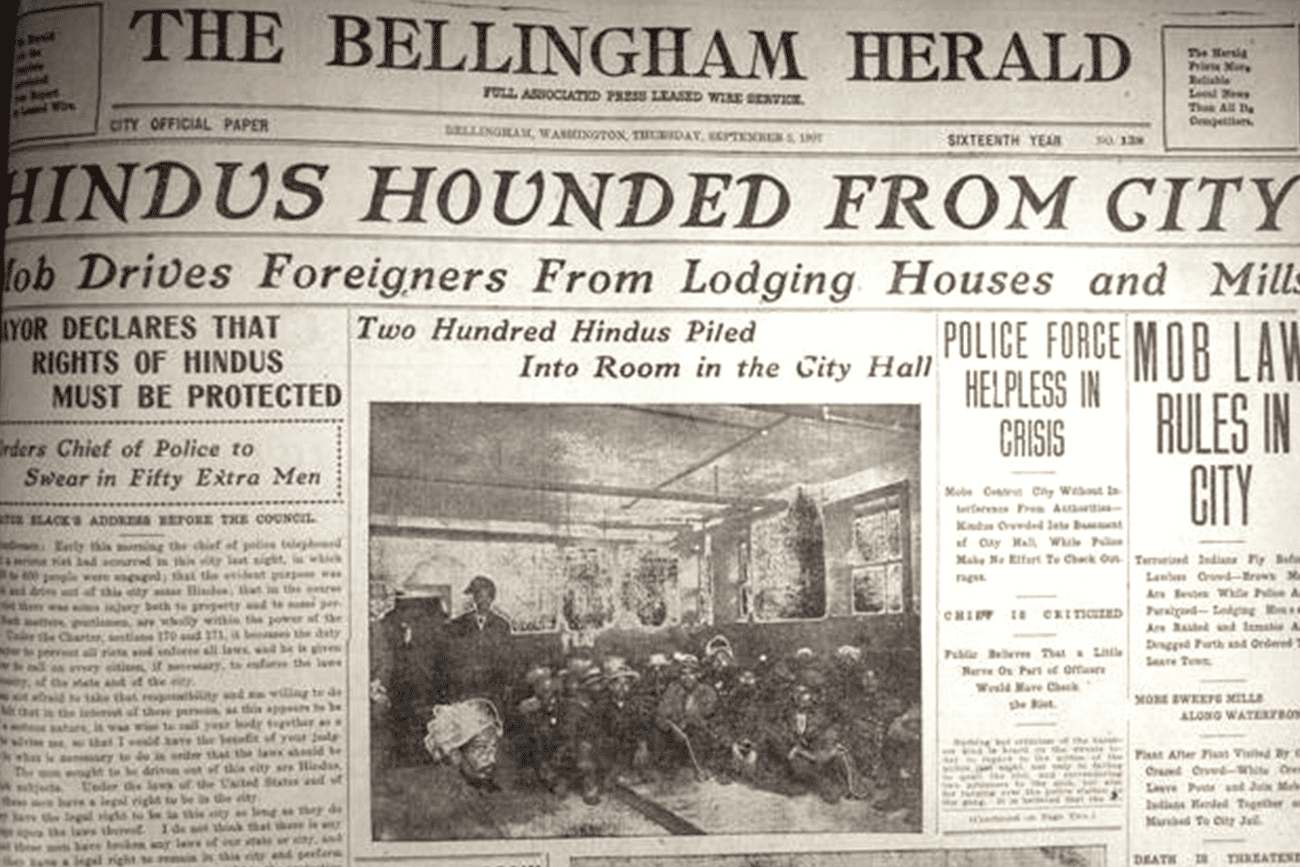
In September 1907, white mobs stormed through the lumber town of Bellingham, Washington, dragging Sikh workers from their boarding houses and forcing them onto trains headed out of the city. The newspapers called them “Hindoos.” These men had been in America for years, felling timber, sending money home, and navigating a country that did not quite know what to do with them. That night, under threat of violence, they were expelled from the lives they had built.
This is not where the story of South Asian America usually begins. The dominant narrative starts in 1965. That starting point hides something. It hides the fact that South Asian America was first shaped not by opportunity, but by exclusion.
The First South Asians in America
Long before the immigration gates opened for professionals, South Asians were already woven into the American landscape — not as elites, but as laborers navigating a country that had no coherent place for them. On the West Coast, thousands of Punjabi Sikh men arrived in the early 20th century, drawn by the same industrial expansion that was pulling workers from across the globe. They found work in the lumber mills of Washington and Oregon, felling timber in forests that did not belong to them, in a country that had not yet decided whether they belonged in it either. Further south, in California’s Imperial Valley, they became indispensable to the agricultural economy, working land they could not legally own. In these rural communities, cut off from the families and villages they had left behind, many Punjabi men built new lives in unexpected directions — marrying Mexican-American women, raising bicultural children, creating communities that existed in the margins of two cultures simultaneously.
The West Coast story was not the only one. On the East Coast, Bengali Muslim sailors — lascars, in the language of the colonial shipping trade — had been jumping ship in port cities like Baltimore and New Orleans since the late 19th century. They were men who had crossed oceans in service of an empire that did not consider them its subjects in any meaningful sense, and who chose, at the first opportunity, to disappear into something else. They slipped into the social fabric of established African American neighborhoods, finding in those communities a foothold that the wider country refused to offer. The geography of their settlement was not accidental. It reflected a shared position at the bottom of the same racial order.
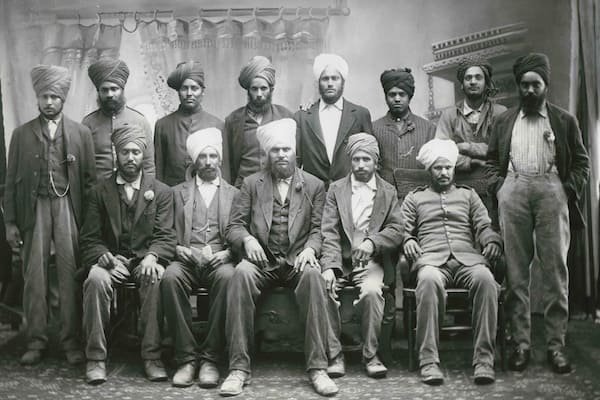
Across the country, these disparate people — Sikh, Muslim, Hindu; Punjabi, Bengali, Tamil — were flattened into a single category. Immigration officials and newspapers called them “Hindoos,” a label that was inaccurate in almost every case and useful precisely because of that inaccuracy. It did not describe them. It contained them. It marked them as racially ambiguous, perpetually foreign, and therefore permanently outside the boundaries of belonging that the country was in the process of drawing. They were here, they were working, they were building lives — and none of that was sufficient to make them legible as anything other than a problem to be managed.
When Whiteness Became a Verdict
The precarious position of early South Asian migrants was not just a matter of social prejudice; it was soon codified into law. For decades, the central question for South Asians in America revolved around a simple but profound issue: could they become citizens? The answer would ultimately come from the nation’s highest court.
In 1923, Bhagat Singh Thind, a U.S. Army veteran and a high-caste Indian, stood before the Supreme Court. He argued that as a “Caucasian” according to anthropological classifications of the time, he was eligible for naturalized citizenship. The court’s decision in United States v. Bhagat Singh Thind was a landmark blow. The justices unanimously ruled that while Thind might be anthropologically Caucasian, he was not “white” in the understanding of the “common man.” Whiteness, the court declared, was not a matter of scientific definition but of popular perception. With that verdict, the door to citizenship slammed shut for all South Asians. The ruling had devastating retroactive consequences, as dozens of South Asians who had already gained citizenship were stripped of it, losing their right to own land and their standing in American society.
Across the country, disparate people — Sikh, Muslim, Hindu; Punjabi, Bengali, Tamil — were flattened into a single category. Immigration officials and newspapers called them “Hindoos,” a label that was inaccurate in almost every case and useful precisely because of that inaccuracy.
This legal exclusion was the culmination of years of hostile policy. The Asiatic Barred Zone Act of 1917 had already drawn a line across the globe, prohibiting immigration from most of Asia, including India. For those who still managed to arrive, detention centers like Angel Island in San Francisco Bay became formidable gates. There, migrants categorized as “Hindoo” were subjected to rigorous interrogations and often denied entry. The Immigration Act of 1924 further solidified these racial barriers, establishing a quota system that effectively ended Asian immigration for decades.
The legal framework was clear: South Asians were not just unwelcome; they were legally disqualified from participating in the American project. The community did not disappear. It was narrowed.
The Ghadar Moment
While facing legal and social exclusion, the early South Asian community was far from silent or passive. In fact, it became a hotbed of radical political thought — and understanding what happened to that radicalism is as important as the radicalism itself. The Ghadar Party, founded in California in 1913, was its clearest expression.
Composed primarily of Punjabi students, laborers, and intellectuals, the Ghadar Party’s mission was explicit and audacious: to overthrow British colonial rule in India through armed rebellion. From their headquarters in San Francisco, they published a weekly newspaper — Ghadar, meaning “mutiny” — circulated among the global Indian diaspora, calling for revolution. This was not a quiet assimilationist project. It was a transnational anti-colonial movement organized from American soil, by men who had been driven out of lumber towns and told they were not white enough for citizenship, and who responded not with resignation but with fury.
Their activities quickly drew surveillance, prosecution, and sustained pressure from both British and U.S. authorities, culminating in the 1917 Hindu-German Conspiracy Trial. The message was clear: political organizing by people deemed racially unfit for citizenship would not be tolerated. It is worth noting that this suppression followed a familiar pattern. Across the same decades, Black political organizations were being surveilled, infiltrated, and dismantled by the same federal machinery. The tools used to silence Ghadar were not invented for Ghadar. They were borrowed from a longer, deeper project of racial control.
Over time, as exclusionary laws reduced the South Asian community to a fraction of its earlier size, the radical tradition quietly died — not rejected, but starved of the community needed to sustain it. When the post-1965 wave arrived, they inherited almost none of it. The doctors and engineers did not know about Ghadar. Many still don’t. What arrived with them instead was a different imperative: prove you belong by being useful, and be useful by being quiet. The revolutionary thread was not abandoned. It was buried under decades of exclusion, and then covered again by the comfortable soil of arrival.
The Reset
For decades, the South Asian community in America remained small, hemmed in by exclusionary laws. Then came 1965, a year that fundamentally reset the course of South Asian America. The passage of the Immigration and Nationality Act, also known as the Hart-Celler Act, did more than just open doors; it curated who was allowed to walk through them.
The act abolished the old national origins quota system that had effectively banned Asian immigration since the 1920s. Emerging from the Civil Rights era and set against the backdrop of the Cold War, the new policy was designed to project a more equitable American image on the global stage. It replaced the explicitly racist framework with a preference system that prioritized two main categories: family reunification and professional skills. The United States was looking for doctors, engineers, scientists, and other highly educated individuals to fuel its post-war economic and technological boom.
This shift was transformative. The profile of the South Asian migrant changed almost overnight. Instead of laborers and farmers seeking a foothold, the new arrivals were largely graduate students and credentialed professionals from urban, elite backgrounds. They were not chosen for their cultural traits but were selected for their résumés. The demographic of South Asian America that emerged in the late twentieth century — educated, upwardly mobile, and professional — was not a happy accident or a testament to inherent cultural superiority. It was the direct result of deliberate policy design. The law privileged a specific kind of immigrant, and in doing so, it engineered a new community narrative while leaving the old one behind.
The community that arrived after 1965 was educated, credentialed, and professionally ambitious. It was also, in ways it would take decades to understand, already being shaped by a story it had not yet been told — and a label it had not yet been handed. That is where Part Two begins.
Part Two – The Reckoning
In Part One of this series, we traced the forgotten first chapter of South Asian America — the laborers and sailors, the legal exclusions, the radical tradition that was suppressed and then lost. Part Two begins where that history ends: with the community that arrived after 1965, the label America gave it, and what that community chose to do with both.
The Model Minority and the Power of Forgetting
The newly selected, highly educated South Asian community that grew after 1965 was soon folded into a uniquely American racial category: the “model minority.” This label was never a neutral descriptor. It was a political instrument with a specific target, and understanding how it worked requires being honest — unflinchingly so — about who designed it, who deployed it, and who learned to deploy it themselves.
The label emerged to serve a particular ideological function during the civil rights era: to produce a counter-narrative against Black demands for structural change. The logic was simple and insidious. If one minority group could achieve prosperity through quiet discipline and educational attainment, then racism could not be the systemic obstacle Black Americans were naming it to be. Success, in this framing, was a matter of culture and compliance. Struggle was a matter of choice. The label did not just praise Asian Americans — it conscripted them into an argument against Black equality. That was its architecture from the beginning.
The newly selected, highly educated South Asian community that grew after 1965 was soon folded into a uniquely American racial category: the “model minority.” This label was never a neutral descriptor.
Post-1965 South Asian immigrants did not build this architecture. But many moved into it willingly, and that willingness deserves honest examination rather than structural alibi. The model minority label offered something genuinely seductive to a community that had so recently been legally excluded from citizenship: a script for belonging. Work hard, stay apolitical, succeed professionally, and America will make room for you. The immigration system had selected for exactly those traits. The reward structure confirmed them. And so the community complied — in its professional choices, in its political disengagement, in its quiet distance from Black causes, in the dinner table conversations where Black struggle was described as someone else’s problem, in the reflexive pride at being called a model while never asking what the model was built to do.
This was not simply a matter of individuals making bad choices. The structural incentives were powerful and deliberately designed. But structure does not fully explain the active dimension — the South Asian professional who invoked his own success to dismiss claims of racism, the community organizations that accepted the label as tribute rather than interrogating it as trap, the generational transmission of political silence as cultural virtue. Structural forces create the conditions. Communities make choices within them. Acknowledging both is not an indictment. It is the minimum requirement of honest self-reckoning.


The label also performed its work inward. It required the community to forget — to accept a clean origin story in which post-1965 success was the natural flowering of cultural values, rather than the engineered outcome of a selection process. The model minority narrative needed no laborers driven out of Bellingham, no men stripped of citizenship, no radicals surveilled into silence. It needed a beginning that looked like merit. And so that is the beginning it invented.
What Was Lost in the Rewrite
There is a particular kind of poverty that comes with a sanitized origin story. It does not announce itself. It wears the face of pride, of achievement, of a community that made it. But underneath the polish is an absence — a gap where history should be, filled instead with a narrative convenient enough to repeat at dinner tables and graduation ceremonies and cable news panels where someone is asked to represent the South Asian success story.
What was lost in the rewrite was not just history. It was the capacity for a certain kind of self-knowledge. A community that does not know it was expelled from Bellingham cannot fully understand why it went quiet when other communities were being expelled in different ways. A community that does not know its own men were stripped of citizenship by the same courts enforcing Black subjugation cannot honestly account for why it accepted, so readily, a label designed to be wielded against Black Americans. The forgetting was not incidental to the complicity. It was its precondition.
The Ghadar organizers understood something that the post-1965 professional class was structurally incentivized to unlearn: that belonging in America was never going to be granted — it had to be contested. They chose contestation. The community that followed chose legibility. That is not simply a moral failing; it is what happens when a legal apparatus first eliminates a radical tradition and then selects, from the outside, for its opposite. But legibility has a cost. It requires accepting the terms on which you are made visible. And the terms on which South Asian America was made visible after 1965 required a clean story, a compliant posture, and a willful distance from the uncomfortable history of what it had taken to get the doors open at all.
What was lost, finally, is the thread back to a self that was not defined by usefulness. The lumber workers in Bellingham, the lascars who slipped into Baltimore’s Black neighborhoods, the men who published Ghadar from a San Francisco basement — they were not building résumés. They were building lives, and when the country came for those lives, some of them fought back. That fight is the inheritance the community never received. Recovering it is not an act of nostalgia. It is the precondition for understanding where the community actually stands — and what it still owes.
The Longer Timeline
The story of South Asian America did not begin in 1965. But to understand what 1965 actually was, you have to understand what made it possible — and that story does not begin with South Asians at all.
The Hart-Celler Act was a product of the civil rights movement in the most direct sense. It passed in the same year as the Voting Rights Act, carried forward by the same political momentum, signed into law by a president who understood it as part of the same moral reckoning. The movement that forced America to confront its racial architecture was led by Black Americans who were not fighting for immigration reform. They were fighting for the right to vote, to live, to be treated as fully human in the country that had enslaved and then systematically subjugated them. The immigration doors that opened for South Asians were a downstream consequence of that upstream sacrifice. The legal foundation that made space for new arrivals was built on victories paid for in blood that was not ours.
This is not a minor footnote. It is the central fact that the model minority narrative was specifically designed to obscure. The story of South Asian professional success, told without this context, implies that the community earned its place through merit alone — that the doors were always there, waiting for the right kind of immigrant. They were not. They were forced open by people whose names most South Asian Americans cannot name, whose marches most have never studied, whose struggle the model minority label was invented to undercut.
Honest accounting requires holding all of this simultaneously. The Ghadar organizers who were surveilled and silenced shared something fundamental with the Black radical tradition being suppressed by the same federal apparatus in the same decades — a refusal to accept the racial order as permanent. The legal walls built against South Asian citizenship were drawn from the same architecture of hierarchy that enforced Black subjugation. And when those walls finally came down, it was not because America developed a new appreciation for South Asian talent. It was because Black Americans had broken something open that could not be closed again.
A longer timeline does not weaken pride. It burdens it, in the way that honest history always does. It means the Ghadar organizers belong in this story not as a curiosity but as the radical tradition that was interrupted and never recovered. It means the model minority label belongs in this story as the bargain it always was — flattery as conscription. And it means the debt South Asian America owes to the Black freedom struggle belongs not at the end of the story, as an obligatory acknowledgment, but at its center, as the condition of its possibility.
We are in the month when America is asked to remember what it prefers to forget about Black history. South Asian America has its own forgetting to reckon with. The two are not separate acts.
Ganpy Nataraj is an entrepreneur, author of “TEXIT – A Star Alone” (thriller) and short stories. He is a moody writer writing “stuff” — Politics, Movies, Music, Sports, Satire, Food, etc.
Good topic, but I don’t understand this insistence on the term, ‘South Asia.’ The model minority is Indian American, not Pakistani or Bangladeshi or other smaller communities part of South Asia. Why not call it Indian American? Is it shameful to use that correct term? Article does not mention the earliest Indian s brought to the North American continent as indentured labor to the Caribbean. The Indo-Caribbean Hindu & Muslims suffered a lot under British plantation colonizer and the Christian missionary. Today the same two faiths collaborate to keep their youth from being converted by the predatory Christian missionaries. Th history of early migration from India is never taught in US schools. None of this history is required for Indian American citizenship in US. To put all the blame on the ‘South Asian’ community is not a responsible ask.
Thank you for this timely, passionate and thoughtful article. I am a board member of a small museum in Lombard, Illinois, National Indo American Museum. We are dedicated to preserving the history of Indian immigration to America. We opened the first part of our exhibit ‘Desi Roots & Wings,’ a year ago and are now working on the second part.
We are dealing with most of the stuff you discussed in your article.
Particularly dear to my heart are the debt we Indian Americans owe to the Civil Rights activists for the 1965 act, which brought about the Immigration Act, based on the ‘Nationality’ word.
And I’m delighted to read your take on the ‘Model Minority Myth.’
It was written by William Peterson about Japanese Americans
Then we wore it as a merit badge
It does us disservice.
We Indian immigrants benefited from a ‘Triple Selection’ in India.
Let’s give credit where it’s due.
Great article.
Interesting read in these tumultuous times. The current dynamic puts a mirror to American society as we watch a replay of the past