


Underrecognized Hinduphobia: What We Can Learn from the Texas City Council Hindu-Mocking Episode

- For far too long, the growing normalization of anti-Hindu racist actions has been denied recognition by those who have the power to make it happen.

When can an action be considered racist, harmful, or deplorable? That question has long since moved from academic discussions in social science classrooms to the public sphere, and indeed, to the heart of what are sometimes called the “culture wars” in America. Some complain of “political correctness” chipping away at the ideal of free speech, while opponents of that position argue that sometimes words are not just words but can escalate into real harm against historically marginalized or oppressed groups.
While these debates have gone on for some time now, we seem to be entering an especially new territory in terms of society’s ability to ignore what might be generally considered racist and morally and socially unacceptable. The most infamous example in recent days might well be the video shared by President Trump on social media depicting President Obama and Former First Lady Michelle Obama as apes. The video was later deleted but no apology was thought necessary. Clearly, many people, including people in positions of leadership and responsibility, don’t see the video as racist, or perhaps see “racism” as a problem worth changing thoughts or behavior over.
While the brush-off against anti-black racism is rightly condemned by most people, where the debate has become more complicated, polarized, and even tragically complicit in racism itself is the ambiguity in supposedly progressive anti-racist circles about anti-Indian and specifically anti-Hindu racism. For far too long, the growing normalization of anti-Hindu racist actions has been denied recognition by those who have the power to make it happen. Scholars, activists, and lobbyists have either gaslighted those using the term “Hinduphobia” as foreign agents and “Hindu Nationalists,” or at best grudgingly admitted that while occasional incidents may occur, Hinduphobia is not “systemic” and such incidents are better explained as “Islamophobia” or “anti-South Asian” hate more generically (such as a recent CNN article on anti-Indian hate which quoted a report explicitly denying Hinduphobia in them).
Hindu students, parents and community leaders have of course tried hard to raise attention about attacks on Hindu temples, online hatred targeting Hinduism and Hindus specifically (rather than as general “anti-South Asian” hate) but have had little success apart from some nominal political resolutions here and there.
Racist Tropes in the Texas Rant
It is in this context that we should look at the recent incident at a city council meeting in Plano, Texas, carefully. A right-wing podcaster appeared at the meeting dressed in a kurta and wearing a tilak, and proceeded to deliver a full speech in a mock-Indian accent focusing on cows, urine-drinking, and dung-eating. It seems quite stunning that such a long racist rant was allowed to be spoken without any interruption or disciplining from the officials at the meeting. Are they following the new norms of tolerating racism set in the highest echelons of the land? Or is it just the same inertia that seems to offer an excuse for people to stay silent when the target of racism is Indian, and specifically, Hindu?
One way to think through this question is by breaking down the event into all the different themes and tropes that could be considered racist, thanks to the work of scholars, educators, activists and celebrities who have brought awareness to society on the existence of racist tropes. The first thing to think about is the man’s appearance. One can be excused for not seeing his clothing as problematic since Indians largely don’t view others wearing Indian clothes as cultural appropriation (gods on footwear and doormats is a different issue though).
The first warning sign though should have been the mocking accent he feigned. Americans today are quite aware that imitating someone’s accent could be problematic (even an early 2000s show like Frasier has a reference to a character’s jibe about a Chinese accent on a radio program getting a complaint call from the Chinese embassy). Accents are also a big part of the critique offered by South Asian American scholars and celebrities like Hari Kondabolu on racism (“The Problem with Apu,” for instance). There is some awareness that this could be a racist theme, but then, once again, since the target is the Indian community, it doesn’t hit hard to provoke a reaction perhaps.
The most obvious racist tropes in the rant are of course the references to consuming cow-dung and urine. This has been a rapidly growing trope against Hindus (not just Indians generally). It was used widely around 2019-2020 in South Asian social media circles. NPR’s Delhi producer Furkan Khan, for example, tweeted that Indians should convert out of Hinduism with “all the piss drinking and dung worshipping.” The JeM suicide bomber who killed over 40 Indian policemen in Pulwama, Kashmir, on Valentine’s Day in 2019, also referred to the cow-excreta slur in his pre-bombing video. Clearly, this is an insult used by Far Right Brown South Asians and not just Far Right White Supremacists, and naturally it is not a generic “anti-Brown” or “anti-South Asian” slur. It is a specifically Hinduphobic slur. It is aimed at demonizing and dehumanizing Hindus and Hindus alone. And it has a long history too
Dehumanization
In his study on dehumanization, “Less than Human: Why We Demean, Enslave and Exterminate Others,” philosopher David Livingstone Smith writes that creating disgust about certain human beings is an especially powerful tool for rendering them as targets of hatred and maybe even extermination. Animals, in general, may reject foods but humans feel disgust at a more reflective level. Humans who wish to render fellow humans as “less than human” therefore have perfected ways of creating associations of absolute revulsion through creative and deeply sensorial persuasion tactics.
Hindu students, parents and community leaders have tried hard to raise attention about attacks on Hindu temples, online hatred targeting Hinduism and Hindus specifically, but have had little success apart from some nominal political resolutions here and there.
Smith notes that when dehumanization campaigns are launched against a target group, there are one of three kinds of animal comparisons that are often made; predators, prey, and unclean animals. Groups painted as predators get one kind of propaganda, and behavior thrown at them. “Unclean animals” is perhaps the most unkind one. In science fiction, the “roaches” seen by soldiers in an episode of “Black Mirror” come to mind. In history, rats, cockroaches, pigs, these are the animals that have been used to target groups of people. Smith talks about how in World War II Japanese soldiers were depicted in Allied propaganda as insects, rats, or apes. And the number of post-mortem mutilations and humiliations done to Japanese soldiers’ bodies by victorious Allies was far higher than what they did to their fallen European former enemies (a poll found that 44% of U.S. soldiers said they would “like to kill a Japanese soldier” compared to only 6% for Germans).
While wartime propaganda is one thing, what should we make of the fact that disgust-inducing tropes about Hindus have been in play now for a very long time – and not just by “far right MAGA white supremacists”?
In some of my classes, we discuss the history of Western media representations of India. The movies that stand out the most for their impact and familiarity with Western audiences are “Indiana Jones and the Temple of Doom,” and then “Slumdog Millionaire.” Viewers generally don’t have a problem calling out “Temple of Doom” as racist or orientalist, and know the tropes (human sacrifice, child labor, white savior, Asian sidekick etc.). But offering a critique of “Slumdog Millionaire” seems much more challenging — despite the fact that this movie, more than any other single media source in the last 30 years, has possibly contributed to the explosion of excrement-themed insults against Indians in the West. The visually impactful and intense scene where the young Jamal jumps into a river of sewage to go and get Amitach Bachchan’s autograph, leads to some “yews” still. But the fact that this gratuitous and ugly spectacle of a scene (which is absent in Vikas Swarup’s novel) has served little purpose other than equip new waves of far-right religious supremacists from South Asia to the United States with a mouthful of Hinduphobic insults is rarely called out.
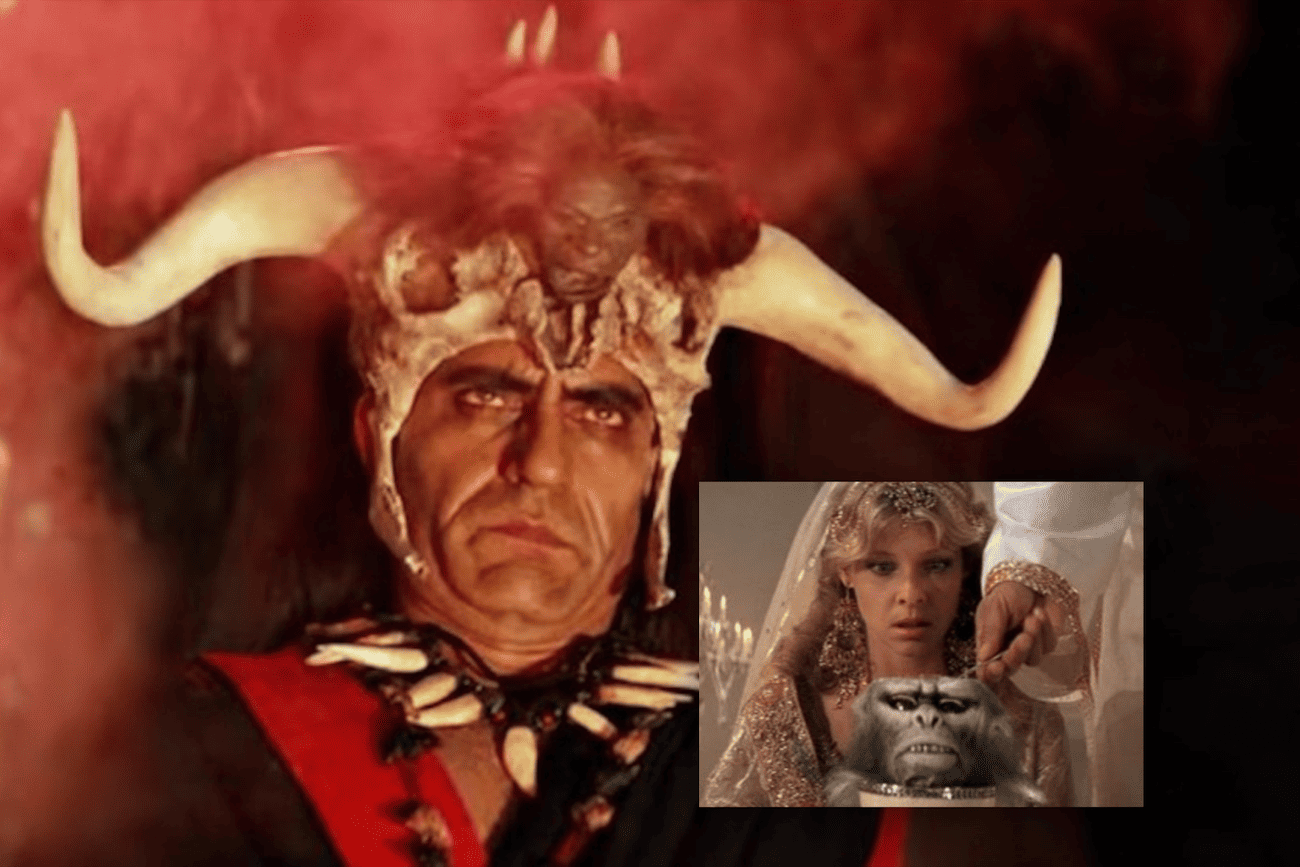
And of course, even in “Temple of Doom,” the use of disgust was seemingly done with callous disregard for consequences – the graphic spectacle of the dinner scene replete with eyeball soup and monkey-brains also revives an old tradition of demonizing “others” over their diets. The book “Yellow Peril,” for example, contains examples of how Chinese immigrants were demonized in posters by showing them about to place rats into their mouths.
Disgust, Diet, Disease
Disgust, diet, disease. These have been the three major tropes at play, generation after generation. On that last point, let us not forget Katherine Mayo’s book “Mother India.” Mayo, after having built her reputation as an anti-immigration activist, found a warm source of support in British intelligence officials who fed her the stories they wanted told about India and ensured a massive publishing success as well. Her descriptions of bloodied temples in Calcutta, children and babies covered in excrement, and other horrors are a triumph of creative writing. She was good at it. She did things like report a statistic of 90% of Indians not having venereal diseases as 90% of Indians actually having one. Her book was a massive success and defined the images through which India and Hinduism would be known in America for decades (or till Slumdog took over). Mayo was adamant in trying to get the WHO to ban migration from India as a global health risk but couldn’t quite pull it off. But the fact the sort of tropes she used are still around, and being used without any censure from town officials or condemnation for academicians otherwise keen to call out racism and Islamophobia, is a worrying reality.
As Andrew Rotter writes in “Comrades at Odds,” the history of Indian representations in the West, from the Abbe du Bois to Arthur Koestler, for centuries that is, have dwelt on the themes of excrement, smell, and disease. And of course, a movie like “Slumdog Millionaire” which became such a celebration of the “underdog” (poor, Muslim, honorable) probably did not realize how much it was part of a very old “overlord” project then, nor do its fans realize that even now as suicide bombers and American xenophobes use its vocabulary of disgust-inducing tactics.


Anglo-American Divide and Rule
On that note, there is one more trope that occurred in the Plano, Texas rant which needs to be examined carefully given its antecedents in both Cold War and British colonial geopolitics over South Asia. The racist rant also includes a reference to the “Muslim Brotherhood.” Now, most well-meaning anti-racist activists might conclude that it proves their thesis that it was just Islamophobia and Hinduphobia isn’t relevant here. However, what he says is interesting. He isn’t saying anything about Muslims here but is actually depicting the Hindu he is portraying as a whiny Islamophobe who wants protection from the Muslim Brotherhood. In a different context, his words could well have been that of an anti-Islamophobia activist mocking “Hindu Nationalists.” Hopefully, people with open minds and hearts will recognize that anti-racism is not a zero sum game, and see that the evocation of Hindu-Muslim relations in strategically divisive ways by Anglo-American supremacists is also something with a history to it.
Katherine Mayo, for example, is quite clear in her religious-racist hierarchy that she admires Muslims and loathes Hindus. In one of her reports, she was found to have actually swapped the religious identities of a murderer and his victims to make it seem as if a Hindu psycho-killer had killed a number of Muslims. One of the criticisms of “Slumdog Millionaire” too had to do with this issue; how a hero with an everyman name like Ram Mohammad Thomas (coined by the Indian author) was turned (presumably by the British writer-director pair) into Jamal. And almost every character who abuses Jamal and the other children happens to be Hindu, such as the mob which kills his mom, the Rama boy who appears during the massacre of Muslims by Hindus, the devious and arrogant quiz master, the policemen who torture him, and so on).
Call a Spade a Spade
Finally, how does one respond to the fact that disgraceful performances of racist anti-Hindu hatred such as what just took place without any pushback from city officials in Plano are not being recognized with the urgency and accuracy they deserve? What is the relationship between truth and tribalism? Are so-called anti-racists and anti-imperialists going to continue to ignore the long history of Hinduphobic tropes in global racism and imperialism just because they have deemed it isn’t “systemic” enough? There is one clear answer to anyone who still has the moral and intellectual integrity to see this question through. There is no good reason at all for anyone to keep denying that Hinduphobia is a legitimately recognizable and reprehensible subset of racism that exists in the real world.
No one denies that anti-semitism exists because the Jewish American community isn’t poor or that Islamophobia exists because there are several extremely wealthy Islamic nations such as Qatar, Saudi Arabia and the U.A.E. Yet, we are told that Hinduphobia isn’t real because Hindu Americans are successful and have no problems or that Hindus are innately “majoritarian” in South Asia. Hinduphobia is growing louder and clearer and those who resort to eyewash-cliches about generic and meaningless “South Asian” or “anti-Brown” racism are peddling platitudes and distractions.
Hinduphobia needs to be recognized as the form of racism that is most underrecognized, undertheorized, and under-disincentivized today. And if anyone wishes to look into the longer history of racism in the West itself, they should read Kathryn Gin Lum’s book “Heathen,” to see how much the supposedly secular “skin color” racism everyone knows to condemn actually has its origins in religion. One might even understand finally how racism is itself a subset of Hinduphobia in a way, drawing on very old tropes about pagans, heathens, devil-worshippers, and the like. Hinduphobia-denial is racism-denial, and reality-denial.
In the end, let us not forget though that the racist clown who decided to vilify the Hindus of Plano is not only a cog in a wheel of something old, vile widespread, and persistently harmful in history, but also deserves to be seen calmly for what he is; a publicity-hack for a glaring lack in his own self. Racists like him seem to get a laugh shouting or typing about Hindus and excrement, little realizing they are the ones, from the time of their colonial ancestors, who have been leaving a stench upon the planet even while writing copious tomes about their well-bathed colonized subjects’ alleged lack of hygiene. All their rants will leave them exposed, exhausted, and embarrassed one day, like a confession written in a trail of toilet paper stuck to their pants.
Top image: Scenes from the film “Indiana Jones and the Temple of Doom.”
Vamsee Juluri is Professor of Media Studies, University of San Francisco. He is the author of “Becoming a Global Audience: Longing and Belonging in Indian Music Television” (Peter Lang, 2003), “The Mythologist: A Novel” (Penguin India, 2010), and “Bollywood Nation: India through its Cinema (Penguin India,” 2013), “Rearming Hinduism: Nature, Hinduphobia and the Return of Indian Intelligence “ (BluOne Ink, 2024) and “The Guru Within” (in progress).