


Six Yards of Everything — Part II: The Cost and Caste of Making and Wearing the Most Complicated Garment in the World

- The saree is not one thing. It never has been. It is a system of things — craft and exploitation, beauty and cost, caste and inheritance, tradition and the quiet violence that tradition sometimes carries inside it.

I grew up Tamil, which means I grew up surrounded by sarees. My Paattis wore them. My Athais, my Periyammas, my Chitthis wore them. My Amma wore them to temple, to weddings, to the vegetable market on Tuesday mornings. I was a boy on the outside of all of it — watching, absorbing, filing it away in some part of my brain I didn’t have a name for yet.
In Part I of this series I wrote about what the saree is and where it comes from — the four-thousand-year history, the colonial blouse, the breathtaking regional variety from Kanyakumari to Kashmir. This part is harder. This part is about what the saree costs — to make, to wear, and ultimately to love honestly. It is about the people who never get mentioned in the celebrations. And it is about a silk dhoti I can no longer bring myself to wear.
—————
III. Caste, the Loom, and the Politics of Design
Here is something the glossy magazine saree features never quite get around to telling you.
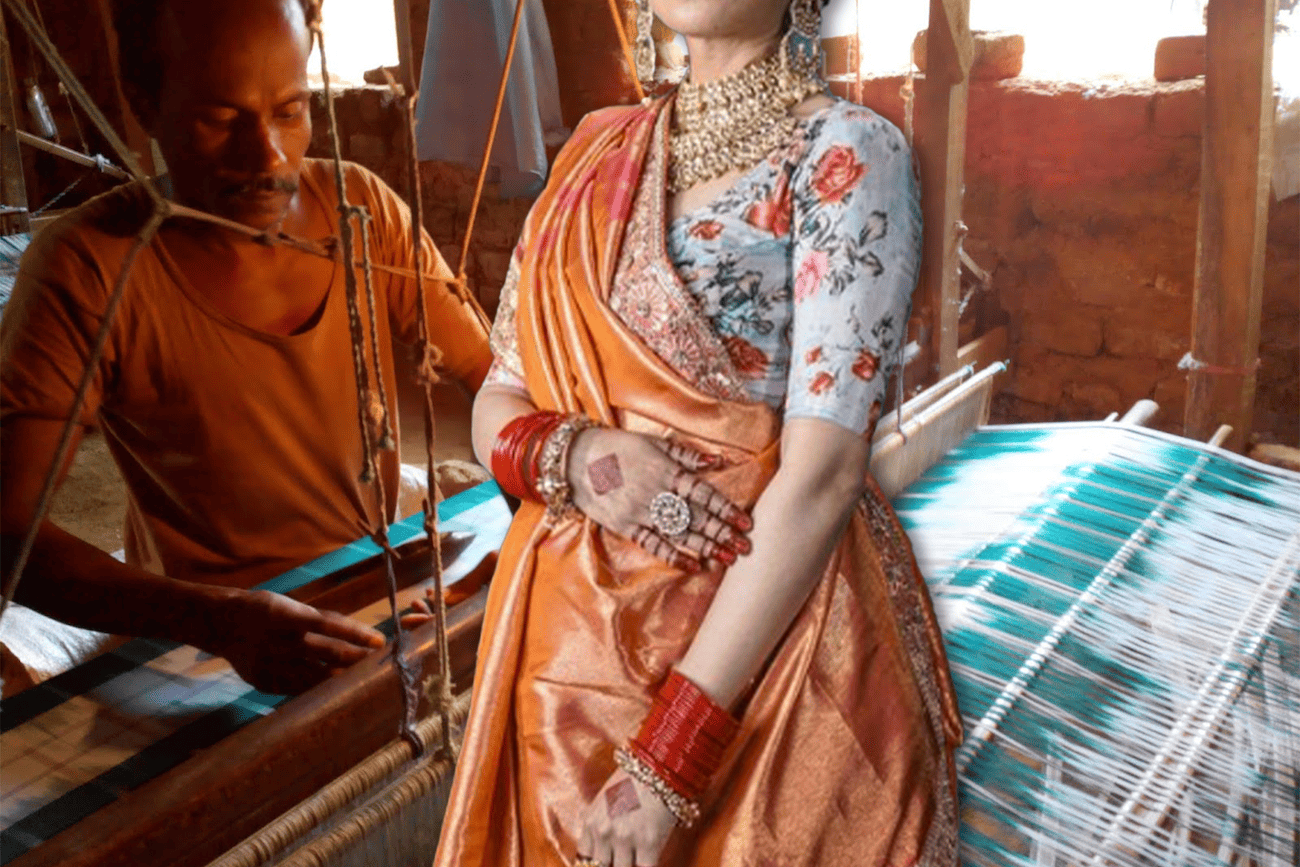
The people who make these sarees — the weavers whose skill produces objects of such beauty that they become heirlooms, whose craft is lauded in UNESCO nominations and government promotional campaigns and Instagram reels — are almost entirely from Scheduled Caste and Other Backward Class communities. Weaving was not a profession one chose. It was a caste assignment, hereditary and inescapable, passed from father to son across generations in a system that gave the weaver no exit and the upper-caste patron no reason to look too closely at where their beautiful things came from.
The Devangas and Padma Saliyars of Tamil Nadu. The Ansari and Momin weavers of Varanasi. The Koris of Uttar Pradesh. The Meghwal weavers of Rajasthan. The Salvi families of Patan. Community after community, tradition after tradition — the people at the loom have almost always been the people at the bottom of the social hierarchy, and the people draping the finished product over their shoulders have almost always been the people at the top.
This is not a coincidence. It is a system.
The design vocabulary of the saree encodes this history in ways that are easy to miss if you aren’t looking. Temple borders — the korvai borders of Kanjivaram sarees — were not merely decorative. They were markers of occasion, community, and in some cases caste entitlement. Certain motifs were associated with Brahmin patrons. Others with merchant communities. The saree you wore to your daughter’s wedding announced not just your taste but your position. The weaver who made it, by contrast, might not have been permitted to enter the temple whose architecture inspired the border he spent three weeks weaving.
The relationship between the upper-caste patron and the lower-caste weaver was also an economic relationship, and not a fair one. The mahajan system — where moneylenders advanced yarn and tools to weavers who then sold their finished cloth back to the same lender at a price the lender set — kept weaving communities in cycles of debt that passed from one generation to the next. You inherited your loom. You inherited your craft. You also, in many cases, inherited your debt. For generations, this was simply the architecture of the industry — invisible to the people buying the sarees, inescapable for the people making them.
The arrival of the powerloom in the 20th century was supposed to change this. It changed it, but not in the direction anyone who cared about weavers might have hoped.
Powerlooms can produce sarees faster, cheaper, and in greater quantities than any handloom weaver. A handloom weaver might complete two or three sarees a week. A powerloom produces dozens in the same time. The market, which rewards price over provenance, shifted accordingly. Weaving clusters that had sustained communities for centuries began to hollow out. Master weavers — people with decades of skill, holders of design knowledge that exists nowhere except in their hands and their memory — started leaving the loom for construction sites and auto-rickshaws because the math no longer worked.
Today, a handloom weaver in India earns, on average, below the statutory minimum wage. The Kanjivaram saree that sells in a Chennai showroom for ₹25,000 might have earned its weaver ₹800. The Banarasi that sells in Delhi for ₹40,000 might have taken a family three weeks to make and earned them proportionally very little of that price. The distance between the loom and the showroom is where the money disappears.
Weaving was not a profession one chose. It was a caste assignment, hereditary and inescapable, passed from father to son across generations in a system that gave the weaver no exit and the upper-caste patron no reason to look too closely at where their beautiful things came from.
There are GI tags — Geographical Indications — that are supposed to protect regional handloom traditions the way Champagne protects French sparkling wine. There is the Handloom Mark, a government certification of authenticity. These are not nothing. But the system that underpays the weaver is older and more stubborn than any certification scheme. It was there before the GI tag. It will be there after it. The only thing that has ever meaningfully threatened it is what has always threatened unjust systems — people deciding, with sufficient collective force, that it is unacceptable. That decision has not yet been made at the scale it needs to be.
IV. The Silk Industry
Let me tell you how silk is made.
Not the romantic version — not the ancient Chinese empress discovering a cocoon in her tea cup, not the Silk Road caravans, not the gleam of a Kanjivaram under a wedding hall chandelier. The actual version. The one that happens in a shed in Ramanagara, Karnataka, or in the sericulture farms of Tamil Nadu and Andhra Pradesh, every single day, in enormous quantities, so that the rest of us can have beautiful things.
A silkworm — Bombyx mori, the domesticated silk moth — spins itself a cocoon. This is not a casual act. The worm spends three to four days producing a single continuous thread of silk protein, wrapping itself over and over in a figure-eight motion until it is completely enclosed. The thread can be anywhere from 300 to 900 meters long. It is one of the strongest natural fibers on earth, relative to its weight. The worm has, in a very real sense, spent its entire short life building toward this moment.
Inside the cocoon, the silkworm is in the process of becoming a moth. It will take another two weeks to complete the transformation.
It never gets those two weeks.
The cocoons are collected and dropped into boiling water — or exposed to steam or dry heat — to kill the pupa inside before it can emerge. The reason is practical and ruthless: if the moth emerges naturally, it breaks the continuous thread to exit the cocoon, rendering the silk commercially useless. The cocoon must be intact. The thread must be unbroken. The worm must therefore die before it becomes what it was becoming.
To make one silk saree, approximately 10,000 to 15,000 silkworms are killed this way.
Read that number again. Sit with it for a moment.
Ten thousand to fifteen thousand lives — brief lives, perhaps not lives in the way we conventionally mean the word, but living creatures with nervous systems and biological drives — ended in boiling water so that a single piece of fabric can exist. Every silk saree you have ever seen or touched or admired represents that number. Every Kanjivaram at every Tamil wedding. Every Banarasi in every bridal trousseau. Every Mysore silk, every Paithani, every Baluchari. The gleam of them is real. So is this.
India is the world’s second largest producer of silk, after China. Karnataka alone — specifically the district of Ramanagara, once called Closepet, an unremarkable town about 50 kilometers from Bangalore — is one of the largest silk markets in Asia. The cocoon market at Ramanagara trades hundreds of thousands of kilograms of cocoons every year. The scale of this is difficult to hold in your mind all at once. So don’t try to hold the scale. Just hold the single number. Ten thousand to fifteen thousand. Per saree
The Workers Nobody Talks About
The silkworm is not the only one paying a price.
The process of reeling silk — unwinding the cocoon’s thread from the boiling water — is done largely by hand, in conditions that are brutal in ways that rarely make it into the promotional materials for heritage silk. Workers plunge their hands into near-boiling water repeatedly to find the thread ends and guide them onto the reel. Burns are common. Chronic skin damage is common. The workshops are hot, humid, poorly ventilated. The pay is low.
And the workers are disproportionately children. Child labor in silk reeling units has been documented extensively — by Human Rights Watch, by Indian labor rights organizations, by journalists who go to Ramanagara and Dharmavaram and report back on what they find. The children — some as young as seven or eight — are nimble-fingered, quick, and cheap. They are also being burned. They are also not in school. It is true that the number of children employed has decreased in India over the years. But decreased is not the same as resolved.
The silk saree sits at the intersection of several forms of suffering simultaneously — the animal, the child, the adult worker underpaid for dangerous labor. We tend to discuss these separately, if we discuss them at all. It is easier to discuss them separately. The alternative is to look at the whole picture at once, and the whole picture is uncomfortable enough to make you put down the saree you were about to buy.
Or, at minimum, to make you stand in the silk section of a saree shop feeling something you didn’t feel before you knew any of this.
The Dhoti Problem — A Personal Note
I should tell you about the dhoti.
At family weddings and religious ceremonies, Tamil men of a certain tradition wear a silk dhoti — the veshti, the white or cream pleated garment wrapped around the lower body, sometimes with a silk angavastram across the shoulder. It is elegant. It is traditional. It connects you, visibly and physically, to something older than yourself. My father wore one. My uncles wore one. My cousins do — though I confess I am notorious in my family for finding reasons not to attend functions in the first place. When I did show up, I wore one too. Without thinking about it. The way you do most things that are simply part of the furniture of your culture — unexamined, automatic, comfortable.
And then I learned what I’ve just told you. And the silk dhoti became complicated.
I want to be clear about what I’m not saying. I am not saying that everyone who wears silk is a bad person. I grew up with the sounds and shimmers of silk sarees and there is a love for all of it I cannot just set aside. I am not saying that a grandmother who has worn a Kanjivaram to every significant event of her life for sixty years should feel guilty. Tradition is not a simple thing. Culture is not a simple thing. The relationship between what we know and what we do is rarely clean or immediate. People who have thought far more seriously about animal ethics than I have still make different choices about silk than I do, and I respect that.
What I am saying is that I, personally, cannot now unknow what I know. I cannot stand at a wedding in a silk dhoti and feel the same uncomplicated relationship to it that I once did. Something has shifted. The fabric feels different when you know what it cost. Not heavier, exactly. Just — different. Present in a way it wasn’t before.
So I’ve stopped. Quietly, without making it a declaration or a dinner table argument. I am aware that quiet, individual choices are the most comfortable form of conscience — the kind that costs you least and changes least. I am not proud of that. I am just being honest about what I have actually done, as opposed to what I like to think I might do.
I wear cotton. I wear the cream cotton veshti that is, frankly, cooler and more comfortable in the Tamil Nadu heat anyway, and if anyone at the wedding notices or cares, they haven’t said so to my face.
It is a small thing. I know it is a small thing. One man’s dhoti choice is not going to restructure the Indian silk industry. But small things are sometimes the only things available to us, and doing the small thing you can do is better than doing nothing while waiting for the large thing to become possible.
Is There Another Way? Ahimsa Silk
In 1992, a man named Kusuma Rajaiah — a government officer in Andhra Pradesh with a background in sericulture — asked what seemed like a simple question: what if you waited?
What if, instead of killing the pupa inside the cocoon, you simply waited for the moth to emerge naturally — and then reeled the broken threads together afterward?
The resulting silk would not have a single continuous thread. It would be slightly coarser, slightly less uniform, slightly less lustrous than conventional silk. It would take more time and more skill to process. It would be more expensive to produce.
But nothing would be boiled alive to make it.
Rajaiah spent years developing the process, working with weavers and sericulture experts, and eventually produced what he called Ahimsa silk — peace silk, non-violent silk. The name comes from the Sanskrit ahimsa, the principle of non-harm that runs through Hindu, Jain, and Buddhist philosophy and that Gandhi made the moral foundation of an independence movement. It is a word that carries considerable weight in Indian ethical thought, and Rajaiah chose it deliberately.
Ahimsa silk exists. It is produced in Andhra Pradesh and in a few other centers. It is more expensive than conventional silk — sometimes significantly so. The texture is slightly different, the sheen slightly less intense. Whether this matters to you depends on what you are optimizing for.
What it proves, at minimum, is that the choice to boil the worm is a choice. Not an inevitability, not a technical requirement without alternative. A choice. And choices, by definition, can be made differently.
A Note on Tussar and Muga
Not all silk requires the same calculus.
Tussar silk — also called Kosa silk — is produced by wild silkworms of the Antheraea genus, living in forests rather than domesticated sericulture farms. The production methods vary and are not uniformly cruelty-free, but Tussar exists in a somewhat different ethical category from Bombyx mori silk — wilder, less intensively farmed, and in some traditions harvested after the moth has emerged. It is rougher, earthier, with a natural gold-brown tone that takes dye beautifully. Bihar and Jharkhand produce Tussar with a quiet pride that the more glamorous silk traditions occasionally overshadow.
Muga silk from Assam — that extraordinary golden silk that grows more lustrous with age — is similarly semi-wild, and some Muga production allows natural moth emergence. It is also, practically, one of the rarest and most expensive silks in the world, so the ethical question is somewhat moot for most people’s wardrobes.
These distinctions matter. Not all silk is the same. But conventional mulberry silk — Bombyx mori, the silk of the Kanjivaram and the Banarasi and the Mysore and the Paithani — is produced the way I described. At scale. Every day
All of this — the silkworm, the reeling unit, the child’s burned hands, the Ahimsa alternative, the small personal decision about a dhoti — is the weight the saree carries that you cannot see when you look at it. Now let’s talk about what you can see. What happens when the fabric meets the body. How a woman takes six yards of everything we’ve just discussed and makes it, somehow, into something graceful.
V. The Choreography of Draping
A saree is six to nine yards of fabric and zero instructions. What you do with it depends on where you’re from, what community you belong to, what occasion you’re dressing for, what your mother taught you, and — not insignificantly — how much time you have. The woman who can drape a perfect saree in four minutes flat has practiced for decades. The woman doing it for the first time needs a friend, a YouTube tutorial, approximately forty-five minutes, and considerable philosophical acceptance of imperfection.
There are, by careful documentation, over a hundred distinct draping styles across India. A hundred ways to take the same rectangle and make it into something different. The researcher and saree historian Rta Kapur Chishti spent years traveling across India and documented 108 of them — regional styles, community styles, occupational styles, ritual styles. One hundred and eight ways to wear a saree. The saree does not have one correct form. It has a hundred correct forms, each correct in its own context.
The Nivi and the Erasure of Everything Else
Here is something worth knowing: the draping style you almost certainly picture when you picture a saree — pleats at the front, pallu over the left shoulder, fitted blouse, petticoat underneath — is called the Nivi drape. It originated in Andhra Pradesh, among Telugu-speaking communities.
It is now the dominant style across urban India and the Indian diaspora worldwide. If you see a saree in a Hollywood film, a fashion magazine, a Bollywood song, an Air India advertisement — it is almost certainly the Nivi. It has become, through a combination of colonial standardization, elite adoption, and Bollywood ubiquity, the default saree in the global imagination.
This happened at the expense of everything else.
The Bengali atpoure style. The Maharashtrian nauvari — the nine-yard drape tucked between the legs, worn by women who needed to move. The Coorgi kuppya style from Karnataka. The Tamil madisar — the traditional Brahmin woman’s drape, also nine yards, also tucked, a complex arrangement that takes years to learn and is now worn fluently by very few women under sixty. The fisherwomen’s style of coastal Tamil Nadu — practical, unromantic, designed for work on boats and beaches rather than wedding halls. The Gond tribal drape of central India. The Kasavu style of Kerala.
Each of these is a complete and coherent way of wearing a saree. Each carries the marks of the community and landscape that produced it. And each has been quietly pushed to the margins by the Nivi’s relentless, accidental dominance.
There is something melancholy about this — the way a single style, through historical accident and cultural power, can make a hundred others feel like they are in costume rather than in clothing. The madisar grandmother at a Chennai wedding is wearing what her grandmother wore. She is not performing heritage. She is simply dressed. But increasingly, she is also the only one in the room who knows how to do what she is doing, and when she is gone, that knowledge may go with her.
Which Shoulder? The Pallu and Its Politics
Even within the Nivi — the so-called standard drape — there is a divide that anyone who has attended both a North Indian and a South Indian wedding will have noticed without necessarily being able to articulate.
In much of North India, the pallu is worn over the right shoulder. In South India, it falls over the left. Both are correct. Both are traditional. Both have been done this way for long enough that each side is quietly convinced the other side is doing it wrong.
The left-shoulder pallu is the South Indian default — Tamil, Telugu, Kannada, Malayalam traditions all generally follow it. It is also, interestingly, the style depicted in most classical temple sculpture from the south — which suggests it is the older of the two conventions in this part of the world, or at least the more continuously documented one.
The right-shoulder pallu is associated with North Indian draping traditions — Rajasthani, Gujarati, UP — and also with certain specific ritual contexts. In many Hindu ceremonies across regions, the pallu is brought forward over the right shoulder for ritual moments — the mangalsutra ceremony, the saptapadi — because the right side is considered auspicious, the side of action and sacred intention. So a woman who drapes left-shoulder in daily life may shift her pallu to the right for specific ceremonial moments. The saree is adaptable that way. It has always known when the occasion requires something different.


There is also the seedha pallu style — common in Gujarat and parts of Rajasthan — where the pallu is draped across the front of the body from right hip to left shoulder, rather than thrown back. This style keeps the decorative end visible and forward-facing at all times, which is either a practical choice for showing off beautiful fabric or a philosophical one about not hiding your best things — possibly both.
The traditional saree, before the 19th century, was draped directly on the body. No petticoat. No underskirt. The fabric fell differently — more fluid, more classical, closer to the temple sculptures and the Natya Shastra descriptions.
And in the Bengali style, the pallu is worn over the left shoulder but brought under the right arm first — a distinctive wrap that gives the drape its characteristic fullness across the front and creates the particular Bengali silhouette that is instantly recognizable to anyone who knows what they’re looking at.
The direction of the pallu is, in the end, a small thing. A question of six inches and one shoulder. But it is also a marker — of region, of community, of family tradition, of the specific grandmother who taught you. Among Indian women of a certain generation, you can often tell roughly where someone is from, or where they learned to dress, simply by watching which shoulder the pallu falls on.
Six yards of fabric, and it still finds ways to tell you exactly who you are.
The Ghunghat — When the Pallu Becomes a Veil
And then there is what happens to the pallu in parts of Rajasthan, Haryana, Uttar Pradesh and Bihar — a practice so different from the South Indian relationship with the saree that it feels, almost, like a different garment entirely.
In these communities, the pallu is not primarily decorative. It is a veil.
The ghunghat — the practice of pulling the pallu forward over the head, sometimes down over the face, in the presence of elder male relatives, in-laws, or male strangers — transforms the saree’s most beautiful element into a gesture of concealment. A young bride in rural Rajasthan may spend the first months or even years of her married life with her face partially covered whenever she moves through her husband’s home. The pallu — the part of the saree that a weaver spent the most time on, that carries the most intricate work, that a woman or her family spent the most money on — becomes the thing that hides her.
This is not a small detail. It is a window into how the same garment can carry completely opposite meanings depending on where you stand in India’s vast geography of culture and custom. In Tamil Nadu, the pallu announces you — it falls over the left shoulder with the embroidered or woven end visible, forward-facing, the part of the saree you are meant to see. In parts of the Hindi heartland, the pallu retreats, covers, effaces.
Neither tradition is monolithic. Urban North Indian women do not practice ghunghat. Many rural communities where it was once universal are seeing younger generations push back against it. The practice exists on a spectrum — from a light, token gesture of respect among relatively progressive families, to a near-total veil worn for hours at a stretch in more conservative communities. And the women within these traditions have complicated, varied relationships with it — some experiencing it as oppressive and suffocating, others describing it as a form of dignity and belonging, a way of being legible within a community that has its own logic of respect and hierarchy.
It would be easy — and dishonest — to write about the ghunghat purely as a symbol of patriarchal control, the way it is sometimes treated in urban Indian commentary. It would be equally dishonest to romanticize it as pure tradition. It is both, and neither, and the women who live inside it are not waiting for outside observers to resolve the question for them.
That is the saree’s most honest complexity — that the same garment, the same six yards, the same pallu, can be both of these things simultaneously. An expression and a concealment. A language and a silencing. Not in different places and different eras but right now, today, in the same country, sometimes in the same family.
It deserves to be said plainly. It also deserves to be held without resolution, because there is no resolution. There is only the complexity, and the women living inside it, making their own meanings.
The Petticoat Problem, Revisited
The traditional saree, before the 19th century, was draped directly on the body. No petticoat. No underskirt. The fabric fell differently — more fluid, more classical, closer to the temple sculptures and the Natya Shastra descriptions. The petticoat gives the modern saree its familiar silhouette, the slightly stiff front pleats, the defined shape at the waist. It also makes the saree easier to manage for women who weren’t trained in the original draping techniques. There are genuine practical arguments for it.
But there are women — particularly in Kerala and parts of Tamil Nadu — who still drape without a petticoat in traditional styles, and the result is visually startling if you’ve only ever seen the modern version. The fabric moves completely differently. It looks older, somehow. Closer to something. A reminder that what we think of as the “traditional” saree is already several layers of historical revision away from its actual origins.
The Weight of Wearing
There is one more thing about the saree that I want to say, as someone who has watched women wear them all his life without ever having to wear one himself.
It is not easy. And the ease that the women around me made it look was not natural ease. It was practiced ease — the ease of something done so many times that the effort has gone underground, invisible, metabolized into the body until it looks effortless.
My Paatti could drape a saree in under three minutes. I have timed her. She did it without a mirror. She did it while simultaneously conducting a conversation, keeping track of something on the stove, and being aware of everything happening in a 40-foot radius of her person. The saree was not something she wore. It was something she inhabited. She was not the exception in my family. She was the standard.
That is what forty, fifty, sixty years of daily practice looks like. And every time someone describes the saree as “timeless” and “effortless” and “graceful,” I want to gently point out that the grace is not an accident. The grace is work. Invisible, unacknowledged, lifelong work — the kind of work that women perform so consistently and so well that the world has decided it doesn’t count as work at all.
—————
The saree is not one thing. It never has been. It is a system of things — craft and exploitation, beauty and cost, caste and inheritance, tradition and the quiet violence that tradition sometimes carries inside it. Understanding that doesn’t make the saree less beautiful. If anything, it makes the beauty more honest. Part III of this series asks what happens when all of that meets the present moment — the Instagram revival, the designer markup, the diaspora kitchen table in Michigan or Manchester, and the question of how you love something this complicated in 2026. It ends, I promise, somewhere worth arriving.
—————
Part III — on revival, the diaspora, the political saree, and a closing — continues in the next installment.
Glossary
Paatti — grandmother. Athai — paternal aunt. Periyamma — mother’s elder sister. Chitthi — mother’s younger sister. Amma — mother.
Mahajan — a moneylender or merchant; in the weaving context, the middleman who controlled yarn supply and purchase prices.
GI tag — Geographical Indication, a certification protecting regionally specific products. Handloom Mark — government certification confirming a saree is genuinely hand-woven.
Bombyx mori — the domesticated silkworm used in conventional silk production. Ahimsa — non-violence; the Sanskrit principle of non-harm.
Nivi drape — the dominant saree draping style, originating in Andhra Pradesh. Madisar — the traditional nine-yard draping style of Tamil Brahmin women.
Veshti — the Tamil male dhoti. Angavastram — a cloth worn over the shoulder by Tamil men at formal occasions. Ghunghat — the practice of veiling with the pallu in parts of North India.
Pallu — the decorative end of the saree, typically draped over the shoulder.
Ganpy Nataraj is an entrepreneur, author of “TEXIT – A Star Alone” (thriller) and short stories. He is a moody writer writing “stuff” — Politics, Movies, Music, Sports, Satire, Food, etc.