



Six Yards of Everything: A Love Letter to Saree, the Most Complicated Garment in the World — Part I

- This is the piece I’ve been meaning to write for thirty years. About the garment that clothed every woman I have ever loved.
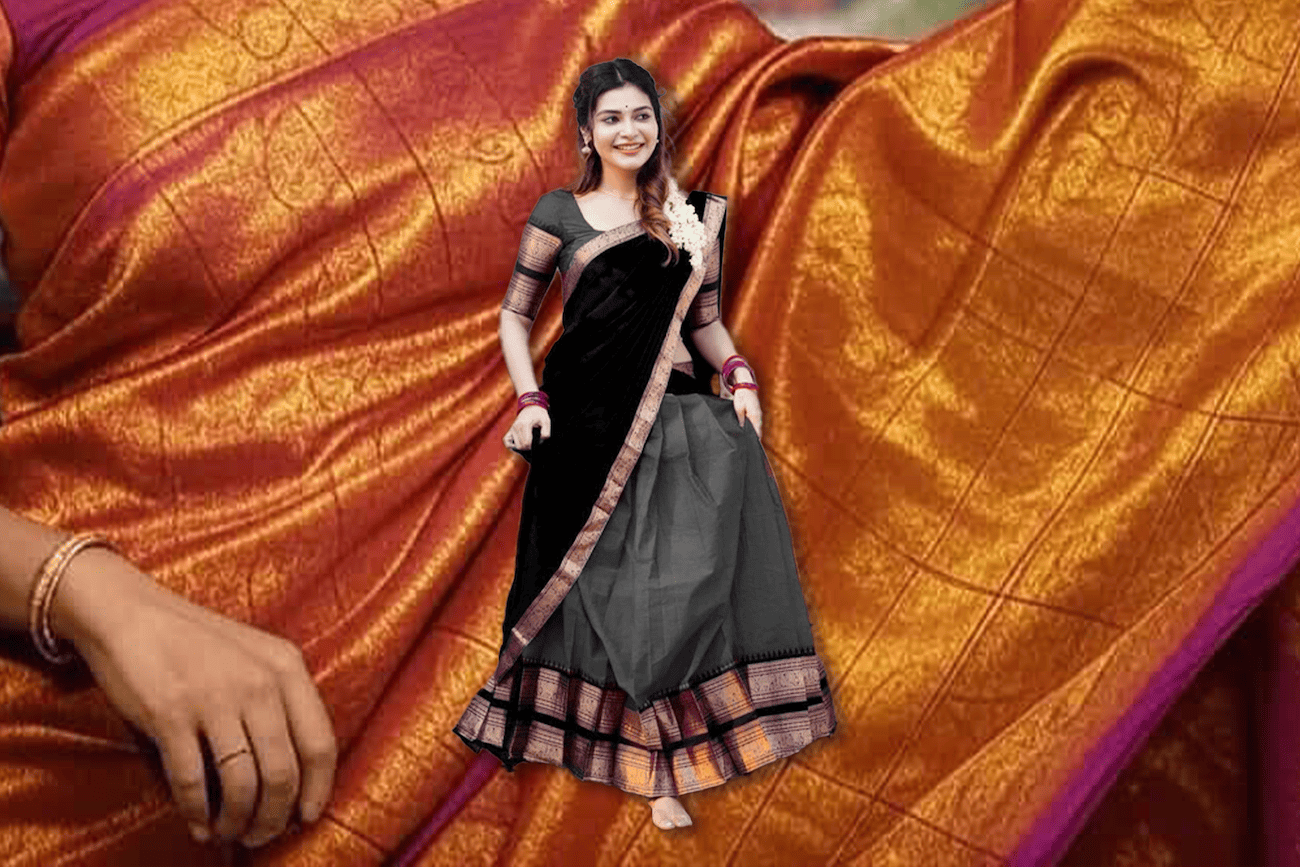

If you asked me to close my eyes and describe the women who raised me — the first thing I would see — before their faces, before their voices fully form — is fabric. Six yards of it. Draped, tucked, sometimes pinned with quiet authority. A pallu thrown over a shoulder with the casual elegance of someone who has never once thought about how elegant they look.
I grew up Tamil, which means I grew up surrounded by sarees the way some children grow up surrounded by snow — it was simply the weather. My Paattis wore them. My Athais, my Periyammas, my Chitthis wore them. My Amma wore them to temple, to weddings, to the vegetable market on Tuesday mornings, and occasionally, unforgettably, while scolding me at considerable volume. There was no occasion the saree was not equal to.
And then there were the girls. My cousins and their friends. The teenage girls in the neighborhood and the young women in their half-sarees — that particular Tamil rite of passage, that elegant in-between, not quite a child’s paavaadai, not yet a woman’s full six yards. A half-saree is a girl learning a language she will speak for the rest of her life. I didn’t know that then. I just knew it looked like something important was happening.
I was a boy on the periphery of all of this. Watching. Absorbing. Filing it away in some part of my brain I didn’t have a name for yet. This piece is me, finally, finding the name.
—————
Every Tamil wedding I attended as a child smelled like jasmine and sounded like silk.
That particular sound — the rustle of a Kanjivaram as a woman crosses a room, the soft percussion of it against the floor — is one of those sounds that lives below memory, in the body. I couldn’t have named it then. I was seven, or ten, or twelve, sitting cross-legged somewhere I wasn’t supposed to be, watching the women of my family move through a wedding hall with a composure I found quietly baffling. How does anyone carry that much fabric and still look like they’re doing nothing at all?
At those same weddings I was dressed in a small, stiff shirt and trousers that someone had ironed with great ambition. Later, a silk dhoti — something I’ll have more to say about in Part II. But the saree was never mine to wear. Only mine to witness.
Which, it turns out, was its own education.
—————
This is the piece I’ve been meaning to write for thirty years. About the garment that clothed every woman I have ever loved. About its four-thousand-year history, its regional obsessions, its caste politics, its breathtaking variety. About the weavers who make it and the system that exploits them. About silk, and what silk actually costs — and I don’t mean the price tag.
About why a boy who grew up on the outside of all of this still can’t stop thinking about it.
I. What Even Is a Saree?
Before anything else — before the history, the politics, the silk and what silk costs — there is the question of what a saree actually is. The answer is deceptively simple.
One thing before we go further: is it sari or saree? I prefer saree. Don’t ask me why.
A saree is a single rectangular piece of unstitched cloth. Anywhere between five and nine yards long, roughly four feet wide. No buttons. No zippers. No cuts, no seams, no instructions included. You take this rectangle and you make it work — around your body, over your shoulder, across your chest — through a system of folds and tucks and a single safety pin if you’re being cautious, or no safety pin at all if you’re the kind of woman my Paati was.
That’s it. That’s the whole garment.
And somehow, this rectangle has clothed the subcontinent for over four thousand years.
There is something almost philosophical about the saree’s refusal to be cut. While the rest of the world’s clothing traditions evolved toward tailoring — toward measuring and cutting fabric to fit the body — the Indian textile tradition held firm to the idea of the unstitched garment. The body adapts to the cloth. The cloth is not sacrificed for the body. For centuries, stitching was associated with foreign influence, with the ‘mleccha’ — the outsider — and the uncut garment carried connotations of ritual purity that a sewn one could not. You wore unstitched cloth to temple. You wore it for prayer. You wore it because the needle had not violated it.
There is an entire theology hiding inside a saree’s hem.
The earliest evidence we have places the saree — or something very much like it — in the Indus Valley Civilization, around 2800 to 1800 BCE. Terracotta figurines from Mohenjo-daro show women draped in fabric pulled over one shoulder. The famous “Priest-King” statue wears a shawl with trefoil patterns. These are not sarees as we would recognize them today, but they are the same idea — fabric wrapped, not stitched.
By the Vedic period, the clothing system had names. The antariya was the lower garment. The uttariya was the upper shawl. The stanapatta was a chest band. Together, these three pieces covered the body in a system that would slowly, over millennia, consolidate into the single garment we now call the saree. Sanskrit literature is full of fabric. The Natya Shastra describes performers’ costumes in detail. The Silappadikaram — the great Tamil epic, written right here in the tradition I grew up in — describes a woman’s garment with the specificity of someone who clearly cared very much about cloth.
Temple sculpture is our best textile archive. The carvings at Khajuraho, at Konark, at Mahabalipuram — these are not merely art. They are documentation. Look at the women carved into stone across a thousand years of Indian temple architecture and you are looking at a history of how fabric moved, how it was draped, where the pallu fell, how the pleats were arranged. Stone, improbably, remembered what cloth could not.
And then the British arrived. And with them, the missionaries.
The Colonial Influence
This is the part of the saree’s history that tends to get left out of the celebratory accounts. The traditional saree — particularly in South India — was worn without a blouse. The upper body was covered by the pallu, or not fully covered at all. This was unremarkable. This was simply how it was.
Victorian missionaries found it deeply, urgently remarkable.
The pressure on Indian women — particularly Christian converts in Kerala and Tamil Nadu — to cover themselves “properly” led to the widespread adoption of the blouse and the petticoat in the 19th century. The fitted blouse, the underskirt that gives the saree its current silhouette — these are not ancient. They are colonial. What we think of today as the “traditional” way to wear a saree is partly a Victorian moral imposition that has been so thoroughly absorbed it no longer looks like an imposition at all.
The saree survived the British Empire. It just had to put a blouse on first.
And having survived all of that — the Mughals, the missionaries, the machine looms — it then had the audacity to multiply. To become not one thing but thirty things, each convinced of its own primacy, each carrying a different history in its threads.
Let’s take the journey.
The pressure on Indian women — particularly Christian converts in Kerala and Tamil Nadu — to cover themselves “properly” led to the widespread adoption of the blouse and the petticoat in the 19th century.
II. The Geography of Cloth
If you want to understand how vast and various the saree is, try this. Stand at the southernmost tip of India — Kanyakumari, where three oceans meet — and start walking north. Every few hundred miles, the saree on the women around you will change. The colors will shift. The border will widen or narrow. The fabric will go from stiff to gossamer to rough to liquid. The drape will alter. The occasion it is worn for, the community that makes it, the motifs woven into its body — all of it will change, sometimes dramatically, sometimes in ways so subtle only an insider would catch them.
The saree is not one garment. It is a family of garments, bound together by the same basic idea — a rectangle, a body, a drape — and separated by everything else.
The South: Where the Saree Is Loudest
Tamil Nadu is where I begin, for obvious reasons. And Tamil Nadu begins, as most things in Tamil Nadu do, with a certain confidence about its own importance.
The Kanjivaram — also written Kanchipuram, named for the temple city an hour from Chennai — is the undisputed queen of South Indian silk sarees. Heavy, stiff almost to the point of architectural, woven in pure mulberry silk with real zari — gold or silver thread — in the border and pallu. The colors are bold to the point of audacity: deep magenta paired with forest green, peacock blue against burnt orange, combinations that should not work and somehow always do. The motifs are temple-sourced — gopuram towers, mango paisley, the rudraksham bead, the mayil (peacock) — because for the Devangas and Padma Saliyar weavers who have made these sarees for generations, weaving was never separate from worship.
A Kanjivaram is what a Tamil bride wears. It is what she receives as a gift from her mother-in-law, sometimes her own mother, sometimes both — a negotiation of silk that carries the full weight of two families’ pride. Prices begin in the tens of thousands of rupees and climb, without embarrassment, into the lakhs.
But Tamil Nadu is not only Kanjivaram. Not even close.
The Chettinad cotton saree comes from the Karaikudi region — the land of the Naattukotai Chettiars, that merchant community whose palatial homes and extravagant cuisine have become a kind of cultural shorthand for South Indian opulence. The sarees, however, are the opposite of ostentatious. Bold checks. Strong stripes. Contrasting borders in colors that pop without shouting. Slightly thicker than most cottons, built for daily wear, for a woman who has things to do and needs a saree that can keep up. My Paati’s kind of saree.
Then there is Kanchi cotton — lighter, softer, the democratic cousin of the Kanjivaram. Same temple borders, same color sensibility, none of the silk weight or the silk price. A Kanchi cotton saree is what you wear when you want to look like you’re wearing a Kanjivaram but you have a four-hour pooja ahead of you and some basic self-preservation instincts.
Sungudi from Madurai — tie-dyed dots on fine cotton, festive without being formal, the saree you wear when the occasion is happy but not ceremonial. Salem cotton — fine-woven checks and stripes, sold in enormous quantities through Co-Optex, the state handloom cooperative that has been quietly doing the right thing since 1935 and deserves far more credit than it gets. Negamam cotton from Coimbatore — soft and breathable, the kind of fabric that makes you understand why cotton has been grown and worn in this part of the world for four thousand years.
And Co-Optex itself deserves a moment here. The Tamil Nadu Handloom Weavers’ Cooperative Society — to give it its full, slightly bureaucratic name — represents over 200,000 weavers across the state. Every saree it sells is 100% handloom. No powerloom. No shortcuts. And each one comes with a small tag bearing the weaver’s photograph and their story. You pick up a Negamam cotton saree priced at ₹400 and you are holding someone’s week. Someone’s month. Someone’s craft, passed down through generations of a family who probably never imagined their work would end up being written about by a Tamil boy sitting in front of a laptop somewhere far from Chennai. But here we are. Growing up, I recall my Paatti and Thatha insisting that we shopped at Co-Optex, at least once, for festivals like Deepavali and Pongal. Now I know why.
Kerala does everything the Tamil way doesn’t. Where Tamil Nadu loves color, Kerala loves restraint. The Kasavu saree — cream or off-white cotton with a single gold border — is the Kerala saree, worn for Onam, for temple, for the quiet ceremonies of a life lived close to tradition. It is the most elegant understatement in Indian textile history. No peacocks. No gopurams. Just cream and gold, and the confidence of a tradition that knows it needs nothing else.
The Balaramapuram saree, woven in a small village near Thiruvananthapuram, takes that restraint even further — finer weave, softer hand, the kind of fabric that makes you want to use words like diaphanous without feeling pretentious. It has a GI tag. It deserves one.
Karnataka gives us the magnificent Mysore silk — softer and more fluid than Kanjivaram, with a drape that moves rather than stands. Where a Kanjivaram holds its shape like architecture, a Mysore silk flows like water. Same luxury, different personality.
Then Ilkal from northern Karnataka — a cotton saree with a trick up its sleeve. The cotton body (usually Chanderi cotton) is joined to an art silk border (usually Mysore silk) using a technique called Tope Teni, a joining so specific and so skilled that the seam itself is considered part of the craft. The pallu carries patterns derived from the kasuti embroidery tradition. Ilkal is the saree that makes you look twice at the border and then realize you’ve been staring for five minutes.
Andhra Pradesh and Telangana are where the ikat tradition reaches its peak. Pochampally — now officially in Telangana — gives us the Pochampally ikat, where the yarn is resist-dyed before weaving so that the pattern emerges in the cloth almost like a magic trick, geometric forms bleeding into each other with a softness that woven patterns can’t replicate. The Gadwal saree is another marvel — cotton body, silk border, joined by a technique called kuttu. A Gadwal saree, fully folded, can reportedly fit inside a matchbox. This is either a weaving miracle or an extremely good party trick, possibly both.
Mangalagiri cotton — flat, slightly lustrous, with a distinctive nizam border — is the everyday workhorse of Andhra textile culture. Narayanpet brings geometric borders and checked bodies from Telangana. Venkatagiri offers fine weave and delicate gold motifs, light enough for all-day wear without the all-day ache.
And then Kalamkari — not strictly a weave but a surface tradition, cotton sarees hand-painted or block-printed with scenes from the Mahabharata, the Ramayana, from nature and mythology, in earthy pigments derived from plants and minerals. A Kalamkari saree is less a garment than a manuscript you can wear.
The East: Where Cotton Is Philosophy
West Bengal has a relationship with cotton that borders on the spiritual.
The Tant saree is the Bengali daily saree — crisp, light, slightly stiff from the sizing, with a traditional border and a texture that you can hear when it moves. Bengali women wear Tant the way the French wear linen — casually, confidently, as if it were the most natural thing in the world, which in Bengal it is. Tant is not dressed up. Tant is worn to the market, to the office, to a cousin’s afternoon wedding where the food is more important than the formality.
Then there is Jamdani — and here the register shifts entirely. Jamdani is cotton’s highest ambition. Woven on a fine muslin base, its patterns are created by supplementary weft threads floated across the fabric by hand, motif by motif, the weaver working from memory and intuition rather than a mechanical template. The result looks almost like embroidery but is entirely woven — flowers and vines and geometric forms that seem to float on the surface of the cloth like shadows. Hold a Jamdani up to light sometime and you will understand immediately why it took the world that long to find the right category for it. Some things resist classification because they are too completely themselves. UNESCO recognized Jamdani weaving as an Intangible Cultural Heritage of Humanity in 2013. Bengal already knew.
Baluchari from Bishnupur tells stories in silk — mythological scenes from the epics woven into the pallu with a density of narrative detail that makes each saree a kind of illustrated manuscript. Dhaniakhali is the Tant variant with a thicker border and occasional zari work, a little more dressed up, a little less weekday.
Odisha brings us Sambalpuri — cotton and silk both — with its distinctive ikat tradition, bold geometric motifs of fish, conch shells, flowers and wheels, colors that are deep and saturated and completely specific to this tradition. The Bomkai saree from southern Odisha adds supplementary weave work in the border and pallu, tribal motifs translated into textile with a directness that feels ancient because it is.
The North: Mughal Memory and Desert Light
Varanasi — Banaras, Kashi, the city of light, the oldest continuously inhabited city in the world — makes the Banarasi saree, and the Banarasi is everything the city is: layered, ancient, slightly overwhelming, and absolutely worth the effort.
Banarasi silk carries the Mughal aesthetic in its bones. When the Mughal court brought Persian design vocabulary to India — the jaal lattice pattern, the kalga and buta flowering motifs, the dense gold zari brocade — it was the weavers of Varanasi, predominantly Muslim Ansari weavers whose families have worked these looms for generations, who absorbed it and made it Indian. A Banarasi saree pallu can take weeks to weave. The zari work is so dense that the fabric can stand on its own. These are sarees that become heirlooms before they are even given.
Rajasthan gives us Bandhani — the ancient tie-dye tradition, tiny dots of resist created by pinching and tying the fabric before dyeing, producing spotted patterns that range from simple grids to complex figurative compositions. And Leheriya — wave-dye, fabric rolled diagonally and dyed to produce diagonal stripes that ripple across the cloth like water. These are sarees built for desert light, for the colors that survive in a landscape of sand and sky.
Then Kota Doria — the most surprising cotton saree in India. Woven with alternating cotton and silk threads in a distinctive square pattern called khats, Kota is so light, so open in its weave, that holding it up to light is like holding a cloud. In extreme Rajasthani summer heat, where temperature is not a metaphor but a genuine threat, Kota Doria is not fashion. It is physiological necessity.
Madhya Pradesh offers the famous pair — Chanderi and Maheshwari. Chanderi is gossamer, slightly glossy, woven with fine cotton and occasionally silk, its surface decorated with small booti motifs and traditional borders. It sits in the ambiguous, wonderful space between cotton and silk in terms of feel — too fine for pure cotton, too matte for silk. Maheshwari comes from the banks of the Narmada, from the town of Maheshwar where the 18th century queen Ahilyabai Holkar patronized the weaving tradition personally. Its distinguishing feature is the reversible border — different on each side — and a soft sheen that catches light without demanding attention.
The Northeast: The Forgotten Silk Road
The Northeast of India is so consistently left out of saree conversations that mentioning it feels like an act of mild justice. It should feel like the bare minimum.
Assam produces Muga silk — a golden silk, literally golden in color, produced by the Antheraea assamensis silkworm that feeds on som and sualu trees. Muga is one of the rarest silks in the world. It gets more lustrous with every wash, which is the textile equivalent of aging gracefully. The Mekhela Chador — Assam’s traditional garment — is technically not a saree but a two-piece wrap that shares the saree’s unstitched philosophy. To leave it out of this conversation would be its own kind of erasure.
Manipur has the Moirang Phee, Nagaland its own woven traditions, Meghalaya its Jainsem — each a reminder that the story of Indian textile is not a story with one center. It is a story with thirty centers, each convinced, with some justification, that it is the most important one.
The West: Geometry and Ceremony
Gujarat is the home of Patola — the double ikat silk saree from Patan, where both warp and weft threads are resist-dyed before weaving, producing patterns of geometric precision so demanding that a single saree can take a family of weavers six months to complete. The Salvi families of Patan have kept this tradition alive for generations. A genuine Patan Patola costs what a small car costs and is worth considerably more to the people who understand what they are holding. Bandhani from Kutch and Jamnagar — tie-dyed in the same tradition as Rajasthan but with its own distinct color palette and motif vocabulary — is Gujarat’s everyday festive saree.
Maharashtra brings us Paithani — silk sarees from Paithan with a distinctive peacock and lotus motif in the pallu, woven with real gold zari in a tapestry technique that predates the Common Era. Paithani is the Maratha ceremonial saree, historically associated with nobility, worn at weddings with a particular draping style — the nauvari, the nine-yard drape, tucked between the legs in a style that looks like it was designed for women who also needed to move freely, which it was. The nauvari is the saree of the Maharashtrian woman who has somewhere to be and intends to get there without the fabric getting in her way first.
—————
This is the saree as India presents it to the world — the variety, the craft, the regional pride, the breathtaking accumulation of traditions. It is all real. Every word of it is true.
Here is what that version of the story leaves out.
—————
This is Part I of a three-part essay. Part II covers caste, silk, and the ethics of making. Part III covers revival, the diaspora, and a closing.
Glossary
Paatti — grandmother. Athai — paternal aunt. Periyamma — mother’s elder sister. Chitthi — mother’s younger sister. Amma — mother. Akka — elder sister.
Pallu — the decorative end of the saree, typically draped over the shoulder. Paavaadai — a long skirt worn by young Tamil girls.
Mleccha — a Sanskrit term for foreigner or outsider. Zari — gold or silver thread woven into fabric.
Co-Optex — the Tamil Nadu Handloom Weavers’ Cooperative Society, established 1935. GI tag — Geographical Indication, a certification protecting regional products.
Top images, courtesy of icytales.com and belegendcollection.in
Ganpy Nataraj is an entrepreneur, author of “TEXIT – A Star Alone” (thriller) and short stories. He is a moody writer writing “stuff” — Politics, Movies, Music, Sports, Satire, Food, etc.