


Putin’s India Visit: New Delhi Demonstrates Strategic Autonomy in Troubled Times by Reaffirming Old Friendship

- Even if nothing substantial was achieved, the summit was Modi’s attempt to fight off India’s international isolation in a world order being reordered by Trump.
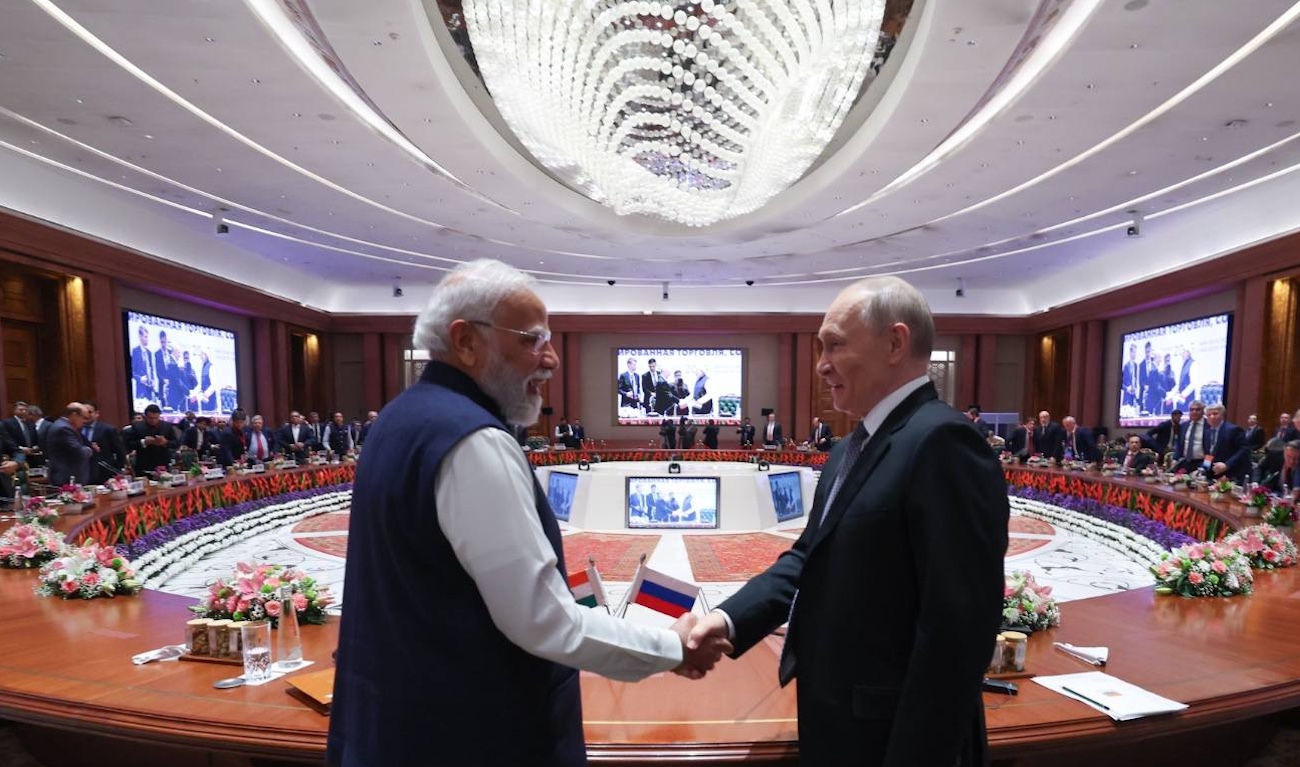

Vladimir Putin’s recent India visit aroused curiosity, hope, and apprehension in different quarters around the world, but in the end it proved to be nothing more than a reaffirmation of an old relationship rather than the start of a new alignment in international relations. Both countries agreed to keep carrying on dialogue and while India sought spares for the weapons systems it has purchased from Russia, the latter was able to get Russia Today in India – a not insubstantial gain in a country that is loath to allow foreign media within its borders.
Historically, India has enjoyed good ties with post-Stalin Russia (and its former avatar, the USSR) since the late 1950s. Defense cooperation started in the early 1960s and by 1971 solidified into the Treaty of Peace, Friendship, and Cooperation. At one point, 50% of India’s defense imports came from the Soviet Union/Russia, this is now down to 36% — still the dominant country. In major defense systems such as fighter aircraft and tanks, the principal supplier is still Russia (MiG 29/Su30/T90 tanks) though India has tried to broaden its base by purchasing equipment from the U.S., Israel, and France. Indo-Soviet ties stagnated in the last decade of the Soviet Union’s existence due to changing geopolitical realities and India’s refusal to wholeheartedly support the invasion of Afghanistan.
Ties picked up again in the 1990s and the Treaty of Friendship was reborn as the India-Russia Treaty. The unreliability of the U.S. in defense matters (always subjecting India to technology denial due to its nuclear program until the Bush-Singh agreement of 2007), and the reluctance of Western (British, French, Swedish, pan-European) countries to allow domestic production of weapons systems, or their overwhelming expense, made Russia a convenient and reliable defense partner. India’s tilt towards Russian equipment was not a major sticking point in Indo-U.S. relations from the 1990s on, though the American hope was for India to become a major consumer of its defense industry. The new equilibrium of Indian foreign relations that emerged in the 1990s was incrementally in India’s favor as successive U.S. administrations – Clinton and Bush – wooed India even as it maintained a cordial relationship with Russia.
Soft Pedaling Russian Excursions
Two major events changed the comfortable position of India’s foreign policy status. One was the increasingly combative moves made by Putin’s Russia from 2008 onward in which Russian fears of NATO expansion and desire to reclaim lapsed influence in congruent territories led to belligerence towards Ukraine. The annexation of Crimea and a desire to rein in Ukraine was met by Western hostility and Russia was suddenly viewed again as a hostile and dangerous power by the NATO countries. India’s equable relationship with Russia was met with increasing disapproval from Western countries coming into sharp focus as India tried to soft pedal criticism of the invasion of Ukraine.
The world has become an unstable place, but especially for India. The security of its cold peace with China is over and punctured by numerous hostile incidents on a monthly basis.
The second factor leading to problems for India has been the Trump administration’s targeting it over the past year and levying sanctions and tariffs that are slowly exerting a toll on India’s economy. No U.S. administration has been this hostile to India in the past three decades since the Cold War ended. There is a general agreement that this recent hostility is personality driven with President Trump’s ire at India’s lack of acknowledgement of any role the U.S. played in ending its standoff with Pakistan during the late spring. As an aspiring great power, India could hardly be expected to kowtow to American descriptions of its role in the conflict, particularly as India has historically kept the India-Pakistan issue a bilateral one. The ensuing tariffs have battered India.
So, for the first time in decades, India finds itself in relative international isolation. Russia’s ability to help India is limited to “oil and guns.” Meanwhile, China remains an ever-increasing problem. Recently an Indian national from Arunachal Pradesh (a state whose territory is claimed by China) was harassed in China and while the matter was sorted India is on the defensive. The past few years have seen multiple acts of border violence by China that have negated India’s relative security that had existed from the late 1980s until a decade ago. This is part of the new muscular Chinese nationalism that is the hallmark of Xi Jinping and the assertive wolf-warrior diplomacy by which China is slowly but surely trying to replace the U.S. as world hegemon.
Narrowed Asymmetry With Pakistan
Even the recent short conflict with Pakistan did not go India’s way as it appears that Pakistan shot down multiple Indian jets (including the much-touted new French Rafale fighters), albeit with Chinese defense equipment and NATO tactics that it got via China. The asymmetry between India and Pakistan seems to have been narrowed now by a mix of superior weapons systems and tactics on the Pakistani side.
Finally, the West as a whole, and the United States specifically, appear to be less than pleased with India. Broadly the EU countries and North Americans have not been very happy with India’s BJP and its Hindu nationalism which has sometimes manifested in extra-judicial actions by Indian intelligence services against “terrorists” (or Sikhs speaking militantly against India), most recently in Canada and America. This is despite the short-lived love fest between Modi and Trump during the latter’s first term.
In short, the world has become an unstable place, but especially for India. The security of its cold peace with China is over and punctured by numerous hostile incidents on a monthly basis. Reliance on the West is ebbing away as Europe looks to its borders and blames India for inaction on Ukraine, and a Trumpist America heaps tariffs and angry rhetoric against Indian emigrants (and thereby against potential Indian remittances).


It is in this light that the Putin visit must be seen. True, the hope for the S400 missile deal did not emerge. Nor did anything happen with talk of the Su 57 fifth generation fighter that can supposedly match the F 35 or Chinese J 20. But the warm welcome accorded to Putin – Modi met him on the tarmac – signaled that New Delhi was not without friends in high places. And while the Trump White House saw it as evidence of the perfidy that India was blamed for in the first place, many American observers have seen it for what it is – India’s not so subtle hint that it is keeping other options open. In recent months, Modi’s visits and meetings with Chinese counterparts suggests an attempt to tone down the hostility in that relationship as well. Indeed, Chinese foreign ministry speakers showed no objection or apprehension about the Indo-Russian meeting, perhaps viewing it for the positive it is for China – a clear sign that India pursues strategic autonomy outside U.S. influence and interference.
Russo-Indian trade is brisk but is fundamentally defense and oil – India imports $63.8 billion and exports $4.9 billion; peanuts compared to India’s trade with the U.S. which is $212 billion and much more diversified for India. India has also decreased the purchase of oil from Russia, which the latter is keen to resume and has indicated publicly that it can beat U.S. sanctions.
India’s needs friends badly at a time when it has none that are powerful. It has underlined its relationship with Russia by this meeting – the 17th between Modi and Putin — and named the 23rd India Russia Summit. India has shown that the direction of its foreign policy is not the historical policy of non-alignment, but multi-alignment in an uncertain world.
Top image, Narendra Modi/Facebook
Milind Thakar is Professor and Graduate Director of International Relations at the University of Indianapolis.