


Imperialism v Fundamentalism: Empathizing With Iran Must Recognize the Internal Struggle Against Religious Despotism

- The progressive international response has often privileged geopolitics and anti-American imperialism at the cost of the struggle for democracy in Iran.

The 13th century Persian poet Saadi Shirazi writes of human beings as “members of a whole,” of one essence and soul, and calls for sympathizing with human pain:
If one member is afflicted with pain,
Other members uneasy will remain.
If you’ve no sympathy for human pain,
The name of human you cannot retain!
As imperialist bombs terrorize Iran’s already subjugated population, it is necessary for the foreign response to express its deep empathy with the people’s pain, and the tragic quagmires that wars can potentially produce. But it is equally important to empathize with the Iranian liberation struggle, without reducing it to one merely instigated by imperialism or subjecting it to the imperatives of global anti-imperialist resistance.
The American-Israeli war on Iran is already having devastating consequences. With nearly 2,000 dead, the progressive foreign response has, rightly, criticized the illegality of the war.
Yet, according to Iranian feminist and democracy activists, the progressive foreign response in the past has often privileged geopolitics and anti-American imperialism. This has come at the expense of a focus on the internal dictatorship and struggle for democracy in Iran. Some prominent global Left parties and groups, leaders and intellectuals have taken such a position. It is one which has grossly underemphasized Iranian suffering under a despotic Islamic clericalism.
Instead, what is needed is a reckoning with the catastrophic consequences of imperialism and religious despotism, both in their interconnections as well as in their separateness, and without equating the two.
The litany of Western, imperialist crimes in the world is too long to be recounted quickly. The irony of American imperialism seeking to bring democracy to Iran cannot be lost on anyone as it was an Anglo-American-sponsored coup that scotched the birth pangs of democracy by overthrowing the Iranian government of Prime Minister Mohammad Mosaddegh in 1953. His crime was that he asserted sovereignty over Iranian oil. Since the installation of a pliant monarch Mohammad Reza Pahlavi after that, Iran has not experienced democracy.
This Western scuttling of democratic and working-class aspirations, backed by big American oil companies, was not restricted to Iran. It extended to Lebanon, Syria, Saudi Arabia and Iraq. Political theorist and historian Timothy Mitchell argues, in his seminal work Carbon Democracy, how the production and distribution of a fossil fuel like coal was vulnerable to worker disruption and led to mass demands for democracy in the West.
Contrarily, the development of cheap and abundant oil and the way it was produced and distributed, which was less amenable to worker control, led in the opposite direction in West Asia. Mitchell shows that the cycle of humongous Western oil imports, flow of dollars to West Asian producers, military threats to oil production, and the procuring of American weapons using petrodollars to counter these threats led to Western democracy being dependent on, and propping up, an undemocratic West Asia.
Western imperialism has produced staggering human costs. According to research from The Lancet Global Health, from 1970 to 2021, excess deaths caused by Western sanctions on countries of the Global South totaled a shocking 38 million lives – not including casualties from imperial wars. Half of this toll are children and the elderly.
As America and Israel – which has been charged with the Gaza Genocide – want to eliminate the “evil” Iranian regime, it is critical to reckon with the history of “the democratic West”, which, through its intentional economic policies, has arguably caused more civilian deaths than the widely known killings by the Nazi and communist dictatorships of Adolf Hitler (11 million), Joseph Stalin (six to nine million), and Mao Xedong (three million) through state repression.
Despite this history, it is unfair to ask Iranians to feel better about their suffering in a comparative sense as Western imperialism killed people in the millions while their theocratic dictatorship killed people only in the thousands. Western sanctions have significantly worsened Iranian lives and deprived them of vital economic, political, cultural, and scientific exchanges with the world. Yet, despotism is not a result of sanctions or imperialism.
As scholar Eskandar Sadeghi-Boroujerdi argues, Iran is characterized by multiple domestic contradictions: from extreme gender control to crises of Persian and Shi’i-dominated nation-state, of “religious democracy”, and, crucially – ignored in foreign narratives – of an Islamic Republic which is now in sync with an authoritarian capitalism.
A democratic Iran would be a disaster for American imperialism. Western imperialism is also perfectly fine with Islamic fundamentalism as long as it is servile.
Some of these features are hardly unique to Iran. But it is the violent enforcement of a religious order, which included arrests, torture and executions, that has scotched freedom, especially of women.
Women did attain total literacy and the share of women student enrollment in public universities rose to nearly 60% under the regime. But laws enforced male guardianship, discrimination in criminal and inheritance laws, reduction of the marriage age from 18 to nine, mandatory veiling and dress codes, and curbs on mixed-sex socializing. This, in combination with the absence of mobility because of abysmal labor participation and high educated unemployment of women, led to waves of protests.
The spectacular 2022 protests, for instance, following the death of a 22-year-old Iranian Kurdish woman, Jina Mahsa Amini, in security custody following a hijab law violation. The protests with the slogan “woman, life, freedom” reached 160 cities and towns.
As political scientist Shadi Mokhtari argues, these protests drew from the discourse of human rights but were not instigated by Western imperialism. They were also not contesting Islam, but the state that was justifying oppression in the name of Islam.
The January 2026 protests, on the other hand, were sparked by a financial crisis. Just as the 2019 protests which were led by the working classes and the poor that were brutally suppressed with hundreds killed. If imperialist sanctions contributed to the economic crisis, it was also exacerbated by the systematic adoption of capitalist policies in favor of the elite classes in recent decades, ironically, by a regime that sought to liberate the poor through the Revolution. Crucially, the regime took draconian measures against communists and working-class organizations, including the killing of activists.
Gender and class discrimination and state violence is compounded in the case of Iran’s large ethnic and religious minorities such as Azeris, Kurds, and Sunni Baluchs, who also face state-imposed cultural discrimination.

The foreign progressive response falters when it sees the Iranian state only as a resistor to American imperialism, and not also as an oppressor of its people. Take, for instance, the uncritical celebration of assassinated Iranian leaders as well-educated philosophers. It also falters when it demands that Iranian people should conform to neat plans and theories of global anti-imperialism and wait for liberation, ignoring that nearly half a century has already passed, in which brave resistance without legitimate avenues has exacted heavy costs.
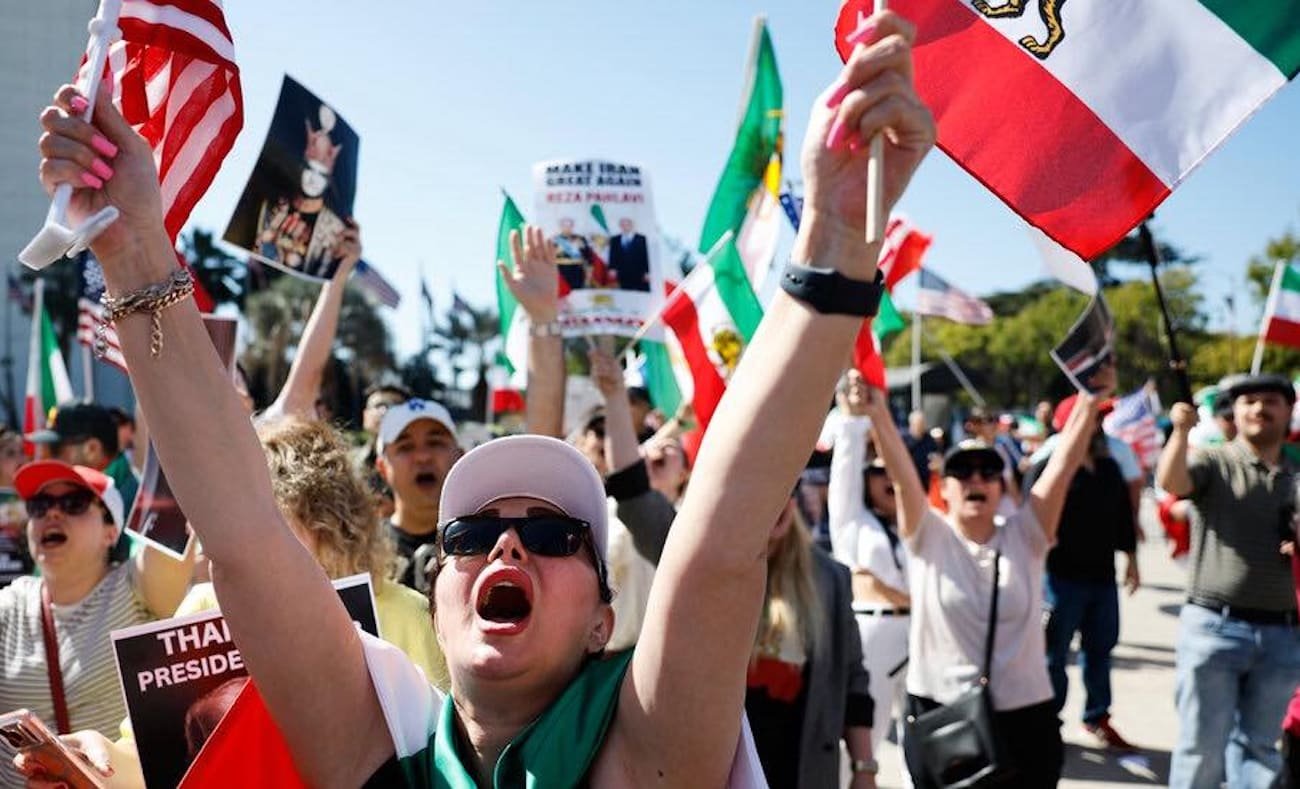
People themselves are ideologically complex, like in any other diverse society. Unsurprisingly, there are Iranians who still support the regime, those who align with monarchism, and those who seek American imperialism’s help in seeking to liberate Iran.
Anthropologist Shahram Khosravi had contended after the January 2026 protests, in which thousands were killed, that it is the defeated revolution and the condition called estisal, or helplessness, that forces people to turn to even inexplicable solutions like war as a deliverer of freedom.
But when the war actually begins, these solutions change. Reports indicate that some of those who initially cheered the assassination of Supreme Leader Ali Khamenei, and the intimation of freedom, are now afraid: of bombs falling on them, their children being killed and of their nation breaking apart.
In a poll conducted after the war began amongst Iranian-Americans, there was an even split on the U.S. decision to start a war but 62% favored diplomatic resolution going forward.
As history shows, imperialism is not interested in liberation or democracy. Donald Trump, a favorite of Christian nationalists, brazenly refused to accept that American strikes killed 165 Iranian children. A democratic Iran would be a disaster for American imperialism. Western imperialism is also perfectly fine with Islamic fundamentalism as long as it is servile: Mitchell coined the term “McJihad,” in which McDonalds and Jihad are not always opposites. He points to the history of the Saudi Arabian state, which is the “linchpin of the U.S. empire in the Middle East and of the global oil system.”
The war produces deep pathos, not just from the tragic devastations, but also from the realization that it reflects the failure of progressive international solidarity, for five decades, with those Iranians who simultaneously fought imperialism as well as religious despotism. A news report comment from an Iranian woman echoes the fears that many have about the war: “What if we are left with ruins and the same mullahs and the same government?”
And we can add: what if there is renewed Western imperial domination?
This story was first published in scroll.in and republished here with permission.
Nissim Mannathukkaren is a professor at Dalhousie University, Canada. His X handle is @nmannathukkaren.