


Fathers and Sons They Are a-Changin: ‘Single Papa’ is a Delightful Cure for Our Woke Versus Anti-Woke Times

- There are themes in this series that relate to a lot of broader questions playing out about Indian society, politics and culture today.

Blood may be thicker than water and bureaucracy stickier than both, but love — love alone conquers all! That was the resounding message I heard from the new Netflix miniseries “Single Papa.” And yet, being a social scientist, I could not help noticing how each of these themes (blood, love, bureaucracy) was represented in somewhat closer detail than what is expected of a colorful, breezy, engaging rom-com style show.
What is the show saying about the great questions of our liberal arts classroom, about agency and determinism, about gender, patriarchy, privilege and accountability, about Gen Z and its parents, tradition and modernity, the human condition in our times, as it were? These thoughts are pertinent, and yet, I would not be doing justice if I didn’t share up front how much I enjoyed racing through these six episodes in just a couple of evenings.
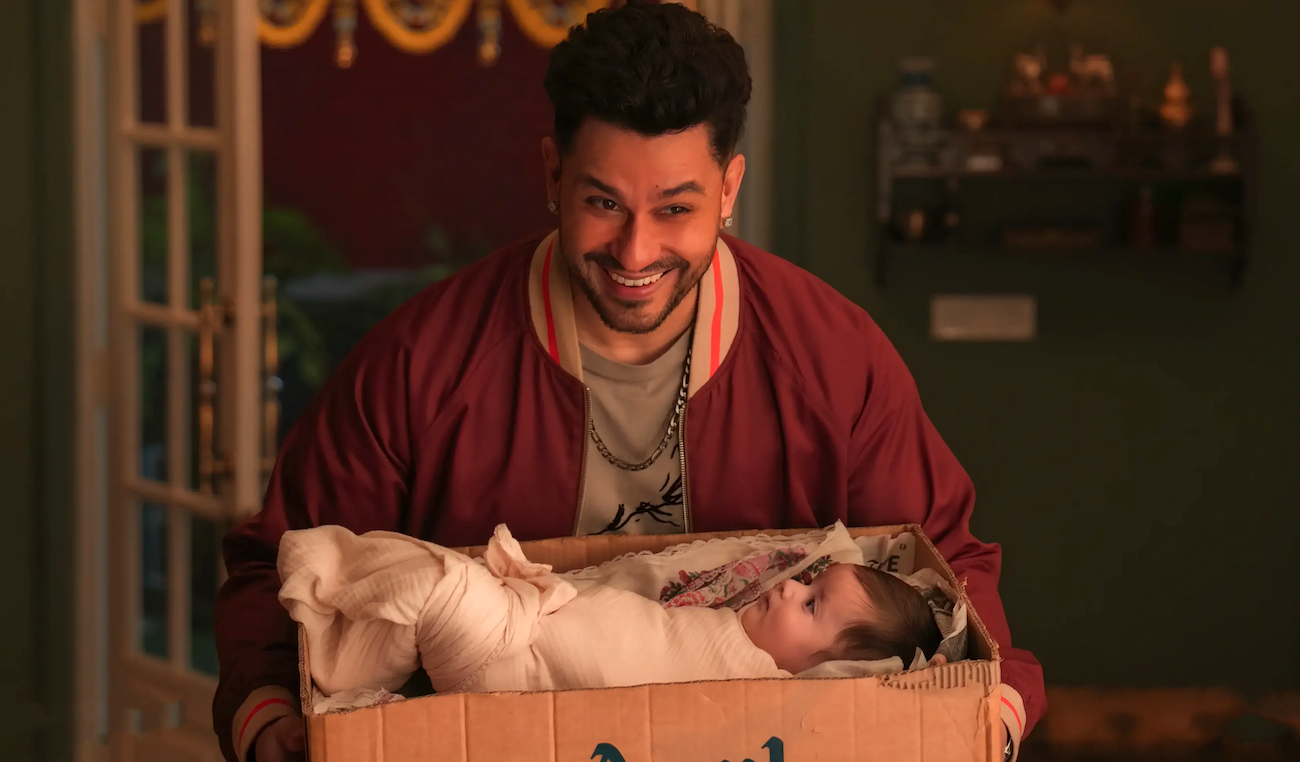
“Single Papa” (which after a few episodes I couldn’t help but pronounce affectionately as “Sin-gulluh Pappa”) is the story of a baby named Amul (because he mysteriously showed up in the hero’s car in a carton with that brand name) who, without saying a word (well, except one word towards the end), turns the protagonist from an “entitled” and “irresponsible” newly-divorced young man to the titular “Single Papa.” Gaurav Gehlot (Kunal Khemu) is a fun-loving husband who wants to be a father but does not inspire confidence in his soon-to-be ex-wife. The show begins with a cordial and not too bitter divorce, and then the twist – as if the gods want him to prove his worth as a future dad, someone leaves a baby in his car.
What happens from that point on is what makes the show a relentlessly engaging, funny, and heart-warming experience – even while some pretty weighty concerns unfold when one considers the real-world implications of everything being depicted. Gaurav has to first of all deal with a suspicious adoption agency director who is determined not to like him (Mrs. Nehra, portrayed by Neha Dhupia). Although he finds a wonderful ally in her young son (“Woke-Shlok”), he has his own personal and familial, not to mention wider societal and legal challenges, to work out. Gaurav’s sister Namratha (Prajakta Koli) is about to get married, and her future in-laws have some serious privilege and borderline prejudice issues of the caste and class kind. Gaurav’s father is annoyed with him and kicks him out of the house and the family liquor store, leaving him unemployed and even more vulnerable to rejection by the adoption agency. More and more funny, tender, and sometimes silly complications unfold (tempting as it is to celebrate more of them, I will pause rather than offer too many spoilers).
Viewers familiar with the usual contestations between Left and Right, or “Woke” and “Anti-Woke” (to simplify our complex positions and complex realities), will probably have a fun time figuring out where exactly the show lands in relation to the hot “culture war” topics of our time.
While the show hurtles towards the resolution we are hoping for (whether Gaurav gets to keep his Amul and become the Single Papa he so earnestly wants to be), it is worth considering what the creators of this story are able to reflect about families, parenthood, love, duty – and fun – in a society that has been undergoing rapid changes since the beginning of economic liberalization policies in the early 1990s. A logical comparison point for me as a student of media is the movie “Hum Aapke Hain Koun” (Who am I to You?). I was so intrigued by that movie’s success that I conducted an audience research study in the mid 1990s (and still discuss it with my students nearly thirty years later). If HAHK captured a cultural longing about finding a balance between love and duty, the individual and family, and self-interest and “sacrifice,” in the first years of post-liberalization India, “Single Papa” seems to tell a story of what happens when the children born in the wake of that cultural moment grow up (or don’t grow up) and try to become husbands and fathers in their own style at the moment.
In HAHK’s time, nightclubs, parties, consumerism and brand-worship were still somewhat new things in India. Today, they are as pervasive and normalized as high rises, construction dust, and traffic. Individualism, personal advancement, careers, identity defined through one’s actions rather than one’s inherited expectations are also much more widely felt and sought to be expressed. Yet, the traces of both the past and the present of India are in evidence in “Single Papa.” People in the show are liberal enough to stay friends after divorces, and yet fail to get over their own prejudices over either biology, or bureaucracy (or tradition, and modernity, as it were). Gaurav’s father has a tough time accepting what the neighbors might say about a stranger’s baby being brought up by his son. Mrs. Nehra has some stern ideas about men being incapable of parenting children on their own. From early liberalization years to the 2020s, modern India has got used to the idea of a “Single Mama,” a little bit, but the “Single Papa” is clearly something a show like this has to pick up deliberately, and to engage with creatively.
Those engaged with the ongoing debates in India about masculinity, parenting, and family (such as the Indian Express series “How to raise a boy”) might find this show a useful point from which to explore not only older assumptions and biases and prejudices, but also interrogate somewhat newer ones which have become rapidly normalized as well. Viewers familiar with the usual contestations between Left and Right, or “Woke” and “Anti-Woke” (to simplify our complex positions and complex realities), will probably have a fun time figuring out where exactly the show lands in relation to the hot “culture war” topics of our time.
Is it saying “woke” needs to be reined in, and boys given a chance to be good parents? Or, is it saying that “woke” is good, and boys need to step up beyond toxic masculinist roles to find their tender parental sides? Or neither? Or both? For once, politics seem inadequate before a story that is ultimately about relatable, vulnerable, flawed, yet likeable characters. And words – as a writer, I have to recognize how much the series came alive because of attention to language. It was so appropriate and powerful to hear a word like “mamta” (in the sense of vatsalyam, or maternal affection) being used, even while puns, slang, and colloquialisms kept the fun alive (and of course, full credit also to the directors and actors for making words and worlds come alive!)

In conclusion, it may be worth recognizing that there are themes in this show that relate to a lot of broader questions playing out about Indian society, politics and culture today. While, hopefully, many of us are realizing that things are bad enough in the world without our having to dig into our polarized political camps (an effect frankly of social media technologies as much as the politics themselves), there are creative moments like “Single Papa” which allow us to notice things not only in the show but in the pop culture and in people’s lives at large. Clearly, the message of the show is progressive, and tells us love is beautiful, even if it is not ordained by biology. Those who yearn for the annihilation of caste whether from the Left or the emerging Right in India who dream of utopias where babies are raised by the state not knowing who their biological parents are (or at least intra-caste marriages are banned) will appreciate that message.
And those who believe that inheritance is not only about nature but also about culture, who view tradition as not an unchanging monolith but a vast, nurturing cultural resource, will also see a “HAHK”-ish message. In the end, after all, the family, and who knows, the nation, maybe the whole world, can be both; liberal to overcome the prejudices of blood and caste, and respectful enough to draw on the strengths of continuity, kinship, family, and the past.
Gaurav may be a “Single Papa.” But his own papa, his mama, his sister, not one of them will let him down, will they? Nature or nurture doesn’t have to be one or the other. Blood doesn’t have to discriminate, but feed the heart that grows to include. Love truly will conquer all. May all beings enjoy Christmas, New Year, Sankranthi, holidays, and Single Papa together! Samastha Loka Sukhino Bhavanthu!
Vamsee Juluri is Professor of Media Studies, University of San Francisco. He is the author of “Becoming a Global Audience: Longing and Belonging in Indian Music Television” (Peter Lang, 2003), “The Mythologist: A Novel” (Penguin India, 2010), and “Bollywood Nation: India through its Cinema (Penguin India,” 2013), “Rearming Hinduism: Nature, Hinduphobia and the Return of Indian Intelligence “ (BluOne Ink, 2024) and “The Guru Within” (in progress).