



As We Commemorate Darwin Day, Let’s Examine if Hindu Thought Can Coexist with Darwinism

- Hindu philosophy does not reject evolution. It simply refuses to treat biology as ethics.
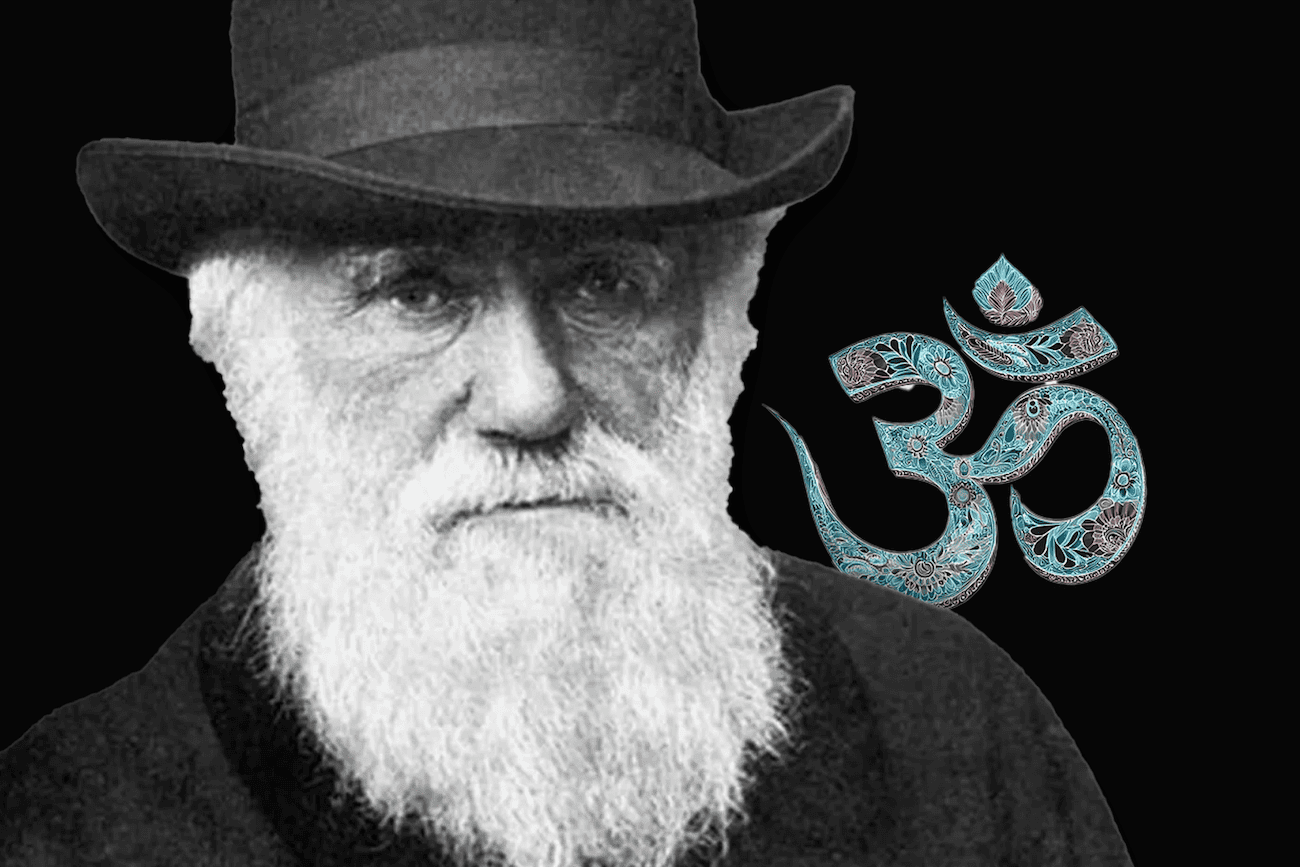

Today, February 12, is Darwin Day commemorating the birthday of Charles Darwin, the British naturalist known for his work on the theory of evolution by natural selection. Step into any modern arena — business, politics, education — and Darwinism quietly rules: survival of the fittest. Compete harder. Outperform others. Adapt or be replaced.
Charles Darwin meant something narrower and biological. “Fitness” simply described adaptability — organisms best suited to their environment survive and reproduce. But outside biology, the phrase has hardened into a philosophy. Life becomes a race. Winning becomes virtue.
This is where Hindu thought offers a broader, deeper view. It prizes compassion, duty, and restraint. Yet Hindu philosophy does not reject evolution. It simply refuses to treat biology as ethics.
Deendayal Upadhyay’s philosophy of Integral Humanism describes human life as an organic balance among four interlinked spheres: vyashti (individual), samashti (society), srushti (nature), and parameshti (spiritual world). Health lies not in competition among them, but in harmony.
Darwin speaks most directly to srushti, the realm of nature. The Bhagavad Gita acknowledges this dynamic world plainly:
“प्रकृतिं स्वामवष्टभ्य विसृजामि पुनः पुनः” (Gita 9.10)
“Under My supervision, nature brings forth the moving and the unmoving.”
What is Integral Humanism?
Integral Humanism, articulated by Deendayal Upadhyay, is a holistic social philosophy rooted in Hindu thought. It views life as a balance of four interconnected dimensions:
Vyashti – the individual
Samashti – society
Srushti – nature
Parameshti – the spiritual or transcendent consciousness
Progress comes not from maximizing competition in any one sphere, but from harmonizing all four through dharma, responsibility, and cohesion.
Life is not fixed; it unfolds through law and change. Saankhya philosophy similarly describes the world as an evolving process of cause and effect. In such a worldview, biological evolution presents no threat. Species adapting over time fits comfortably within Hindu cosmology’s vast cycles.
At the level of nature, “survival of the fittest” simply describes a mechanism. Humans are not merely organisms. We are ethical beings. That is the domain of vyashti and samashti.
Hindu dharma repeatedly asks us to restrain instinct, not glorify it:
“तेन त्यक्तेन भुञ्जीथा” (Isha Upanishad 1)
“Enjoy through renunciation.”
“अद्वेष्टा सर्वभूतानां मैत्रः करुण एव च” (Gita 12.13)
“One who has no hatred toward any being, who is friendly and compassionate.”
Compassion, not competition.
Civilizational heroes embody this ethic. Shri Ram relinquishes a kingdom to keep his father’s word. King Shibi offers his own flesh to protect a dove. Karna gives away his armor even at personal risk. By evolutionary logic, such acts appear irrational. By dharmic standards, they are above survival instinct: they are conscious, morally elevated, and hence, noble.

Upadhyay warns that a society driven only by individual competition eventually fragments. The global upheavals we’re experiencing today are proof to that. The vyashti must act with responsibility toward samashti. Service (seva), charity (dana), and restraint sustain communities far better than ruthless rivalry. Cooperation, not conquest, is what allows civilizations to endure.
Yet Integral Humanism adds one more dimension Darwin cannot address: parameshti, the spiritual unity underlying life. If our deepest identity is not the perishable body but an enduring consciousness, then life is not fundamentally a struggle for survival. We are not isolated competitors, but participants in a shared whole.
Seen this way, Darwin and Dharma occupy different domains. Evolution explains the body’s journey within srushti. Dharma guides conduct within samashti. Parameshti gives life meaning beyond survival.
Darwin explains how life changes.
Dharma explains how life should be lived.
Darwin tells us how we came to be.
Dharma reminds us what we ought to become.
In an age obsessed with winning, integral humanism might be the higher evolution we need most.
Anil Kothari is an Oklahoma City-based mechanical engineer, yoga practitioner and teacher.