



‘Chhaunk’: An Afternoon With Abhijit Banerjee at the South Asian Literature and Art Festival 2025

- The Nobel laureate turned out as a sharply dressed author, a passionate home cook, and a witty storyteller.
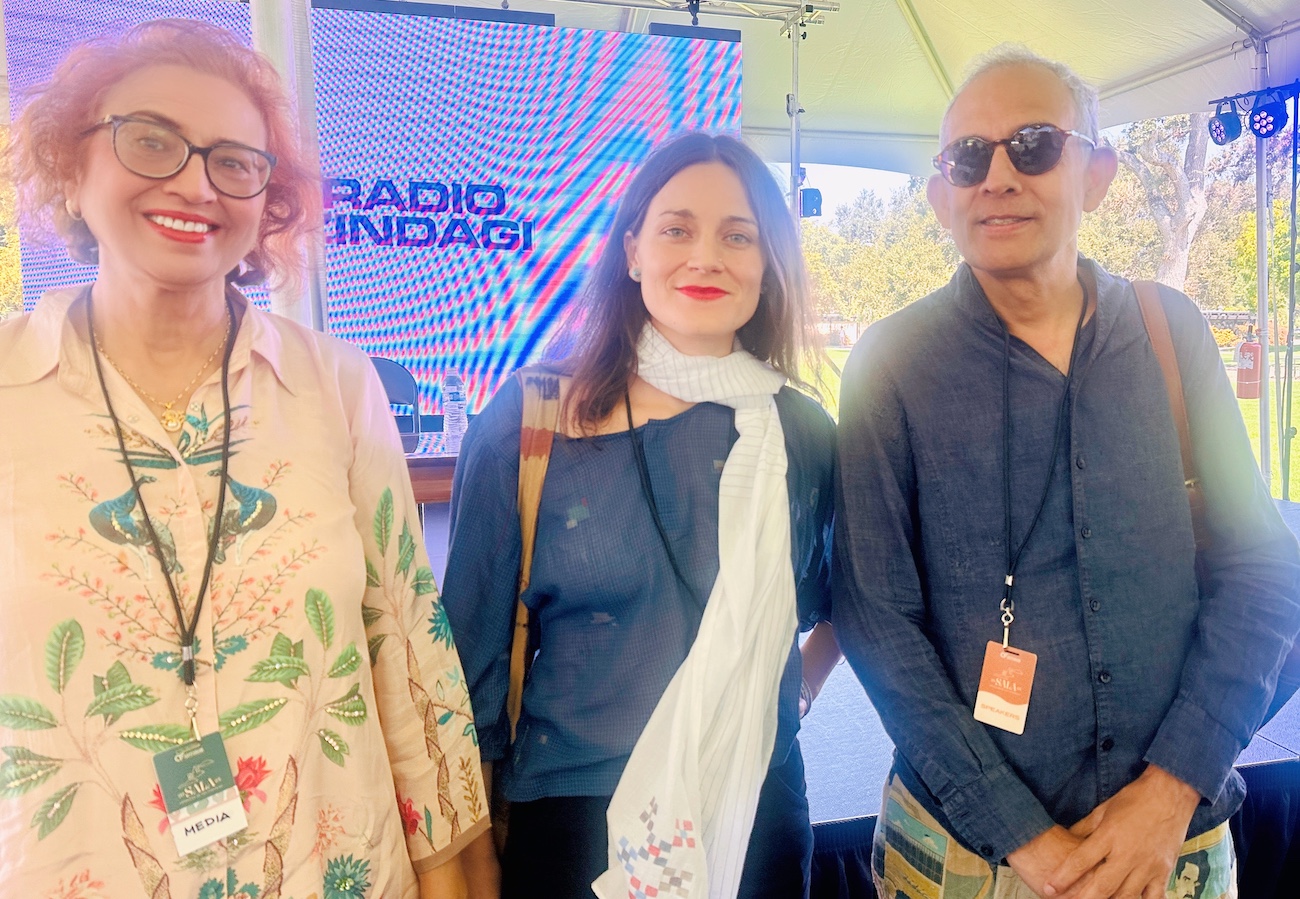

On a golden September afternoon at the South Asian Literature and Art Festival (SALA), I was thoroughly entertained and deeply moved by an unforgettable conversation with Nobel laureate Abhijit Banerjee. The occasion was the Bay Area launch of his latest book, “Chhaunk,” a deliciously original blend of memoir, food writing, and social commentary. The book comes alive not through glossy photographs of plated meals, but through whimsical illustrations by Cheyenne Olivier, a French artist.
SALA, now in its landmark edition, is the only festival of its kind in the United States. It is thoughtfully curated to showcase contemporary literature, visual arts, culinary traditions, and socio-political discourse from the South Asian subcontinent and its diaspora. This year’s theme, “Thoughts Without Borders,” encouraged reflection on the boundaries: national, cultural, and emotional, that we create, and how storytelling, art, and dialogue can help us transcend them.
Banerjee, who was awarded the Nobel Prize in Economics in 2019 for his work on poverty alleviation and development economics, appeared far removed from academic settings that afternoon. He was a sharply dressed author, a passionate home cook, and a witty storyteller. He spoke with warmth and ease, reminiscing about the tang of pickles and the comfort of sinking into a chair with a good novel and a bowl of geeli khichadi. His dry, self-deprecating Bengali humor added just the right flavor to the conversation.
The book, he explained, originated from his habit of sending recipes to his brother-in-law. As the idea evolved, he introduced Olivier to the Indian technique of tempering—chhaunk—where spices are briefly sizzled in hot oil to enhance the flavor of a dish. Olivier recalled burning the spices during her first attempt at making palak paneer, but with time, she mastered the technique. The title “Chhaunk” became a perfect metaphor. “It’s just a little splash, but carefully administered, it changes everything.”
The essays are light in tone but layered with insight. Banerjee draws unexpected connections between food, economics, gender, and migration. One piece explores women’s empowerment through the making of Bengali ghanto, while another examines the logic of savings through the preparation of shami kebabs. Banerjee described how he prefers to shop for seasonal and organic ingredients without worrying about cost, whereas Olivier, who grew up in France with a thrifty father, emphasized adapting and substituting ingredients to avoid overspending. A reflection, in itself, on the individual economics with food and the art of cooking.
What resonated with me most was Banerjee’s meditation on khichadi, the humble Indian dish made with rice, lentils, and leftover vegetables. For him, khichadi is more than comfort food—it’s a metaphor for the world today.
The choice to use illustrations rather than photographs was deliberate. Banerjee and Olivier explained that while photographs fix food in a specific time and place, illustrations invite memory, imagination, and cultural interpretation. One particularly memorable image shows a hungry man walking into the grandeur of Lucknow’s Imambara, rendered in a way that evokes both awe and loneliness. “Food is memory, not presentation,” Banerjee said. Olivier’s artwork captures that dreamlike, in-between space with delicate precision.
What resonated with me most was Banerjee’s meditation on khichadi, the humble Indian dish made with rice, lentils, and leftover vegetables. For him, khichadi is more than comfort food—it’s a metaphor for the world today. “Everything is thrown together, somehow muddled, with flavors colliding in unexpected ways.” When someone in the audience asked about his favorite dish, he smiled and quoted from the book: Bengali geeli khichadi, generously spiced and always served with pickles.
That mention immediately transported me to a small kitchen in Provence, two years ago, where I had cooked khichadi for friends who had come to France dreaming of charcuterie boards and bouillabaisse. But that night, it was my khichadi—tempered with translucent onions, cumin, a hint of asafoetida, and swirled with golden French butter. A simple soul food that everyone devoured. Even Banerjee seemed intrigued.
He also reflected on how food is perceived differently around the world. In America, he noted, food is abundant but often strangely joyless. “So much food, but so little flavor,” he said. In contrast, other parts of the world strive to make even the simplest ingredients taste deeply satisfying. In India, he observed, someone with just ten rupees might still spend it on mithai for a child, or more often, on a packet of Parle-G biscuits, found in nearly every shop, even in the most remote villages.
At that moment, I remembered the three Parle-G biscuits tucked away in my purse from my last trip to India. I had brought them back like talismans, just in case. I reached into my bag and pulled out the familiar yellow packet.
When I held it up, the room burst into laughter.

“Now that’s commitment,” Banerjee said with a smile.
From that moment on, I was affectionately known as The Parle-G Girl at SALA.
It was one of those rare, serendipitous moments that SALA is so good at creating—a space where memory, identity, art, and food come together. Where a Nobel laureate can explain global inequality through a bowl of khichadi, and where the humblest of biscuits can become the heart of a story.
Banerjee’s “Chhaunk” is not just a book. It’s a reminder that stories, like food, are most powerful when shared. And sometimes, it’s the simplest things—a cumin chhaunk in butter, a drawing of a hungry man in an architectural maze, or a tea biscuit from home—that leave the most lasting flavor.
I tried to buy a copy and have it signed by the brilliant duo, but “Chhaunk” had already sold out.
With one foot in Huntsville, Alabama, the other in her birth home, India, and a heart steeped in humanity, Monita Soni writes as a contemplative practice. She has published hundreds of poems, movie reviews, book critiques, and essays, and contributed to combined literary works. Her two books are My Light Reflections and Flow Through My Heart. You can hear her commentaries on Sundial Writers Corner, WLRH 89.3 FM.