


Call It What You May — Appalam, Appadam, Papad. It’s a Sophisticated Piece of Food Engineering in the Ancient World

- Yeah, your papad was engineered. Just not in a lab. This is a food with at least 1,500 to 2,500 years of documented history.
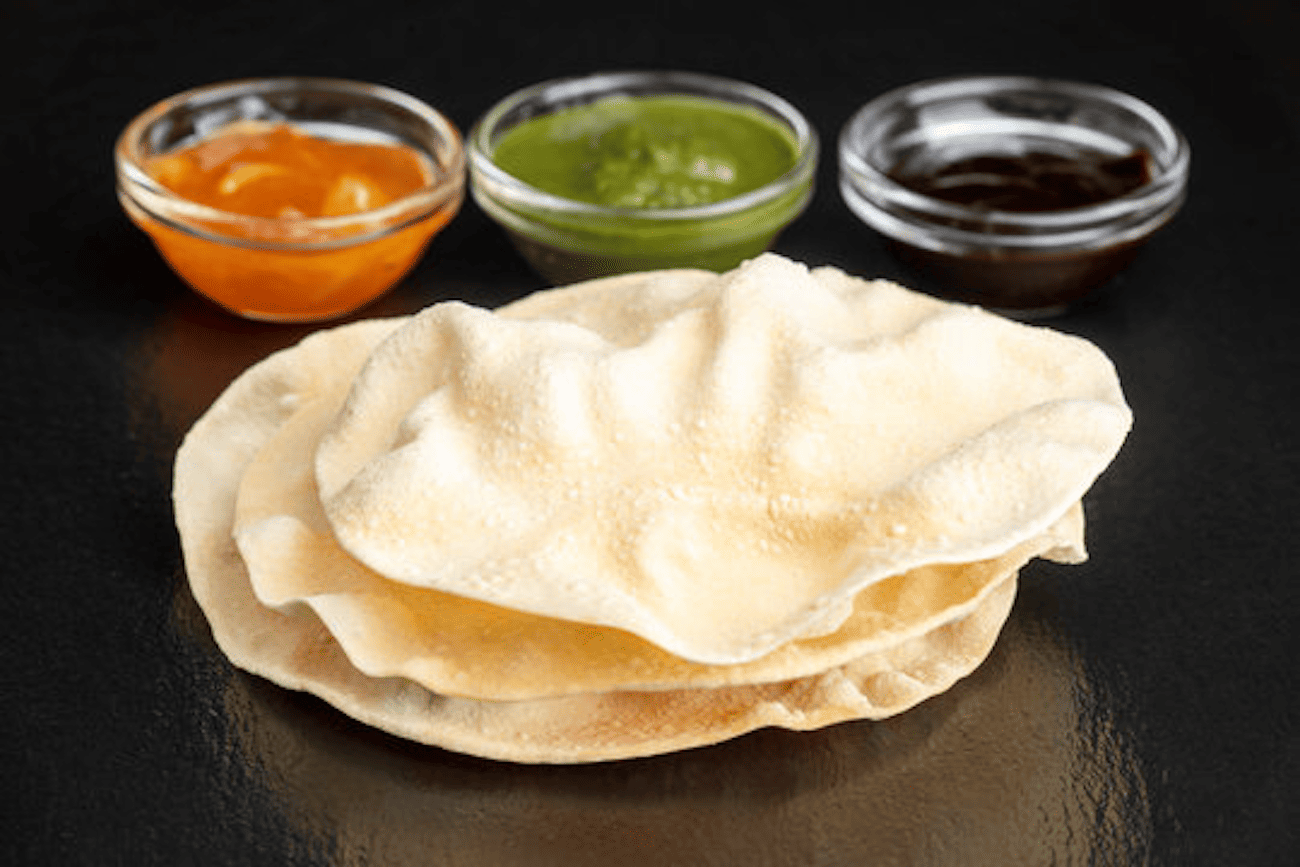

Pick up a papad before it hits the oil. It’s paper-thin — almost translucent. You can bend it slightly. It won’t crack. Now drop it into hot oil and watch: within seconds, it puffs up dramatically, blistering into a light, airy disc that shatters at the first bite.
That’s a paradox sitting right there on your ‘thali’ (plate).
Something thin enough to be nearly see-through should be brittle. Something brittle shouldn’t puff. And something that puffs like that shouldn’t have started as a flat, dense disc of dried dough. Yet every papad does all three things — flex, puff, and shatter — flawlessly, every single time.
The person who first figured this out didn’t have a food science lab. No electron microscope to study protein networks. No rheometer to measure dough extensibility. No peer-reviewed journal to consult. What they had was a lentil — a small, black, humble lentil called urad dal — and the patience to figure out, through generations of trial and error, exactly what it could do.
What they built was, quietly, one of the most sophisticated pieces of food engineering in the ancient world.
The Name Tells You Where to Look
The word papad has a long paper trail. In Hindi it’s pāpaṛ. In Tamil Nadu it’s appalam. In Telugu it’s appadam. In Kerala, pappadam. In Karnataka, happala — a word that appears in Kannada literature as far back as 1200 AD. Food historian K.T. Achaya places the first written mentions in Buddhist and Jain canonical texts around 500 BCE. This is a food with at least 1,500 to 2,500 years of documented history.
Linguistically, the word traces back through Sauraseni Prakrit pappaḍa to Sanskrit parpaṭa — meaning a flattened disc. English possibly borrowed it through Malayalam pappadam, which is how we ended up with “poppadom” entering British English in the 1860s, courtesy of the colonial encounter with South Indian cuisine.
The geography of the word matters. Tamil. Telugu. Kannada. The southern tip of the subcontinent. Because papad — in its truest, most fundamental form — is a South Indian technology. And at its heart is a lentil whose name also points south.
Vigna mungo — urad dal — takes its common name from Proto-Dravidian uẓ-untu, borrowed into Sanskrit as uḍida. In Tamil it’s uḷunthu. The lentil and the dish share a linguistic homeland. Pappu is the word for lentil in Telugu and paruppu is the Tamil equivalent. That’s not a coincidence. It’s a clue about what makes this combination work.
Problem One: Rolling It Impossibly Thin
Try making a papad with chana dal flour. Or moong. Roll it out to near-transparency and it will crack, tear, and frustrate you into abandoning the project. Most lentil doughs simply don’t have the structural flexibility to go that thin without falling apart.
Urad dal does. And the reason is in its proteins.
Food science research has shown that urad’s protein profile is dominated — about 63% — by globulins, with albumins and glutelins making up most of the rest. Critically, prolamins (the protein fraction responsible for gluten’s unique elasticity in wheat) are present only in trace amounts. So urad isn’t doing what wheat does. It’s doing something different — and in some ways, more remarkable.
Urad’s globulin proteins, when hydrated and worked into a dough, form a cohesive, viscoelastic network. Not gluten. But gluten-like in its behavior: it stretches without snapping, holds together under stress, and returns some elasticity when the force is released. Add to this urad’s natural mucilaginous polysaccharides — the same sticky, gel-like quality that makes urad batter so silky when you grind it for idli or dosa — and you get a dough that behaves more like a flexible sheet than a crumbly paste.
This is why a skilled papad-maker can roll the dough to under a millimeter thick, dry it in the sun, and have it hold its shape without a single fissure. No other common dal can reliably do this. Urad’s protein-and-mucilage matrix is, for this purpose, structurally unique.
Problem Two: Drying Without Cracking
Rolling thin is only half the challenge. Once rolled, the papad has to be dried — traditionally sun-dried for hours — without developing hairline cracks that would cause it to shatter during cooking rather than puff.
For Tamil appalam, urad manages this entirely on its own. The mucilaginous polysaccharides in the dough act as a natural binder and plasticizer, keeping the thin sheet flexible and cohesive as moisture slowly leaves during drying. No additives needed. The lentil does the work.
Modern food scientists studying papad quality — and there is a real body of peer-reviewed literature on this — are essentially reverse-engineering decisions that were already locked in over a thousand years ago.
In the North Indian papad tradition, however, a second ancient ingredient enters: papad khar, also called sajji khar(सज्जी खार).
Papad khar is an alkaline salt — not a single compound, but a mixture, historically made by burning certain plants (species like Salicornia and Arthrocnemum) and collecting the ash, then filtering and evaporating it into crystals. Its primary active component is sodium carbonate, alongside sodium bicarbonate and trace minerals. Its pH, when dissolved, sits between 10 and 12 — significantly more alkaline than baking soda.
What does this alkalinity do to the dough? Peer-reviewed food science research has confirmed what traditional makers knew intuitively: papad khar dramatically improves dough rollability. Without it, the dough resists rolling and the papad remains thick. With it, the dough becomes extensible and smooth. The mechanism involves the alkaline environment changing how urad’s proteins interact with each other and with the starch granules — loosening the protein network just enough to make the dough more pliable, while the cations in the salt help reorganize and reinforce the starch structure. The result is a dough that can be rolled to near-transparency and dried slowly without cracking.
Ancient makers didn’t know about sodium carbonate or protein-starch interactions. They knew that a pinch of this particular salt, dissolved in the water before kneading, made the dough cooperate. The chemistry explained itself thousands of years later.
Same Lentil, Different Philosophy
Here is where the story gets richer — because papad khar doesn’t just change the texture. It changes the taste.
In the right quantity, papad khar accelerates the Maillard reaction during frying — the same browning chemistry responsible for the crust on bread or the sear on meat. The result is a deeper, slightly toasty flavor with a faint alkaline bite. It is subtle, but unmistakable if you know to look for it. It is part of what makes a Bikaneri papad taste like a Bikaneri papad.
A Tamil appalam, made without any alkaline salt, tastes entirely different. Cleaner. The pure, neutral flavor of urad dal comes through without interference — brightened by asafoetida (perungayam), which Tamil tradition has always added for its sharp, onion-like depth and digestive properties. The puff is lighter, the snap is crisper, and there is no background alkaline note — just the lentil and the hing, in their most direct form.
Two foods sharing the same ancient origin, the same base ingredient, the same fundamental technique. But two genuinely different flavor experiences, produced by a single decision made differently in two culinary traditions: whether or not to add the salt.
This is what regional food diversity actually means at its most interesting level. Not just different spices or different shapes — but different engineering philosophies, producing different sensory outcomes, both of them refined over centuries into something that works perfectly on its own terms.
Problem Three: The Puff


Now the oil is hot. The papad goes in. And something almost theatrical happens.
Three things are occurring simultaneously, very fast. First, moisture trapped in the dried dough turns instantaneously to steam as it hits the hot oil — a flash evaporation that tries to expand outward. Second, any air pockets in the dough matrix expand rapidly with the heat. Third, the sodium bicarbonate component of the papad khar reacts to heat, releasing CO₂ gas.
In most doughs, these expanding gases would simply escape. The structure isn’t strong enough to trap them. But urad’s protein-starch matrix — that same resilient network that allowed the dough to roll thin and dry without cracking — is strong enough and flexible enough to trap the gases momentarily, forming blisters. Those blisters are the puff. And because the matrix sets almost instantly in the hot oil, the blisters are locked in permanently, giving the papad its characteristic lightness and the airy crunch that makes it shatter so satisfyingly.
Three problems. One lentil. One ancient alkaline salt. All of it working together — and all of it understood functionally, if not molecularly, by the people who made papad for centuries before food science existed as a discipline.
What Ancient Cooks Actually Knew
It’s tempting to romanticize this as pure instinct or luck. It wasn’t. It was systematic empirical knowledge, accumulated across generations and refined through failure.
Someone, at some point, tried making this with a different lentil. It didn’t work. They went back to urad. Someone tried skipping the alkaline salt. The dough was uncooperative, the fried result disappointing. The salt stayed. Someone tried a different drying method. The papad cracked. The sun-drying technique persisted.
What emerged was a recipe that was, functionally, a set of optimized parameters for a complex material science problem: how do you take a legume, reduce it to a thin flexible film, dry it stably, and then transform it with heat into something light, airy, and crisp?
The answer required the right raw material (urad’s unique protein-mucilage profile), the right process (thin rolling, slow drying, high-heat cooking) — and, depending on the tradition, the right additives. In Tamil Nadu, asafoetida (perungayam) for its digestive properties and distinctive flavor. In the North, papad khar to push the dough’s extensibility even further and give the fried papad extra lift and a deeper, toastier character.
Modern food scientists studying papad quality — and there is a real body of peer-reviewed literature on this — are essentially reverse-engineering decisions that were already locked in over a thousand years ago.
A Thought to Take to Your Next Meal
The next time a papad lands on your table — whether it’s a clean, crisp appalam in a Tamil restaurant, a deeper-flavored spiced papad with your dal-roti at home, or a poppadom arriving before your curry in a British Indian restaurant — look at it for a moment before you reach for it. They are not quite the same thing. But they came from the same place.
It is thinner than most paper. It traveled through centuries of accumulated knowledge to get to your plate. It is the product of an engineering problem that was solved without engineers, a chemistry experiment conducted without chemists, and a material science achievement that predates materials science by millennia.
Then break it. It deserves that.
Ganpy Nataraj is an entrepreneur, author of “TEXIT – A Star Alone” (thriller) and short stories. He is a moody writer writing “stuff” — Politics, Movies, Music, Sports, Satire, Food, etc.