



Voldemort Redux: New Carnegie Survey Documents a Rising Hate That ‘Will Not Be Named’

- Like most institutions Carnegie has, time and again, chosen not to connect anti-Hindu findings to Hinduphobia.

Carnegie Endowment’s latest survey on Indian Americans, offers some painstakingly collected data but surprisingly declines to draw the obvious conclusions from it. The survey documents an explosion in anti-Indian hate online, finds that this hate is driving the community to retreat from the public square and hide its identity, and records that a significant portion of the community continues to face in-person intimidation. Given that Hindus comprise at least 55% of the Indian American community, there is a straightforward word for what the survey is describing: anti-Hindu hate or Hinduphobia.
Carnegie, however, never uses it—much like the denizens of the wizarding world who would not speak Voldemort’s name. We can only wonder at the hesitation.
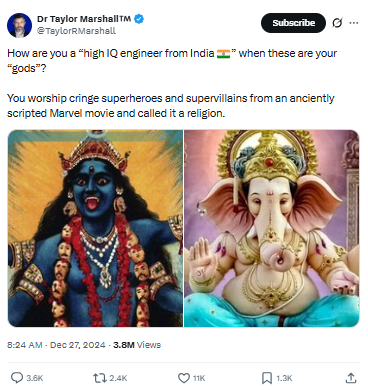
The survey finds that since the start of 2025, one in four Indian Americans have been called a slur. Carnegie’s own report cites research calling the U.S. an “epicenter of anti-Indian digital racism.” What the report shies away from saying is that much of this hate was not simply anti-immigrant, it was specifically and visibly anti-Hindu.
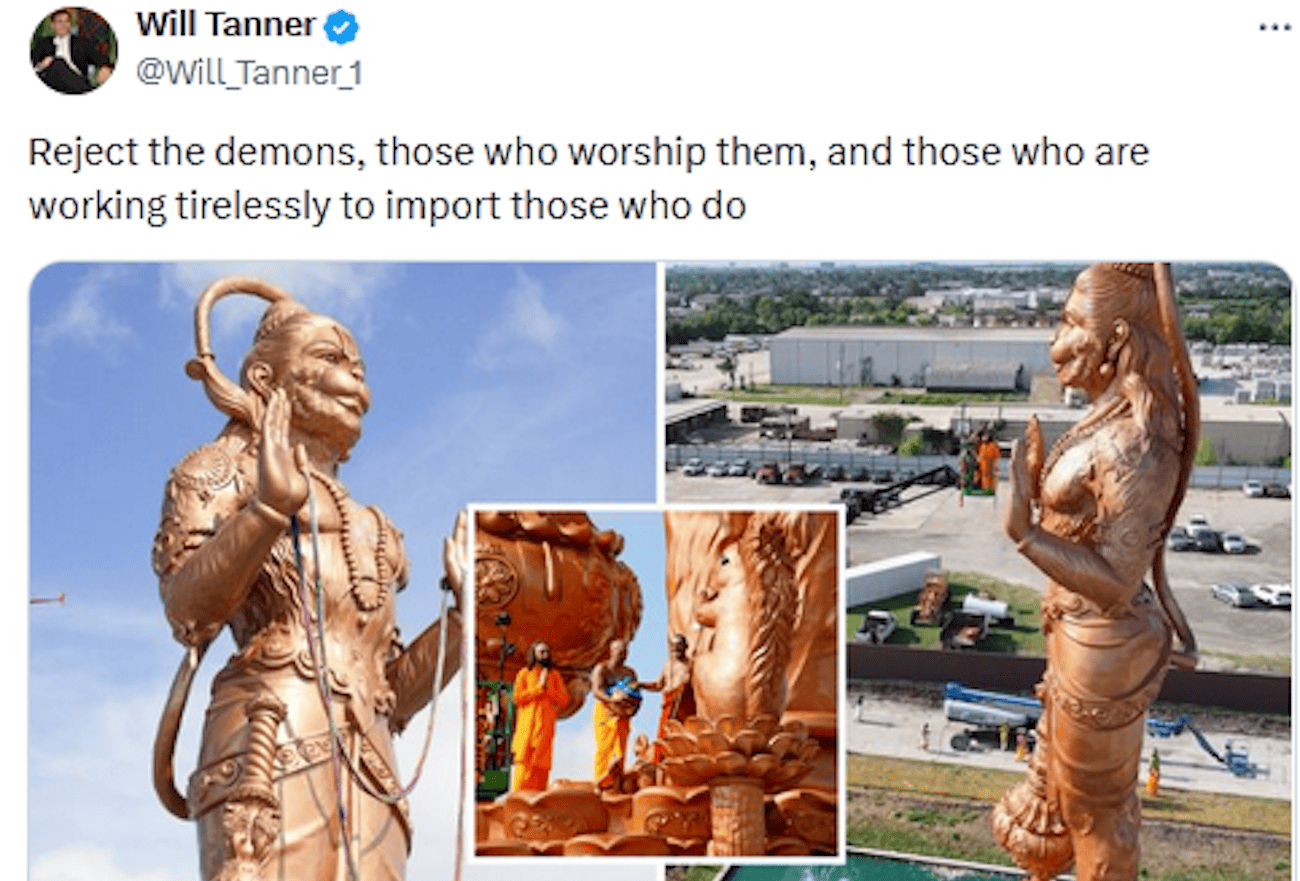
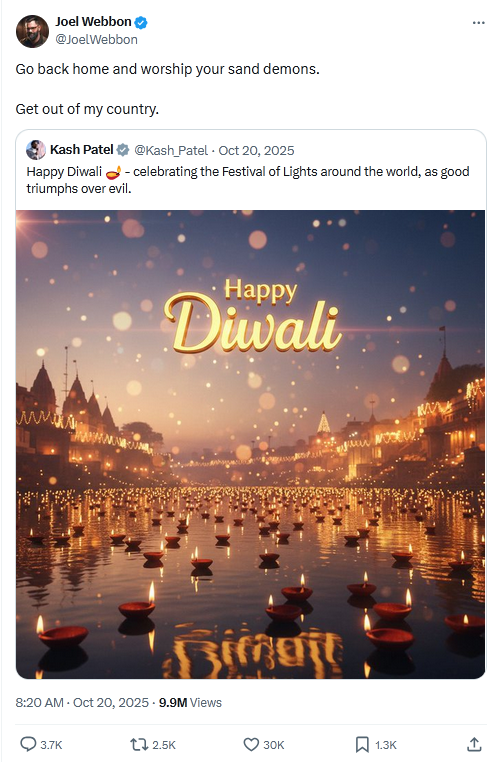
In late 2025, around Diwali, when anti-H1B hate exploded online, the slurs defaulted almost immediately to Hindu deities, traditions and names—even though this visa program for high-skilled workers has no religious criteria. Posts from handles with hundreds of thousands of followers ranted against “idolatry,” “demon gods,” the “monkey god,” and worse. Innocuous greetings for Diwali in 2025 generated a flood of religious bigotry against this beautiful Hindu festival. A New York Timesbestselling author argued against immigration that leads to temples! The target was never immigrants in the abstract. It was always Hindus.
In 2022, research by the Network Contagion Research Institute at Rutgers University documented exactly this pattern wherein social media was systematically weaponized to target Hindu communities often by bots and geo-political players. That study also warned the Hindu community to be cautious since hate in the online world tends to seep into the physical world. Carnegie’s own data now shows that that’s what is happening.
Carnegie’s survey notes that almost every one in five respondents is shying away from wearing their bindis and tilaks; 23 percent of Indian Americans believe Hindus face significant in-person discrimination.
Carnegie’s survey notes that almost every one in five respondents is shying away from wearing their bindis and tilaks; 23 percent of Indian Americans believe Hindus face significant in-person discrimination, and 71 percent feel uncomfortable about how their religious backgrounds are viewed in America. The survey also notes—almost in passing—that reports of in-person discrimination have remained stable, not because the situation hasn’t worsened, but more people are possibly censoring themselves to avoid harassment. That is an important observation which, again, underscores the connection between online Hinduphobic hate and fear in the physical world.
Moreover, the survey data does not exist in a vacuum. In 2025 alone, multiple Hindu temples were vandalized and desecrated across the country—from Indiana to southern California to Utah where gunshots were fired at an ISKCON temple while worshippers were inside. The new year began with a North Carolina temple statue being attacked and damage-even as prominent politicians and influencers ramp up hate against “idols”. California, in particular, has documented a sharp rise in hate crimes against Hindus, second only to antisemitism. There has also been palpable opposition to the construction of new Hindu temples and murtis, no matter that they were financed by private money and built on private land.

In its 2026 survey, Carnegie has documented all of this—the continued rise in anti-Hindu hate especially on the internet; the fear that is creeping into the Hindu American community; and the consequent behavioral changes that are pulling away an otherwise well-integrated community from public life.
But like most institutions Carnegie has, time and again, chosen not to connect these findings to Hinduphobia. It in keeping with the findings from the Rutgers University research that observed how under reported and under studied Hinduphobia is. Indeed you have many academics and institutions that go in the reverse direction – and seek to explain or justify anti-Hindu hate by a number of creative labels to avoid addressing the religious bigotry at play.
In the wizarding world, the refusal to name Voldemort didn’t protect anyone—it just gave the threat more room to grow. We are seeing the same dynamic play out in the real world. Naming a problem is the first step to tacking it. Stop Hinduphobia.
Pushpita Prasad is a storyteller and communications professional with a background in working with media, technology, and history. She is passionate about topics related to India, Human Rights, Hinduism, and Culture. Pushpita is involved with organizations focused on advocating for minorities, finding their stories, and helping to elevate their voices through multiple media and channels.