


A Paean to a Poet: Vinod Kumar Shukla Allowed Me to Accept Parts of Myself That are Not Tended To

- The Sahitya Akademi Fellow, who passed away last week, believed writing is how we create a fresh world and right or oppose the wrongs we see in the world.
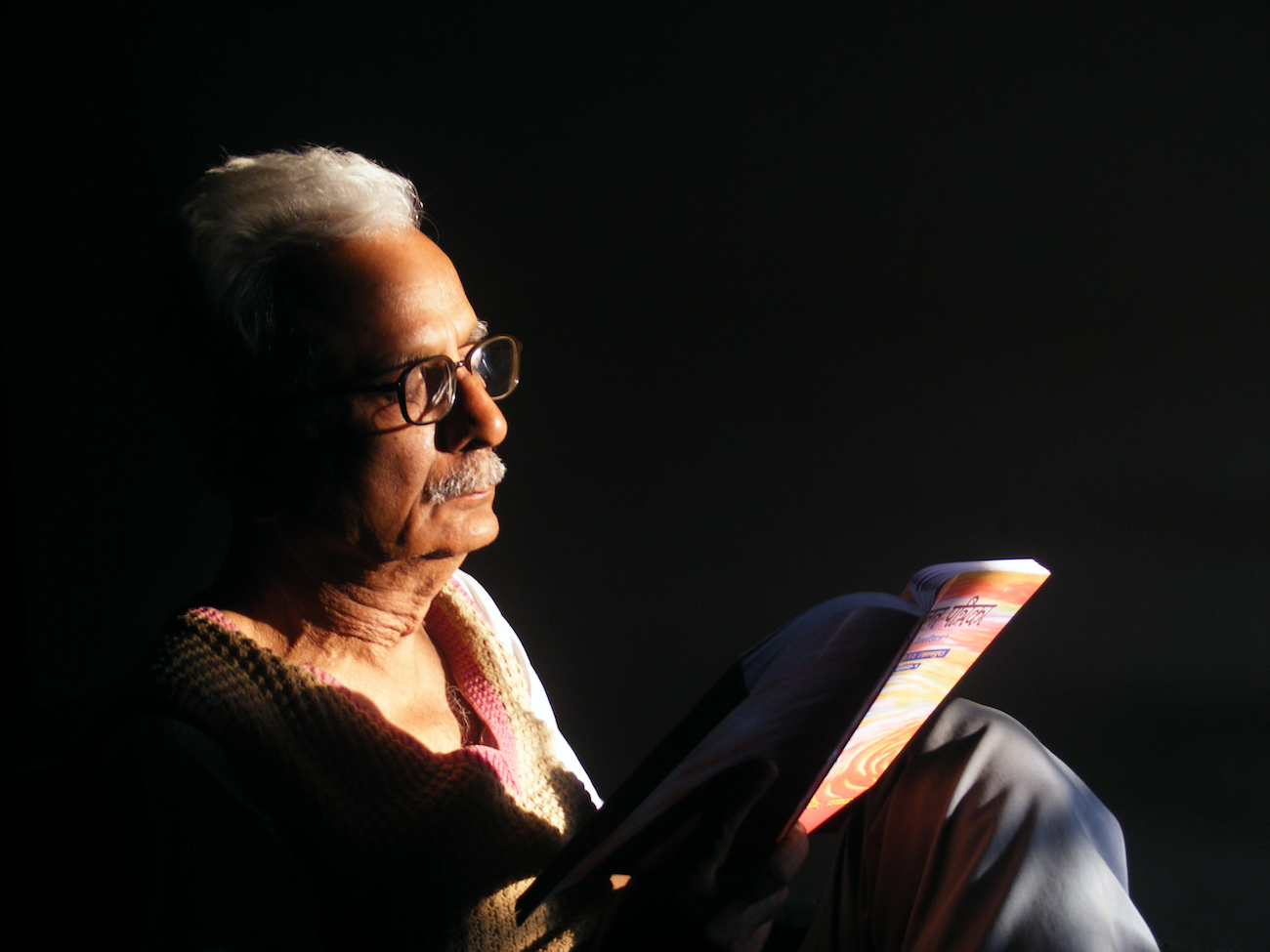
On December 23rd at 5pm IST Hindi writer Vinod Kumar Shukla breathed his last at the AIMS hospital in Raipur, India. In California, I woke up to this news via social media on the morning of December 23rd. Despite having known of his ill health and weeks long hospitalization and the fact that his 89th birthday was coming up on 1st January 2026, my mind wanted to deny the sad news. I remember thinking ‘It is not 5pm here yet. He is still around in my time”
In one of his poems he expressed that — even on his last day, he could start a poem just like his first ever poem and leave it unfinished — but this unfinished is not the same as leaving it undone. Instead, it is proof that life was lived fully. When the former chief minister of Chattisgarh visited this Sahitya Akademi Fellow and award winner in the hospital to ask if he was being treated well, Vinod ji, asked him if it was possible to arrange for paper and pen, so he could continue to write.
Writing for him was synonymous with breathing. He wanted everyone to write. He urged that everyone ought to write their own history, so we can resist what passes for history. Writing is how we create a fresh world and right or oppose the wrongs we see in the world. His gentle but firm opposition was rooted in action — not as an activist — but as a writer. He wrote about the ordinary daily life he experienced around him, by bringing such careful regard and attention to it, that every reader could recognize their own humanity in the relatable simplicity of it. His mastery was not in the use of grandiose vocabulary or clever literary tricks but to write in words simple enough to be accessible to a non-literary casual reader of Hindi, such as this non-resident Indian. To express something simply is the hardest thing to do, as it requires clarity of expression and thought, to identify the idea to its core.
Photos by Shaswat Gopal Shukla.
Vinod ji wrote as he lived, rooted firmly in his experience, with an unmatched imagination to see the parallel possible universes in everything all at once, and a disciplined commitment to his chosen ways through it. A difficult thing to comprehend is his belief that any writer only writes about one thing in their entire life, even if it is expressed differently as poems, prose, fiction or essays. In this world, where most writers will commit to being either a poet, a fiction writer, and maybe even more specific — short story or novel form as well as non-fiction writer, so how can it be just one thing? We make choices everyday as we go about our lives, and these mundane daily choices collapse the possibilities latent in each moment into a single reality that we inhabit. This is the real experience that was the basis for what he expressed in his writing.
Vinod ji won several awards, Pen Nabakov and Sahitya Akademi amongst them. His writings are translated into many languages. He wrote poems, prose, lyrical prose and poems that are prose, exploring an idea and describing the times and nature. He taught at an agriculture college as his primary occupation and had a life long love for nature — with poems to rivers, mountains, birds, trees, etc.
A giant amongst contemporary Hindi writers who won some of the highest national and international honors without even knowing of them, let alone by aspiring to them, his voice will remain a major force for a long time to come. As I walked out in nature— to deal with the sad news, I thought — if he was to be a tree, surely it would be an evergreen tree. The rustling golden and maroon leaves that covered the floor under the bare winter trees — felt like confetti, spreading colors to celebrate his life.
Vinod ji was a poet who chose words carefully, to paint his astute observations of simple everyday scenes from his life in such a manner that his writing resonated with his readers.
Vinod ji was a poet who chose words carefully, to paint his astute observations of simple everyday scenes from his life in such a manner that his writing resonated with his readers as if they were from anyone and everyone’s life. For me, his writing succeeded in delivering self-compassion and empathy to silence my loud inner critic. His poems allow me to accept parts of myself that are not tended to, but carried in embodied ways. The very first time I heard his poem, discovered in a random YouTube scroll, I just teared up, for no apparent reason, than the gentle truth it voiced. Over the years, many of his poems have become like old friends, that I revisit, translate and read out loud, as often as I get a chance to share them with others. In the Poetry of Diaspora circle, I am known as his fan, though I am not the sort to idolize anyone. I found him fluent in silences, that are embedded in-between the words and meanings in-between the lines he pens with the utmost simplicity. It is the most authentic experience for me.
In addition to love of nature, I share with him the regard for traditions. In the documentary made by Manav Kaul, he talks of his life-long love for his wife. They find novelty in it and know and honor the tradition of returning back to love, after the inevitable conflicts. I also share the importance of being rooted in a place enough to know it intimately well, and having rituals that refresh. The rootedness allows for closer observations as the constant changes in the world can only be measured if we have some stable ground for comparison. The rituals observed mindfully is a way to find novelty in it afresh every time, without getting stuck in a rut. Each breath is precious, as the spiritual masters teach — but one does not have to be a renunciate to practice that presence. A house-holder can have a monk’s attitude of mindful intention to all the duties of a householder.
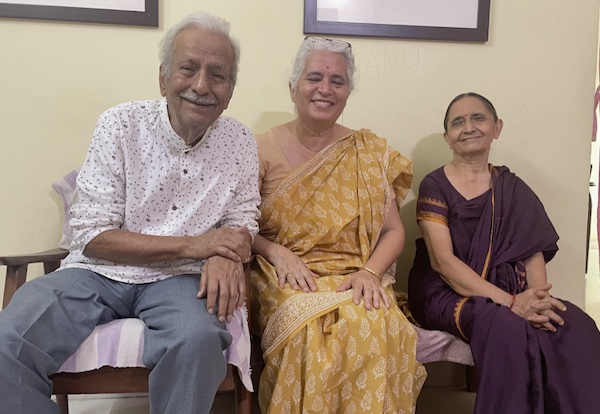
During my last visit to India, in June last year, I visited him at his home, and met his family too. The warmth of their reception was such that I made plans to return to Raipur to spend more time there. The love and the wish for more time together was mutual, because they arranged for me to meet his son and granddaughter again the following day, and arranged a family friend of theirs’ to offer me a guided tour of the local museum to learn about the native tribes of the region. (see photo at the museum). I was also visiting the Indian Institute of Management at Raipur, as a visiting professor, hosted by Prof. Suneetha Sagudi.
Vinod ji believed that once a writer has published something, it belongs to the readers. I also believe that poems have their own journey in this world, independent of the poet’s aspirations. Here is an incident to illustrate what I mean. While I was staying at the IIM Raipur campus, the Chattisgarh Chief Minister and most of his cabinet were also staging in the same executive hostel as they participated in a three day Chintan Shivir (strategy retreat). They moved about with security and press personnel from their rooms to the dining room and the class rooms. One afternoon, I went down to the lobby of the building where we were all staying, with an extra copy of Vinod Kurmar Shukl’s book in hand. My intention was to gift it to a student as I had two copies of the same book. I had purchased one and then Vinod ji had gifted me one too. As I stood in the lobby, talking casually with my counterpart — a strategy professor Samar Singh, the entourage of these politicians moved past as they went from the dining hall towards their class room. The security personnel kept stern looks and marched past with a stiff posture, very close to where we were standing. As the politician they escorted approached, our eyes met so I greeted him with folded hands as per the local custom. He nodded as he approached and as he came closer than an arm’s length, on instinct, I offered him the book I was holding, with a “I have a gift for you.” He accepted it even as he kept moving and disappeared into the class room, with the doors closing after him.
Prof. Singh asked me if I knew this man and if this was my plan for being there. I said no — I did not know who he was and my being there was a spontaneous break in my day, and sheer instinct that had let me offer him the book I had to give away. Prof. Singh then told me that the person I gifted it to was the Chattisgarh Chief Minister Vishnu Deo. This is how the poems found their way to the reader they wished to go to. Later that evening when I met Shaswat Shukla, Vinod ji’s son, and told him this, he made the expression to convey that his father did not care what positions of power his readers held or not. I guess a part of me wants political powers to be more under the influence of poetry, just as President Jimmy Carter and Prime Minister Atal Bihari Vajpayee wrote poetry.
Vinod ji believed that each person should write their own history, and return to what they knew of their childhood, to honor all that is stable even in the midst of all that changes, in our own lives. If we each write our own histories, we will not need to rely on anyone else’s version of it. It is advice I agree with, exactly as I agree with his rooted life — because only with a consistent dedication to place and routines, can we free up the mental bandwidth to engage meaningfully and deeply with the world around us. Like him, I have my daily ritual to get a dose of wonder, mine from a walk by the Bay, where I have walked since 1988. I am never bored of it, though all my friends are happier seeking novelty elsewhere. I find it fresh every time with the weather, time of the day or day of the week and seasons and migratory birds. And like him, I tend to not defend my actions to my critics, focussing instead on creating and building, and there is barely enough time and energy for that.


Despite the vastly different life from mine that was Vinod ji’s life, a remarkable number of similarities also come to my mind. We both have a swing in our homes where we like to sit. We are tree-huggers, although being a professor in the college of agriculture, his relationship with plants is on a vastly different level of intimacy. But we both made a living from occupations unrelated to languages, but also write routinely, all through our life. We both were raised by single mothers with help from caring extended family and have a great deal of empathy for them. We both had to leave our childhood home but carry it within, committing to memory what needs to be preserved. We both are also forgetful with memory playing tricks on us.
The best way to honor an author is to read what they wrote. Here is a trailer to sample online, to try before you buy, with time commitments mentioned alongside.
In 2 minutes, read his best known poem with my english translation of it here.
In an hour, watch this documentary about him, made by Manav Kaul and Achal Mishra.
For reading his books in Hindi original — Naukar ki Kameez and Deewar Main Ek Khidki Rahti Hai are good, as are the poetry collections Atirikt Nahin or Ek Poorv Main Bahut Se Poorv. For English translations, see the books by his long term collaborator Prof. Arvind Krishna Mehrotra.
Dr. Jyoti Bachani is a Full Professor at Saint Mary’s College of California. She is the co-founder of the U.S. and India chapters of the International Humanistic Management Association, and a well-published scholar. She is the founder of the group Poetry of Diaspora of Silicon Valley. She translates Hindi poems and has published three poetry anthologies. Amongst the many awards she has earned for her teaching and research, are the prestigious Fulbright Fellowship and Outstanding Lasallian Educator. She earned her degrees from London Business School, Stanford University, and Delhi University.