



‘Today Begins a New Era’: Inside Zohran Mamdani’s Historic Inauguration as New York City’s First Muslim Mayor


At precisely 12:01 a.m. on Wednesday, January 1, 2026, as fireworks still echoed across New York harbor from Times Square celebrations, Zohran Kwame Mamdani placed his hand on a centuries-old Quran in the ornate, arched-ceiling chambers of the abandoned City Hall subway station and took the oath of office as New York City’s 112th mayor.
“Happy New Year to New Yorkers, both inside this tunnel and above,” Mamdani said, standing beneath a vaulted ceiling with the words “City Hall” overhead. “This is truly an honor and a privilege of a lifetime.”
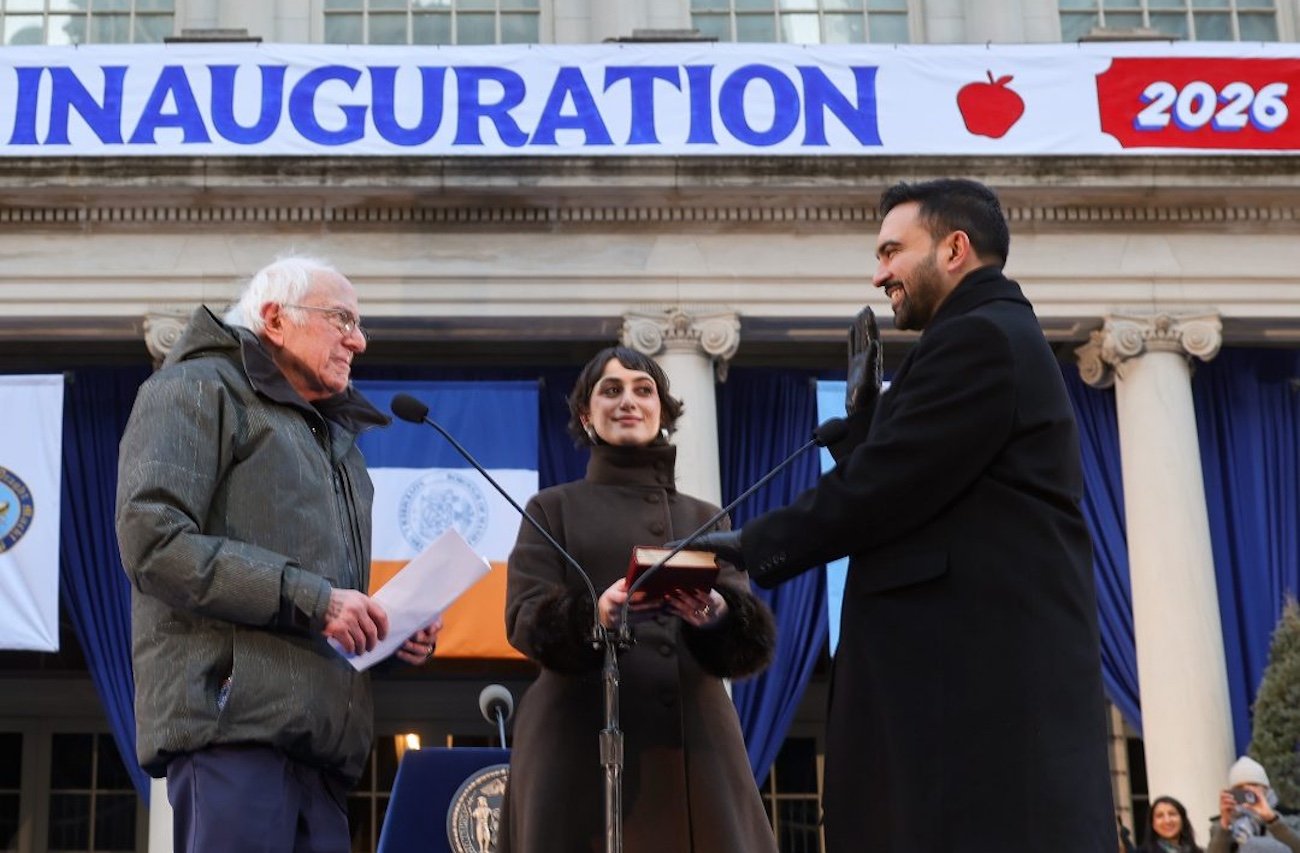
Thirteen hours later, tens of thousands of New Yorkers packed Broadway from Liberty Street to Murray Street—the famed Canyon of Heroes—for what Mamdani’s team dubbed the “Inauguration of a New Era,” a massive public celebration that transformed City Hall Plaza into what felt less like a typical government ceremony and more like a progressive political revival.
By day’s end, the 34-year-old democratic socialist had become the first Muslim mayor, first South Asian mayor, first African-born mayor, and youngest mayor in generations of America’s largest city—while delivering an unapologetically ambitious inaugural address that rejected calls to lower expectations and promised to prove “that when a city belongs to the people, there is no need too small to be met, no person too sick to be made healthy, no one too alone to feel like New York is their home.”
History Made Underground
The private swearing-in ceremony took place in one of New York’s architectural treasures—the original City Hall subway station, opened in 1904 and decommissioned in the mid-20th century. The station is known for its ornate arches and tiled ceiling and is accessible only a few times a year through guided tours.
New York State Attorney General Letitia James, a political ally and one of Mamdani’s earliest prominent backers, administered the oath. Standing beside Mamdani was his wife, artist Rama Duwaji, along with his parents—filmmaker Mira Nair and Columbia University professor Mahmood Mamdani.
Mamdani was sworn in on a centuries-old Quran from the library’s collections, making him the first New York City mayor to take the oath on Islam’s holy book.
“The subway site, according to Mamdani’s transition team, reflects his ‘commitment to the working people who keep our city running every day.’” In his brief midnight remarks, Mamdani called the old station “a testament to the importance of public transit to the vitality, the health, the legacy of our city,” before pivoting to announce his pick for Department of Transportation commissioner.
A Progressive Movement Celebrates
By early afternoon on January 1st, thousands of Mamdani supporters—many decked out in “Zohran” campaign merchandise and buttons reading “NYC Inauguration 2026″—lined Broadway behind barricades for the 1 p.m. public ceremony.
According to CNN, Jen Shoemaker, a New Orleans native who moved to New York 14 years ago and volunteered for Mamdani’s campaign, arrived more than two hours early, “decked out in a colorful headpiece with flowers and a ‘Zohran’ paper fan.”
“Everybody’s so energetic. We’re so ready for Zohran,” Shoemaker told CNN. “We need Democrats with backbones and Zohran has one.”
The ceremony featured some of the biggest names in progressive politics. Independent Vermont Senator Bernie Sanders—whom Mamdani calls his inspiration—administered the oath of office during the public ceremony. Democratic Representative Alexandria Ocasio-Cortez also spoke, as did poet Cornelius Eady.
Sanders told the crowd: “In a moment when people in America and in fact the world are losing faith in Democracy, over 90,000 of you in this city volunteered for Zohran’s campaign,” thanking New Yorkers for what he called “the biggest political upset in modern American history.”
“You showed the world the most important lesson that can be learned today,” Sanders continued. “That is that when working people stand together, when we don’t let them divide us up, there is nothing we cannot accomplish.”
Ocasio-Cortez declared: “In Zohran Mamdani, we have chosen a mayor who is relentlessly dedicated to making life not just possible, but aspirational for working people.”
She continued: “Zohran will be the first Muslim mayor of our great city. He will be our first immigrant mayor in over a century. And he will be the youngest mayor of New York City in generations. But most importantly, Zohran will be a mayor for all of us.”
Poet Cornelius Eady read a poem dedicated “to my trans, queer, foreign students of color at the University of Tennessee, Knoxville,” where he said he had recently retired, “so they can see this is possible.”
“We Will Not Reset Expectations”
Taking the microphone before the assembled thousands, Mamdani delivered an inaugural address that doubled down on his campaign’s ambitious promises rather than tempering them.
“My fellow New Yorkers, today begins a new era,” Mamdani began. “I stand before you moved by the privilege of taking this sacred oath. Humbled by the faith that you have placed in me.”
He acknowledged some confusion about whether he’s the city’s 111th or 112th mayor, “referring to some confusion in the city’s historical record.”
Then came the core of his message—a direct rejection of those who counseled moderation.
“In writing this address, I have been told that this is the occasion to reset expectations, that I should use this opportunity to encourage the people of New York to ask for little and expect even less,” Mamdani said.
But he refused that advice. Mamdani pledged that “we will return the vast resources of this city to the workers who call it home.”
“Not only will we make it possible for every New Yorker to afford a life they love once again, we will overcome the isolation that too many feel, and connect the people of the city to one another,” he stated.
“They know that this belief could be made real if only government dared to work hardest for those who work hardest,” Mamdani said. “Over the years to come, my administration will resurrect that legacy.”
Mamdani pledged that City Hall will deliver on “safety, affordability and abundance.”
“In so doing, we will provide our own answer to that age-old question: Who does New York belong to?” he said. “New York belongs to all who live in it.”
Mamdani emphasized his commitment to all New Yorkers: “Regardless of whether we agree, I will protect you, celebrate with you, mourn alongside you and never — not for a second — hide from you.”
“Let us prove that when a city belongs to the people, there is no need too small to be met, no person too sick to be made healthy, no one too alone to feel like New York is their home.”
In perhaps his most soaring rhetoric, Mamdani added: “If what Sinatra said is true, let us prove that anyone can make it in New York, and anywhere else, too.”
“Let us prove that when a city belongs to the people, there is no need too small to be met, no person too sick to be made healthy, no one too alone to feel like New York is their home,” he said. “The world continues, the work endures, the work, my friends, has only just begun.”
Record-Breaking Participation and Fundraising
The inauguration represented an unprecedented level of grassroots engagement for a New York mayoral transition.
According to CNBC, Mamdani raised $2.6 million for the transition and celebrations from nearly 30,000 contributors—”more than other mayors on record this century, both by the total and single donations, according to official campaign data that presents disclosures of inaugural expenses beginning with Michael Bloomberg’s first term in 2001.”
The inaugural committee, according to CNBC, included Sami Zaman, owner of Astoria’s Sami’s Kabab House, where Mamdani filmed a campaign video with Sanders, “alongside filmmakers, writers and activists.”
Plans for the public inauguration included a ceremony on City Hall’s steps and a program of music and speeches in front of 4,000 guests gathered in City Hall Plaza. According to CNBC, “tens of thousands of people” were able to watch a livestream of the event “in free viewing areas set up along Broadway.”
The ceremony also featured the swearing-in of other citywide officials.
Jumaane D. Williams was sworn in as New York City’s public advocate, a role he’s held since 2019. He was sworn in on his late father’s Bible. As public advocate, Williams serves as a watchdog and ombudsman for the city and is first in line to become mayor if the office becomes vacant.
Mark Levine was also sworn in as Comptroller-elect, according to multiple sources.
Joy, Energy, and Progressive Optimism
Media accounts consistently described the atmosphere as electric with progressive enthusiasm.
According to CNN, the inauguration and watch party “was attended by some of the biggest names in the progressive movement” and supporters “lined the street behind barricades, many decked out in Zohran merchandise from his campaign.”
The scene stood in stark contrast to typical mayoral inaugurations. According to NPR, Mamdani’s “astonishing rise over the last year took him from a marginal role as a backbench New York state lawmaker to the pinnacle of power in the largest city in the U.S.”
NPR noted that after the oath was administered, Mamdani flashed “his trademark grin” while thanking everyone for being there.
The celebration extended beyond City Hall. According to DJ Mag (from earlier reporting), Brooklyn club Paragon hosted the official inauguration party starting at 8 p.m., co-hosted by the New York City Democratic Socialists of America and co-sponsored by Jacobin magazine.
Challenges Ahead
Even as he celebrated, Mamdani acknowledged the immense challenges ahead.
According to Al Jazeera, Mamdani “now begins one of the most unrelenting jobs in U.S. politics as one of the country’s most-watched politicians.”
The publication noted: “Handling rubbish, snow and rats, while getting blamed for subway delays and potholes” are among his responsibilities.
According to ABC News, “Mamdani will also face the challenge of translating his campaign promises into reality, which will include working with the state government, which controls taxes, and the city council on various city proposals.”
His ambitious platform, according to Al Jazeera, “included free childcare, free buses, a rent freeze for approximately 1 million households, and a pilot program of city-run grocery stores.”

According to CNBC, “Mamdani inspired a record-breaking turnout of more than 2 million voters and took 50 percent, nearly 10 points ahead of Andrew Cuomo running as an independent and well ahead of Republican Curtis Sliwa.”
During the campaign, according to ABC News, “he took stances on policing and public safety more moderate than how he had spoken about policing previously, and committed during his campaign to keeping on New York City’s current police commissioner, Jessica Tisch.”
The True Dynamic: From Attacks to Cooperation?
One of the more surprising storylines is Mamdani’s relationship with President Donald Trump, who attacked him viciously during the campaign but has since adopted a more conciliatory tone.
During the mayoral race, “Trump threatened to withhold federal funding from the city if Mamdani won, mused about sending National Guard troops to New York City, and suggested that Mamdani should be deported. He also called Mamdani a ‘100% Communist Lunatic’ in a social media post.”
According to NPR, Trump “falsely described Mamdani as a ‘communist’ and said his growing influence was ‘a disaster waiting to happen. We can’t have a communist in charge of a great, supposedly free enterprise kind of a representative city.'”
But in November 2025, “Trump surprised supporters and foes alike by inviting the Democrat to the White House for what ended up being a cordial meeting.”
“I want him to do a great job and will help him do a great job,” Trump said in the meeting. When a journalist asked Mamdani if he continued to view Trump as a fascist, the president stepped in: “That’s OK. You can just say it. That’s easier,” Trump told Mamdani.
According to NPR, in the meeting that followed his November win, “even Trump promised to support Mamdani, despite his harsh rhetoric during the campaign: ‘I expect to be helping him, not hurting him – a big help, because I want New York City to be great,’ Trump said.”
However, according to NPR, “an immigrant born in Uganda to parents with roots in India, Mamdani’s political triumph in 2025 came at a time when President Trump and his top advisors were rapidly reshaping U.S. policy to sharply limit immigration, especially for Muslims and people from African countries.”
At a Tuesday event with reporters before the inauguration, according to ABC News, “Mamdani focused largely on administration appointments and the road ahead.”
“I will demand excellence from my team, from myself, and also, I will ensure that we create the conditions where that excellence is possible to deliver on,” he said.
What Success Looks Like
Political observers emphasized that Mamdani faces the difficult task of showing progress on ambitious promises while working within institutional constraints.
According to ABC News, Mitchell Moss, a professor at New York University who has studied mayoral transitions, stated: “No one expects a new mayor to do everything they promise, but they have to be making progress on their promises.”
“So Mamdani has to have some wins this year, which lay the ground for bigger wins in the future. And I think the key part is that he has identified what he wants,” Moss said according to ABC.
According to NPR, “achieving Mamdani’s ambitious campaign promises won’t be easy. Many of his proposals require corporate and personal tax hikes for the wealthy, which won’t happen without support from more centrist Democrats in Albany.”
NPR also noted that “Mamdani has also drawn praise for building a management team that includes experienced veterans — including his decision to keep NYPD commissioner Jessica Tisch in his cabinet. But there have been missteps. Last month, one of Mamdani’s top appointments withdrew” after controversy.
From Astoria to Gracie Mansion
The inauguration marked a dramatic personal transition for Mamdani.
According to CNBC, “After becoming mayor, Mamdani will move from his one-bedroom Astoria apartment, protected from sharp price hikes by the city rent-stabilization program, to Gracie Mansion, the official residence of New York City mayors on Manhattan’s upscale Upper East Side.”
According to Al Jazeera, in a symbolic gesture during the midnight ceremony, “Mamdani handed nine dollars to city clerk Michael McSweeney before signing a registry.”
Throughout the day, Mamdani emphasized consistency with his campaign message. According to Al Jazeera, when asked by NBC News about his ambitious promises, Mamdani stated: “That’s something that I’ve said in the past; I say it today.”
The day concluded with confetti falling over City Hall Plaza as thousands of New Yorkers celebrated the beginning of what Mamdani promised would be a transformative administration.
Whether Mamdani can deliver on his ambitious agenda—free childcare, free buses, rent freezes, city-run grocery stores—remains to be seen. But on January 1, 2026, as he stood before tens of thousands in Lower Manhattan promising that “New York belongs to all who live in it,” the mood was one of hope, energy, and the belief that fundamental change might actually be possible in America’s largest city.
As he concluded his inaugural address, according to CBS News, Mamdani declared: “The world continues, the work endures, the work, my friends, has only just begun.”
This story was aggregated by AI from several news reports and edited by American Kahani’s News Desk.