


‘My Husband’: Inside a Candidate’s Calculated Bet on His Indian American Wife in New Jersey’s Most Diverse Congressional Race

- Dr. Khyati Joshi takes center stage in second campaign ad as John Bartlett courts Indian American voters in crowded Democratic primary.
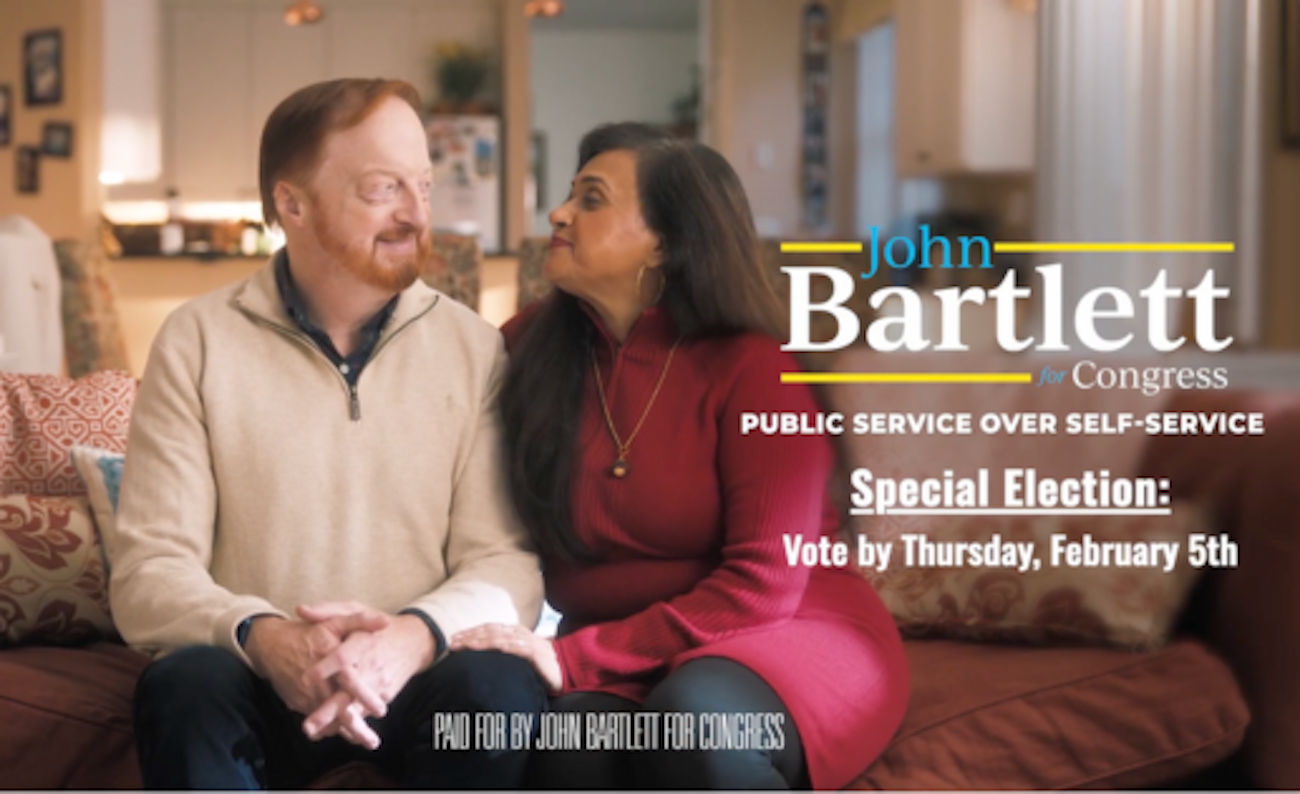

In the increasingly competitive race for New Jersey’s 11th Congressional District, Democratic candidate John Bartlett has deployed an unusual but deliberate weapon: his wife.
The campaign’s second television ad, titled “My Husband,” features Dr. Khyati Joshi—a prominent Indian American scholar and community leader—making the case for her husband’s congressional bid. The 30-second spot, part of a six-figure digital advertising investment ahead of the February 5 special Democratic primary, represents one of the most explicit attempts in recent New Jersey politics to leverage spousal credibility with a specific ethnic constituency.
“Jersey has enough politicians who put self service over public service. Only looking out for themselves,” Dr. Joshi says in the ad, speaking directly to camera. “We know the stories. I’m tired of them, I know you are too. John’s different.”
She continues: “He defeated Trump in the Supreme Court to protect immigrants, protected public health workers from RFK Jr.’s cuts, and defeated the Republican party in court to protect our right to vote. Believe me when I tell you he’s someone North Jersey can count on. And I’d say that even if he weren’t my husband.”
The Strategic Calculus
The ad’s release signals Bartlett’s recognition that in a field of nearly a dozen Democratic candidates competing for Governor-elect Mikie Sherrill’s vacated seat, differentiation matters—and Dr. Joshi’s standing in the Indian American community could provide exactly that edge.
The math is compelling. The 11th District is approximately 12 percent Asian American, with more than half of that population being Indian American. In a special election where turnout typically favors organized constituencies, even a modest advantage with this demographic could prove decisive.
“Through thick and thin, Khyati is my most trusted advisor and the true north of my moral compass,” Bartlett said in a statement accompanying the ad’s release. “When I talk about putting public service over self-service, I think of her, and I am grateful to have her by my side every day in this campaign.”
Who Is Dr. Khyati Joshi?
Dr. Joshi brings considerable credibility to this political partnership. A professor of education at Fairleigh Dickinson University, she received the university’s Distinguished Faculty Award for Research and Scholarship in 2014. Her academic work focuses on the intersection of race, religion, and identity in America, with particular attention to the experiences of Indian Americans and other religious minorities.
Her 2020 book, “White Christian Privilege: The Illusion of Religious Equality in America,” examines how American institutions systematically privilege Christianity while marginalizing other faiths. She has lectured at venues ranging from the White House to the Organization for Security and Cooperation in Europe, establishing herself as a nationally recognized voice on religious pluralism and equity.
Within New Jersey’s Democratic politics, Dr. Joshi has co-chaired the the SAA of NJDSC from 2013 to 2019 and frequency is called on by policy makers for her expertise. These roles have given her extensive networks within the very communities Bartlett now hopes to mobilize.
A 26-Year Partnership Rooted in Shared Values
The couple met while both were studying at the Hebrew University of Jerusalem, where Bartlett was a Raoul Wallenberg Scholar. They have lived in Wayne, New Jersey for 18 years as an interfaith family. Their story, the campaign emphasizes, represents “the American story: John’s family has been in the U.S. for generations, and Khyati immigrated from India as a child,” The Hill reported.
Dr. Joshi’s 2020 book, “White Christian Privilege: The Illusion of Religious Equality in America,” examines how American institutions systematically privilege Christianity while marginalizing other faiths.
As an interfaith family, they attend St. John’s Episcopal Church in Montclair, and participate actively in the Hindu community. The couple and their son observe Hindu holidays together and also attend church together on Sundays.
Bartlett has attended Dushehra and Diwali celebrations throughout northern New Jersey, stating that “the Diwali story of light conquering darkness is a powerful allegory for the challenges we face today,” Daily Freeman reported. At a past Diwali function, Bartlett said: “I can trace my family roots in the U.S. back almost 400 years, whereas Khyati immigrated from India with her parents. This combination of perspectives and the way each of our faiths calls us to public service, shapes everything I do.”
The Political Science of Spousal Influence
Does having an Indian American wife actually help Bartlett win Indian American votes? Political science offers some insights, though not definitive answers.
Research consistently shows that spouses influence each other’s political behavior. A study analyzing 18 million households found strong correlations between partners’ voting patterns and party affiliations. Partners serve as sources of political discussion, social pressure, and joint civic activity.
But that research examines how spouses influence each other—not how a candidate’s spouse influences voters who share demographic characteristics with that spouse.
More relevant is research on co-ethnic mobilization, which suggests Indian American voters show heightened turnout when Indian American candidates appear on ballots. A 2020 Carnegie Endowment study found this effect particularly pronounced among Indian Americans compared to other minority communities.
The question Bartlett’s campaign is testing: does marriage to a prominent Indian American community leader confer similar authenticity and mobilizing power as being Indian American oneself?
The “Authenticity” Question
This strategy carries risks. Some voters might view the prominent featuring of Dr. Joshi as opportunistic—using his wife’s ethnic identity for political gain. Others might question whether a white candidate can genuinely understand and represent Indian American concerns, regardless of family ties.


The ad attempts to preempt these criticisms through Dr. Joshi’s closing line: “And I’d say that even if he weren’t my husband.” The message: her endorsement is based on his record, not marital obligation.
The couple’s decades-long marriage, their interfaith household, Dr. Joshi’s own political engagement, and Bartlett’s long history of attending community events suggest genuine rather than transactional engagement. Yet in politics, perception often matters more than reality.
The Competitive Landscape
Bartlett faces formidable competition in the February 5 primary. The field includes former Congressman Tom Malinowski, who previously represented parts of the district; Brendan Gill, Governor Phil Murphy’s former campaign manager who has secured Murphy’s endorsement; and labor organizer Analilia Mejia, among others.
What Indian American Voters Care About
Understanding whether this strategy works requires understanding what Indian American voters in the district actually prioritize. While immigration and anti-discrimination policies matter, polling consistently shows Indian American voters care most about the same issues as other Americans: the economy, healthcare, education, and good governance.
The ad attempts to thread this needle. Dr. Joshi emphasizes Bartlett’s fights to “protect immigrants” and “protect our right to vote”—issues with particular resonance for communities that have experienced discrimination. But she also highlights his protection of “public health workers from RFK Jr.’s cuts”—a broader economic and healthcare message.
The question is whether Indian American voters will see Bartlett as particularly equipped to represent their interests, or whether they’ll evaluate him on the same criteria as any other candidate.
Growing Indian American Political Engagement
This campaign plays out against a backdrop of increasing Indian American political participation. Indian Americans had one of the highest voter turnout rates among Asian Americans in 2024, at 70 percent according to AAPI Data analysis. New Jersey has a particularly strong Indian American presence, with nearly 5 percent of the state’s population being South Asian—more than any other state.
The 11th District includes municipalities like Parsippany, Wayne, Livingston, and Randolph, which have substantial Indian American populations. In a special election where turnout is typically lower and more dependent on organized mobilization, these communities could be disproportionately influential.
This story was aggregated by AI from several news reports and edited by American Kahani’s News Desk.