



Melodies Without Borders: ‘Ghost Peppers’ Album Challenges South Asian Divisions Through Fusion Music

- A band composed of University of Central Florida English professors released their full-length album "No Borders.”
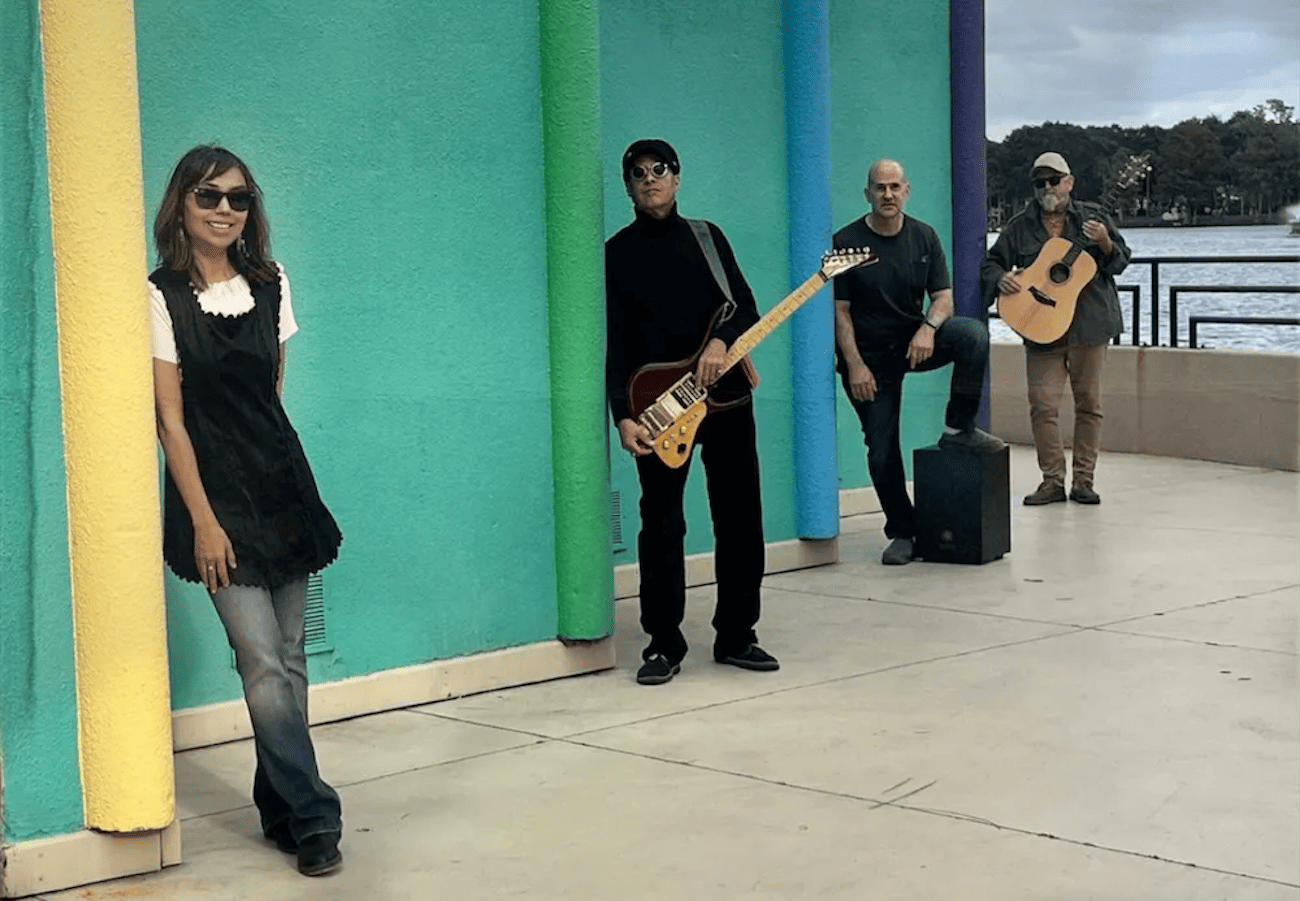

Four Orlando-based educators have released a debut album that uses music as a form of political resistance, blending South Asian and Western musical traditions to challenge the very concept of borders in an era of rising nationalism.
Ghost Peppers — a band composed of University of Central Florida English professors Amrita Ghosh, Kevin Meehan, and James Campbell, along with educator Eddy Jo Martinez — released their full-length album “No Borders” on Feb. 20, 2026, now streaming on all major platforms.
The band’s name itself is a political statement, inspired by the famed, fiery chilies of Northeast India.
A Nine-Track Meditation
“No Borders introduces the band with a nine-track meditative expression against imposed divisions — geographical, linguistic, cultural, musical, and ideological,” the band stated in a press release.
Orlando Weekly, which previewed the album, described it more bluntly as a “nine-track manifesto against imposed divisions,” noting that the band is “pushing back by dismantling the walls of these neo-fascist times through not just message but example.”
The album is multilingual and richly textured, weaving together Hindi, Bengali, English, and Urdu as it moves fluidly across languages and soundscapes, according to the band. Drawing from Hindustani classical traditions, Bengali and Urdu lyrics, Tagore reinterpretations, reggae rhythms, Americana songwriting, and jazz harmony, the project explores what can be shared across cultures often separated by geography and politics.
Indo-Pakistani Collaboration
Central to the album’s mission is bringing together Indian and Pakistani musicians and poets in collaboration — reconnecting musical lineages that long predate modern borders.
One standout track, “Qatra Qatra/Drop by Drop,” was cowritten with award-winning Pakistani-American writer Usman Malik. According to the band, Meehan came up with a haunting tune, and Malik responded with ethereal Urdu lyrics. Ghosh and Meehan then added English parts matching the Urdu sections, resulting in “a song that makes us think of the human condition, war, and collective solidarities that are ever urgent in the present moment.”
Musically, the song fuses Urdu poetry, jazz swing music, and Hindustani classical music through taans — a unique fusion that exemplifies the album’s approach.
The band also noted that their 2025 EP titled “Red” featured another collaboration with Pakistani singer Sana Illahe on a song titled “Ek Dhaaga,” based on the idea of what unites people beyond fragmentations and divisions.
‘Azaadi’: An Anthem for Liberation
The album’s first track, “Azaadi” (liberation), comes with a music video that addresses different forms of long-standing conflict in South Asia while urging freedom from all of them.
“Within South Asia, ‘azaadi’ has always been a potent term laden with resistance, towards independence, freedom towards human rights, gendered equality, resistance against marginalization, discrimination and demanding justice in varied forms,” the band explained.
‘Azaadi’ was a joint venture between Meehan and Ghosh based on their mutual interest in border politics and cultural resistance to border hysteria in South Asia and globally.
“Focusing on this word, ‘Azaadi,’ and building an anthemic song around it, is a way of making people think about freedom, and about the ways in which the borders and boundaries created by Partition actually limit freedom,” the band stated. “Wrapping the idea in a driving beat with rhyming lyrics and (hopefully) catchy guitar riffs and vocal harmonies may be a way to create critical listening in two different languages, and make music a learning process while still enjoying the ‘typical’ music experience of ‘it’s got a good beat, you could dance to it.'”
According to the band, the song was a joint venture between Meehan and Ghosh based on their mutual interest in border politics and cultural resistance to border hysteria in South Asia and globally. The music video was created and produced by Indian videographer and documentary maker Vishnu Murali Menon, who creates montages addressing pertinent issues that continue to haunt the Indian subcontinent, according to the band.
The album’s surprise offering is “Court of Love” (Reggae Raga Version), which blends two distinctly diverse styles into what the band describes as “a complex, least expected music that creates an aura of coming together of divergence into a melody and groove that is reflective of a global harmony.”
The Band’s Formation and Evolution
Orlando Weekly reported that Ghost Peppers was “conceived by UCF English professors Amrita Ghosh and Kevin Meehan as a multi-culti project premised on the intersection of South Asian and Western traditions.” Their 2025 debut, the “Red” EP, was described by the publication as “a bright exemplar of world fusion music.”
Since then, the band added drummer James Campbell and guitarist Eddy Jo Martinez, and has toured clubs and universities across the U.S. and Europe, according to Orlando Weekly.
Ghosh hosted the band in August 2025 to celebrate the release of their “Red” EP, describing them as “a folk duo blending South Asian and American traditions” that “layers original Urdu, Hindi, and English lyrics over classical Indian ragas and beats borrowed from rock, reggae, and American roots music.”
Music as Political Engagement
The band is clear-eyed about music’s limitations and possibilities in creating political change.

“Music, art and culture are not a substitute for political change; at a time when the everyday lives are fractured by borders in myriad realms, music and art are ever important to rethink those dominant ideas,” the band stated.
In their message to viewers in India and Pakistan, they wrote: “Striving against the limitations imposed by borders has particular meanings in India and Pakistan but those limitations and the aspirations to transcend them are universal. May the message of ‘Azaadi/Liberation’ rise across differences in language, musical taste, generations, genders, sexualities, and castes, until the idea of ‘borders’ itself become a distant reality.”
The Academic Context
The band’s scholarly backgrounds inform their artistic approach. Ghosh and Meehan are English professors at UCF, and their work reflects what Orlando Weekly characterized as a project “rooted in scholarship yet alive with creative energy” that “dissolves boundaries of genre, geography, and voice.”
Their approach moves beyond what they call “genre experiment,” instead treating music “as a living space where difference coexists, and connection endures.”
Album Release and Concert
Ghost Peppers celebrated the album’s release with a concert on Feb. 20, 2026, at Orlando’s Stardust Video and Coffee. According to Orlando Weekly, the show also featured UCF Young Poets Society and Heerak Shah & Friends.
The album is now available on Spotify, Apple Music, and other streaming platforms.
The release comes at a moment of heightened border politics globally and particularly in South Asia. By bringing together musicians and poets from India and Pakistan, using multiple South Asian languages, and fusing diverse musical traditions, Ghost Peppers offers what they describe as “musical bridge-building” that reconnects traditions predating modern political divisions.
As Orlando Weekly noted, the band’s explicit political stance — reflected in the album title and their description of it as a manifesto — suits “these unsubtle times.”
Through original compositions and reimagined classics, “No Borders” reflects on migration, memory, and collective humanity, positioning music not as escapism but as a space for critical engagement with the political realities that divide communities across artificial lines.
For a band of professors whose day jobs involve analyzing texts and teaching critical thinking, Ghost Peppers represents a different mode of engagement — one where scholarship meets sound, where analysis becomes anthem, and where the classroom lesson about borders and their human costs transforms into a multilingual, multi-genre musical challenge not to accept those divisions as inevitable or permanent.