


Forbes Calls Her ‘Netflix’s Queen of Screens’: How Bela Bajaria Turned From Undocumented Immigrant to $17 Billion Decision-Maker

- She controls what 300 million people watch every night. Her journey from illegal immigrant raised by grandparents to Hollywood's most powerful woman is the ultimate American story—and she's rewriting the rules of global entertainment.
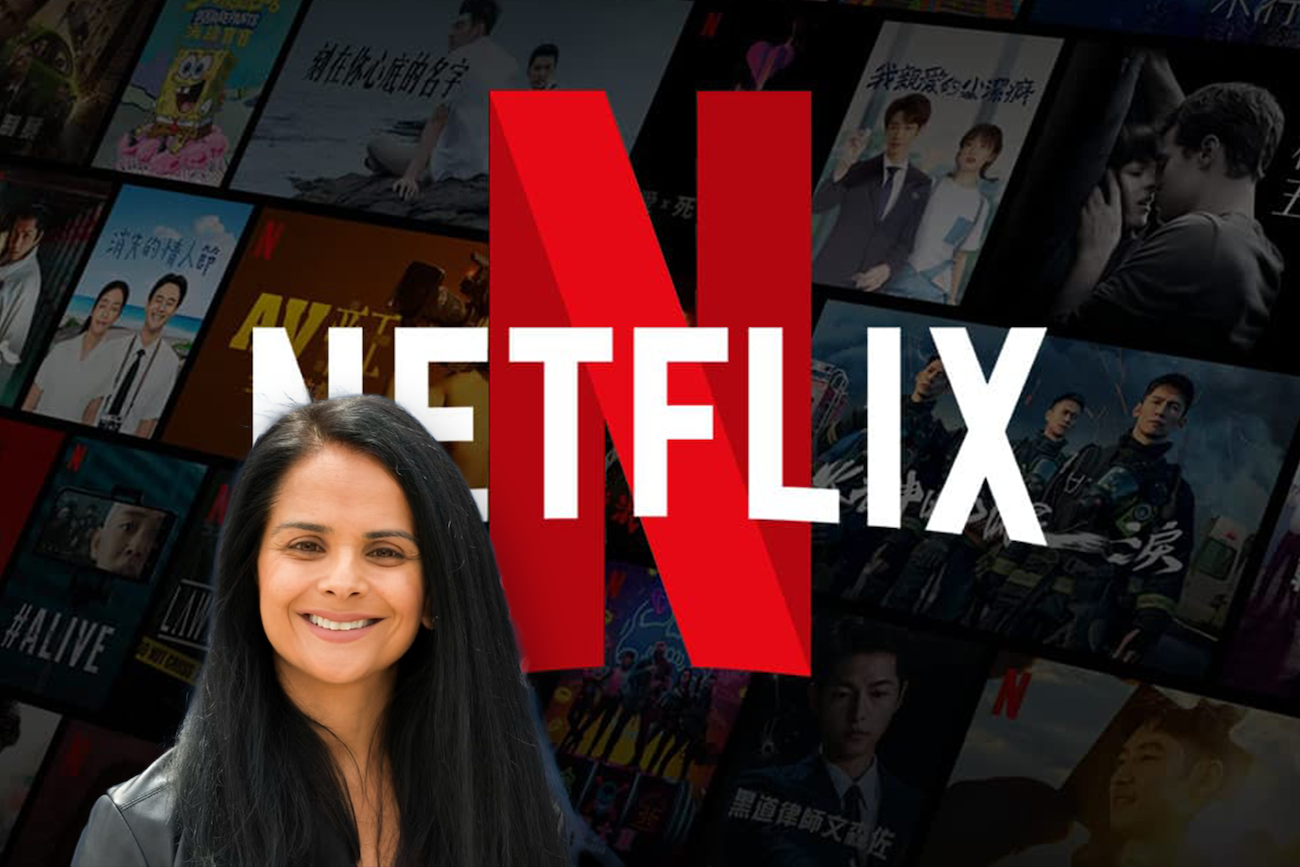

When Bela Bajaria danced on the Netflix party floor last fall, swaying in a brightly colored flowing skirt and off-the-shoulder sheer black blouse as Salt-N-Pepa’s “Push It” pulsed through the room, she embodied something rare in Hollywood: A top executive who genuinely celebrates rather than merely tolerates success.
According to Variety, which captured the scene at Netflix’s Emmy celebration party, Bajaria moved around the space “with easy fluidity,” dancing with programming executives Peter Friedlander and Jinny Howe and communications chief Emily Feingold. Most top executives steer clear of the dance floor at company parties. But as Annie Lennox sang “Sweet dreams are made of this,” Team Bela exulted one last time in their Emmy wins for “Baby Reindeer,” “The Crown,” “Ripley” and other shows.
“Who am I to disagree?” Lennox sang. Not Bajaria. According to Variety, she knows well how much good fortune has come her way.
That fortune—and the strategic brilliance behind it—has made the 55-year-old British Indian-American woman Forbes recently dubbed “Netflix’s Queen of Screens” perhaps the most powerful content executive in entertainment history. As Chief Content Officer since January 2023, according to Netflix official sources and The Coca-Cola Company (where she serves on the board), Bajaria oversees all television and film for Netflix in all languages, managing a content budget of approximately $17 billion annually.
She decides what over 300 million Netflix subscribers around the world watch on any given night. The shows she’s greenlighted—”Squid Game,” “Stranger Things,” “Wednesday,” “Bridgerton,” “The Queen’s Gambit,” “La Casa de Papel,” “Lupin,” “Sacred Games,” “Kingdom”—have become global cultural phenomena that transcend language and geography in ways traditional Hollywood never imagined possible.
From Zambia to Torrance: An Unlikely Beginning
Bajaria was born in 1970 in the London Borough of Brent to parents of Gujarati descent. Her early years were split between London and Zambia, where her extended family had roots—part of the Indian diaspora community in East Africa that her family came from, according to a 2016 LinkedIn profile piece.
“My family is Indian, but my parents and their family were all born and raised in East Africa,” Bajaria told the publication. “We really moved here for the American dream. In the late 70s, you could come to America and you could be anything.”
In the 1970s, when Bajaria was four years old, her parents moved from London to the United States’ West Coast with her brother to explore business opportunities. However, her parents overstayed their visas and became illegal immigrants.
This created a painful family separation. According to Wikipedia, young Bela was raised by her grandparents in Zambia until her parents could legally obtain residency. She was finally reunited with her family in Los Angeles in 1978, when she was eight years old, according to the 2016 profile, enrolling in local Los Angeles public schools.
Her parents owned car washes, according to the LinkedIn profile—”cutthroat and competitive” businesses that instilled in their daughter an unrelenting work ethic. As a teenager enrolled at Torrance High School and then Rolling Hills High School, according to Wikipedia, Bajaria worked as a cashier on weekends alongside her sister.
“I felt like I had an amazing strong family foundation, it was very rooted and very grounded,” she told the 2016 interviewer. “My parents came to America, to Los Angeles, without really knowing anyone. They started a life from scratch. I felt pressure, not pressure really, but drive.”
Variety noted that reflecting on her career arc, Bajaria can’t help pointing out how much change has occurred just in her own family since her great-grandmothers were forced into marriage at ages 13 and 14.
Miss India Worldwide 1991: An Unexpected Detour
Upon graduating high school, according to Wikipedia, Bajaria was encouraged to enter beauty pageants by a friend. “I thought it would be fun to discover the India culture on my own terms, through my own identity,” she told the 2016 profile.
She subsequently won the Miss LA India contest, then Miss India USA, and was eventually crowned Miss India Worldwide 1991. The experience proved transformative in ways she didn’t expect.
“I met these Indian women from all over the world. It was so interesting and we had a similar bond,” she recalled in the 2016 interview. According to IMDB, the title helped her gain visibility in the entertainment industry, though her ambitions lay behind the camera, not in front of it.
Her early years were split between London and Zambia, where her extended family had roots—part of the Indian diaspora community in East Africa that her family came from.
After her pageant win, she spent a few years running a nonprofit organization that helped children in poor countries. But her dream was to work in entertainment. “It wasn’t like I was immersed in American entertainment, but I always liked the idea of storytelling on a big scale,” she said.
The Education of a Content Queen
Bajaria graduated from California State University, Long Beach in 1995 with a Bachelor of Arts in communications. Upon graduating, she accepted a position with CBS in 1996 as an assistant in the movies and miniseries department.
It was unglamorous work, but Bajaria attacked it with characteristic intensity. She read all the scripts and spent hours in CBS’s basement videotape library studying old films to compensate for her lack of traditional Hollywood cultural capital.
“I read all of the scripts, I knew all of the executives and I read their development,” she told the interviewer. “I didn’t know historical movie references, so I spent hours in CBS’ basement videotape library, studying old films.”
Nancy Tellem, former president of CBS Entertainment Group, told Variety that Bajaria’s intellectual curiosity and drive to innovate impressed colleagues from the start. “She’s unbelievably effective as a creative executive and as a manager,” Tellem said. “When you’re heading movies and miniseries—that could have been turned into a pretty formulaic development process. She never did. She was always curious, always wanted to grow the department, always wanted to push her shows beyond what would have been expected.”
Bajaria left CBS briefly for a management position at Warner Bros. Television Studios but returned in 1997 as a director. After the January 2002 departure of longtime CBS Movies and Miniseries senior vice president Sunta Izzicupo, under whom she had worked since the mid-1990s, Bajaria was promoted to vice president and then senior vice president of the department.
“When you are running the department, you are managing people and I had proven myself with some higher-profile movies” like “Joan of Arc,” she told the 2016 interviewer.
When television films began to decline, according to Wikipedia, she requested a move to CBS’s production studio to develop cable shows, demonstrating the adaptability that would define her career. She served as Senior Vice President of Cable Programming for CBS TV Studios.
Making History at Universal Television
In 2011, according to USC Annenberg, Bajaria joined Universal Television as executive vice president and shortly thereafter became president of the studio. She made history as the first woman of color to oversee a major television studio.
When Comcast bought NBCUniversal in 2011 and installed Robert Greenblatt as NBC’s entertainment president, according to the 2016 profile, Greenblatt asked Bajaria to run NBC’s TV studio. “He had produced “Elvis,” the miniseries, for me so it was Elvis who brought us together,” she recalled. “Because I like building things, this was the dream situation.”
She played a pivotal role in producing hit series including “The Mindy Project,” “Brooklyn Nine-Nine,” and “Chicago Fire.” The Coca-Cola Company noted that at NBCUniversal, Bajaria helped revive the major television studio that had been shuttered years before.
The Firing That Changed Everything
Then came 2016 and what Bajaria would later describe as her “greatest learning lesson.”
Bajaria was fired from her position as President of Universal Television in 2016. The 2016 LinkedIn profile, published just four months after her abrupt departure, noted she was “leaving her post” but provided no details about the circumstances.
The setback, Bajaria later said “reshaped her approach to leadership and resilience.” Rather than view it as career catastrophe, she treated it as an opportunity to reassess.
She took a planned family safari trip to Tanzania to clear her head. During that reflective period, she reached out to Ted Sarandos, Netflix’s then-chief content officer, who had told her not to take another job before talking to him.
“I Just Hire Smart People and You’ll Figure It Out”
Sarandos had bought several shows from Bajaria during her Universal tenure and had been impressed. According to Forbes, he pitched a role starting unscripted programming and running licensing at Netflix.
“I was like, ‘Okay, so you know all the things you’re offering me, I’ve never done those things,'” Bajaria recalled to Forbes. “And he was like, ‘Yeah, I just hire smart people and you’ll figure it out.'”
And she did.
Bajaria joined Netflix in November 2016 as Vice President of Content to oversee the streaming service’s push into unscripted programming. “She took the energy and time to really figure out Netflix,” Sarandos told Forbes. “What makes things work and why? Who does what, and how do you get to them? It was that relationship management piece—which is so hard to do in this town.”
Her early Netflix hits included the critically acclaimed “Queer Eye,” “Nailed It!,” and “Tidying Up with Marie Kondo,” according to USC Annenberg, along with scripted originals such as the hit series “Never Have I Ever” and “YOU.”
The Global Gambit
Within two years, according to Forbes, Bajaria also oversaw international content, transforming the streamer into a genuinely global studio. In 2019, according to Wikipedia, she began leading all local language series.


This move would prove revolutionary. According to USC Annenberg, she managed the teams behind shows including “Elite” (Spain), “The Witcher” (Poland), “Lupin” (France), “Dark Desire” (Mexico), “Sacred Games” (India), “Kingdom” (Korea), “Blood & Water” (South Africa), and “Sintonia” (Brazil).
“Opening the non-English local country offices around the world has been such an amazing opportunity,” Bajaria told Variety. Today, according to Variety, she sits atop a pyramid of hundreds of programming executives in 27 countries who are tasked with greenlighting series and movies in 50 languages.
In 2020, she was promoted to the role of global head of television for Netflix, leading the teams for all of television and becoming responsible for hits including “Squid Game,” “Stranger Things,” “Wednesday,” “Bridgerton,” “La Casa de Papel,” and “Cobra Kai.”
The Ultimate Promotion
As Bajaria succeeded, so did Sarandos. According to Forbes, in 2020 he ascended to the co-CEO role at Netflix, and three years later she succeeded him as Chief Content Officer.
According to Netflix official sources, Bajaria was named Chief Content Officer in January 2023 (some sources say January 2024, but Netflix’s official investor relations page states January 2023). She reports directly to Ted Sarandos and sits on Netflix’s leadership team.
The scope of her role is unprecedented in entertainment history. According to multiple sources, Bajaria oversees all television and film for Netflix in all languages, managing a content budget of about $17 billion annually. She leads strategic decisions about what gets made, what gets marketed, and increasingly, what formats Netflix explores.
The Live Programming Revolution
Bajaria has been instrumental in spearheading Netflix’s expansion into live programming—a dramatic shift for a platform built on on-demand viewing.
She forged a groundbreaking, long-term partnership with World Wrestling Entertainment, ensuring that WWE’s flagship weekly program “Raw” is available to Netflix members worldwide. She also secured rights to NFL Christmas Day games for Netflix for the next three years.
The most talked-about live event came in 2024: the Jake Paul vs. Mike Tyson fight. According to Forbes, while the 27-year-old influencer Paul facing the 58-year-old boxing legend was widely derided as “the most boring sporting event of 2024,” it set a streaming record with approximately 108 million live global viewers, with around 65 million watching simultaneously at the broadcast’s height, making it the most streamed global sporting event in history.
Bajaria also secured “The Roast of Tom Brady” and other high-profile live events, fundamentally expanding what Netflix could offer subscribers.
The Hit Machine
Under Bajaria’s content leadership, Netflix has dominated the Emmy Awards and cultural conversation. According to Forbes, the anthology series “Beef” earned eight Emmys in 2024 and has been reimagined for a second season with an entirely new cast.
Other hits under her watch include shows that have become global phenomena:
- “Squid Game” (South Korea) became Netflix’s most-watched series ever
- “Wednesday” broke records for an English-language series
- “Bridgerton” redefined period drama for a global audience
- “The Queen’s Gambit” sparked a chess renaissance
- “Monster: The Jeffrey Dahmer Story” became one of Netflix’s most-watched series despite controversy
According to Variety, Bajaria’s approach centers on a simple question: “I want our shows to resonate with people. That’s what I’m always looking for. Did people love it? Did they stay and watch? Can we make something that you’ll love so much, you’ll talk about it and tell your friends. That’s really the thing.”
Recognition and Influence
Bajaria’s influence has been recognized across the industry and beyond. She was named one of TIME’s 100 Most Influential People of 2022. She has been on Fortune’s Most Powerful Women list for multiple consecutive years (2020, 2021, 2022, and continuing).
In 2024, Bajaria was elected to the Board of Directors of The Coca-Cola Company, with her election effective immediately and bringing the board to 12 directors.
Bajaria is married to Doug Prochilo, a writer and producer. Together they have three children: two daughters and one son. The family resides in Los Angeles.
This story was aggregated by AI from several news reports and edited by American Kahani’s News Desk.