




Trump’s Nemesis: Neal Katyal Secures Historic Supreme Court Victory Blocking Trump’s Sweeping Tariffs

- His past cases include defending the constitutionality of the Voting Rights Act of 1965, challenging Trump's 2017 travel ban, and winning unanimous rulings in major environmental and national security disputes.
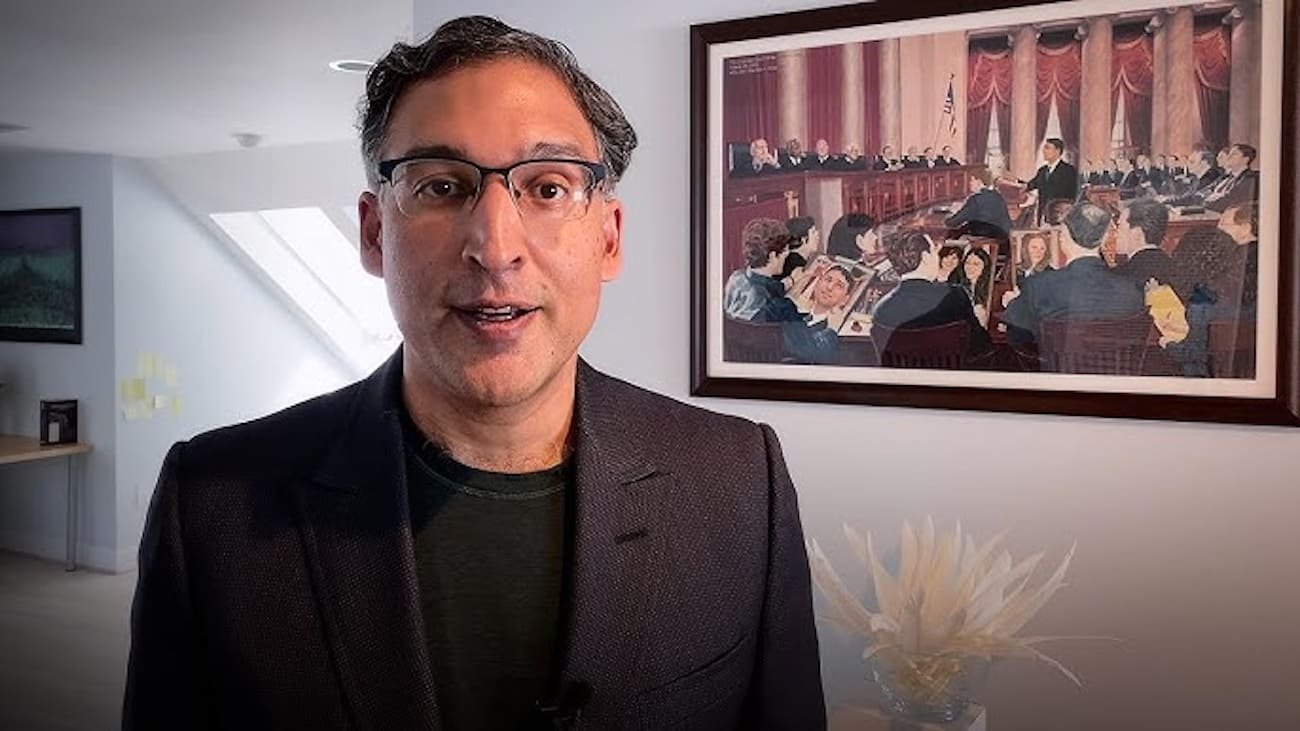

Neal Katyal, the Indian-American attorney and former Acting Solicitor General, scored one of the most significant constitutional victories of his career on Feb. 20, 2026, when the Supreme Court struck down President Donald Trump’s far-reaching global tariffs in a 6-3 decision that reaffirmed Congress’s exclusive power to tax.
“The US Supreme Court gave us everything we asked for in our legal case. Everything,” Katyal declared on social media platform X shortly after the ruling.
In a statement, he added: “Today, the United States Supreme Court stood up for the rule of law, and Americans everywhere. Its message was simple: Presidents are powerful, but our Constitution is more powerful still. In America, only Congress can impose taxes on the American people.”
The Case and the Ruling
The Supreme Court’s 6-3 decision centered on tariffs imposed under the International Emergency Economic Powers Act (IEEPA), including Trump’s sweeping “reciprocal” tariffs levied on nearly every trading partner. Chief Justice John Roberts wrote the majority opinion, joined by Justices Neil Gorsuch, Amy Coney Barrett, Sonia Sotomayor, Elena Kagan and Ketanji Brown Jackson.
“IEEPA’s grant of authority to ‘regulate . . . importation’ falls short. IEEPA contains no reference to tariffs or duties,” Chief Justice Roberts wrote, according to Spectrum Local News. “The Government points to no statute in which Congress used the word ‘regulate’ to authorize taxation. And until now no President has read IEEPA to confer such power.”
The majority found that it’s unconstitutional for the president to unilaterally set and change tariffs because taxation power clearly belongs to Congress. “The Framers did not vest any part of the taxing power in the Executive Branch,” Roberts wrote.
The Legal Journey
The case was originally filed by the Liberty Justice Center on behalf of five small U.S. businesses. Katyal and prominent Supreme Court litigator Michael McConnell later joined the legal team. McConnell became chief counsel for the Supreme Court phase of the litigation, while Katyal “skillfully conducted the oral argument before both the Federal Circuit and the Supreme Court,” according to Reason.
The plaintiffs prevailed at every level: first in the U.S. Court of International Trade, then in the U.S. Court of Appeals for the Federal Circuit, and finally at the Supreme Court, according to Reason.
“A case that had its origins in a blog post laying out some legal theories and another one recruiting potential clients went all the way to the Supreme Court and culminated in an important victory,” wrote Ilya Somin on Reason’s Volokh Conspiracy blog.
Katyal’s Confidence
Speaking to USA TODAY shortly after the decision, Katyal said he had always believed the court would ultimately rule in his favor — even while acknowledging the steep odds of challenging presidential power.
“It was a complete victory for us,” Katyal told USA TODAY. “We got everything we asked for, and I thought the Supreme Court stood up for our Constitution.”
“I’d always known in my heart of hearts, this was blatantly illegal,” he said, according to USA TODAY. He added that his team believed it had “the best originalist understanding from the point of view of our founders.”
Katyal also sharply criticized Trump’s underlying policy, calling the actions “really fundamentally un-American,” according to USA TODAY.
“We always believed this was gravely illegal,” Katyal said. “And it was very gratifying to see six members of the Supreme Court agree with us.”
The Significance of the Victory
The ruling marked “a rare and consequential rebuke of presidential authority in the trade arena, where courts have historically given the executive branch wide latitude,” according to USA TODAY.
“Whenever you’re challenging major presidential action, the court is really circumspect about saying no to a president,” Katyal told USA TODAY. “It’s always a tough hill.”
The tariff case was Katyal’s 53rd argument before the Supreme Court, bringing his career total to 54 arguments before the nation’s highest court.
That the pushback included support from two Trump-appointed conservative judges — Gorsuch and Barrett — made the victory especially significant, according to USA TODAY.
Katyal noted that in several dozen previous cases, the Supreme Court had mostly given Trump short-term wins regarding presidential authority on the emergency docket. But the tariffs case was a regular case before the Supreme Court with full briefings and expedited arguments, giving the justices their first real opportunity “to say yes – or no – to Trump,” according to USA TODAY.
“I felt like this decision was incredibly important at this moment in time,” Katyal told USA TODAY, “to stand up for the rule of law and our separation of powers.”
Katyal described the decision as “a complete and total victory” and “a reaffirmation of our deepest constitutional values and the idea that Congress, not any one man, controls the power to tax the American people,” according to the Associated Press and multiple outlets.
In his statement, Katyal emphasized: “This case has always been about the presidency, not any one president. It has always been about the separation of powers, and not the politics of the moment. I’m gratified to see our Supreme Court, which has been the bedrock of our government for 250 years, protect our most fundamental values,” according to The Hill.
Son of Indian Immigrants
Born in Chicago to Indian immigrant parents — a doctor and an engineer — Katyal has built a career around high-stakes constitutional battles.
He is a graduate of Dartmouth College and Yale Law School and clerked for Justice Stephen Breyer of the U.S. Supreme Court. Appointed Acting Solicitor General by President Barack Obama in 2010, Katyal represented the federal government before the Supreme Court and the Courts of Appeals nationwide.
The tariff case was Katyal’s 53rd argument before the Supreme Court, bringing his career total to 54 arguments before the nation’s highest court, according to USA TODAY. He has broken records for minority advocates arguing before the Supreme Court.


A Distinguished Career
Currently a partner at Milbank LLP and the Paul Saunders Professor at Georgetown University Law Center, Katyal specializes in constitutional and complex appellate litigation, according to Social News XYZ and the Liberty Justice Center.
His past cases include defending the constitutionality of the Voting Rights Act of 1965, challenging Trump’s 2017 travel ban, and winning unanimous rulings in major environmental and national security disputes.
Notable victories include:
– Successfully striking down the Guantanamo military tribunals
– His 2006 win in Hamdan v. Rumsfeld, described by former Acting Solicitor General Walter Dellinger as “simply the most important decision on presidential power and the rule of law ever”
– His 2022-23 Supreme Court term win in Moore v. Harper, the landmark voting case that Judge Michael Luttig described as “the most important case for American democracy in the almost two and a half centuries since America’s founding,” according to the Liberty Justice Center
Luttig also said Katyal’s argument in Moore v. Harper “was the single best oral argument I have ever heard made in the Supreme Court of the United States,” according to the Liberty Justice Center.
Katyal has served as Special Prosecutor for the State of Minnesota in the murder case of George Floyd and is the author of the book “Impeach: The Case Against Donald Trump,” according to Social News XYZ.
Recognition and Hornors
Katyal has received the U.S. Justice Department’s highest civilian honor, the Edmund Randolph Award, and has been named Litigator of the Year by The American Lawyer in 2017 and 2023, according to Social News XYZ. Forbes listed him among the top 200 lawyers in the United States in 2024 and 2025.
He has served as a law professor for over two decades at Georgetown University Law Center, where he was one of the youngest professors to have received tenure and a chaired professorship in the university’s history, according to the Liberty Justice Center. He has served as a visiting professor at both Harvard and Yale law schools.
In 2021, Katyal was named a Trustee of Dartmouth College. In 2022, he was named a Trustee of the Whitney Museum in New York City. In 2023, he was named Vice President and Trustee of the Supreme Court Historical Society, according to the Liberty Justice Center.
This story was aggregated by AI from several news reports and edited by American Kahani’s News Desk.