




Anjali Enjeti’s ‘Ballot,’ an Autobiography of Vote, Makes Democratic Exercise Sacred in a Time of Suppression

- A daughter of American and Indian Deep South, her book "examines what it means to vote in America today, and how endangered some of our votes truly are in an era of rising voter suppression, partisan redistricting, and disenfranchisement.”
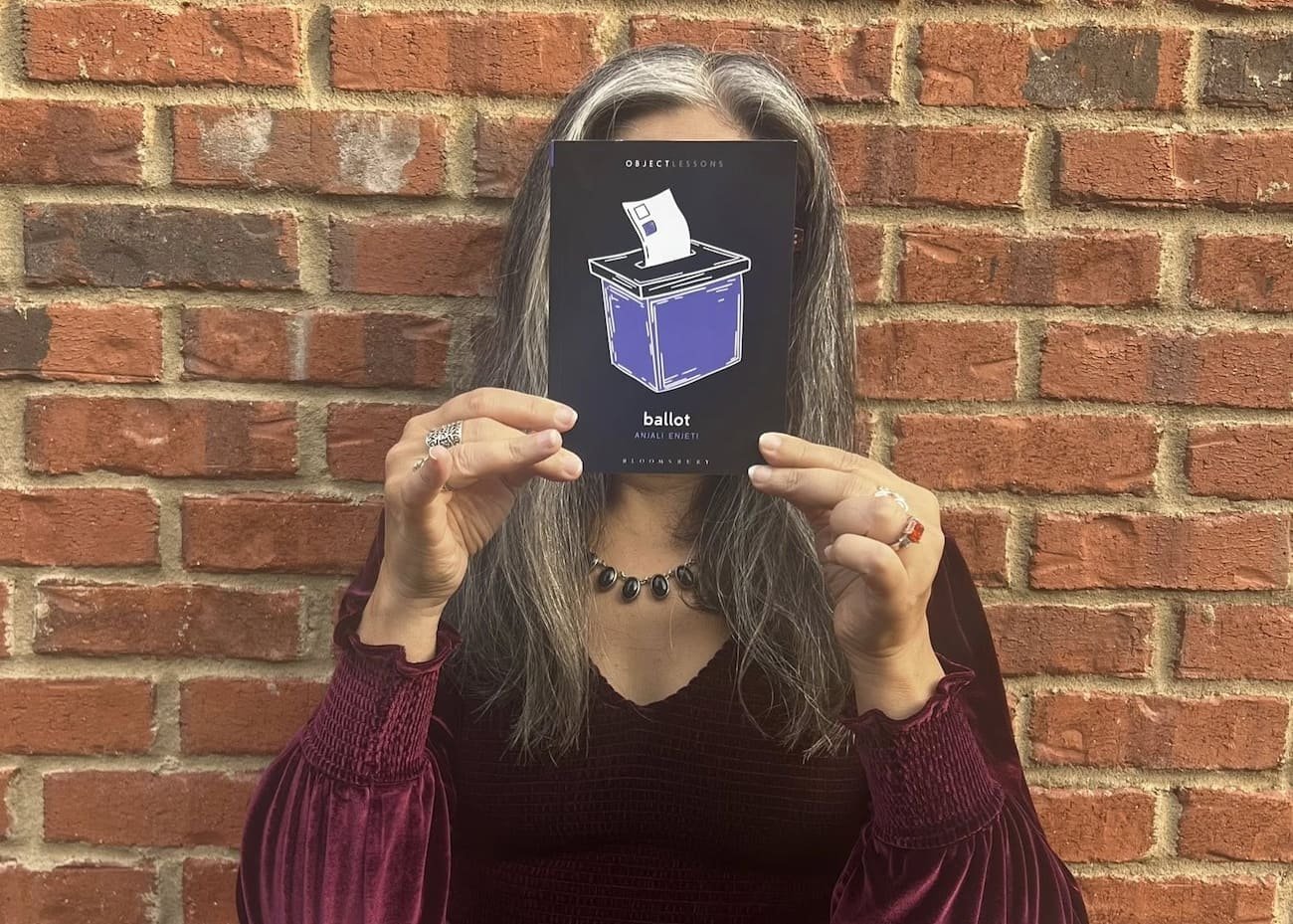

In an era when the right to vote faces unprecedented threats across the United States, Anjali Enjeti’s “Ballot” arrives as both a timely warning and a passionate call to action. Published Feb. 5, 2026, by Bloomsbury Academic as part of the Object Lessons series, this compact yet powerful book transforms what could have been a dry civics lesson into what author Alexander Chee calls “a moving and brilliant autobiography of her vote.”
“Ballot examines the psychological, cultural, and political significance of voting in an increasingly anti-voting climate,” according to the publisher’s description. At 256 pages, Enjeti draws on her personal experiences as a poll worker, electoral organizer and activist to explore what voting means in America today.
The book is part of Object Lessons, a series of short, beautifully designed books about the hidden lives of ordinary things, according to multiple retailers and Enjeti’s website.
A Personal and Political Narrative
According to Kirkus Reviews, Enjeti “pens evocative opening pages linking her childhood participation in mock elections to her ‘reverence for the right to vote.'” The review notes that another engaging chapter explores the etymological, social and technological history of ballots.
However, Kirkus observes that “mostly, though, Enjeti is interested in the current state of the franchise, recounting her experience supporting Democrats while living in Republican-heavy places.” Her observations illustrate how voting has changed due to conservative-friendly court rulings and what she describes as “an avalanche of voting restrictions” enacted after Donald Trump’s false claims about the 2020 election, according to the review.
“Armed with her personal experiences as a poll worker, electoral organizer, and activist, Anjali Enjeti unspools a timely narrative about the precarious state of the ballot during one of the most tumultuous political eras in U.S. history, and recounts the astonishing events leading up to the 2024 presidential election,” according to Amazon’s book description.
The Challenges Facing the Electorate
Enjeti documents how battleground state voters face mounting obstacles. “Enjeti lays out the growing challenges for voters in battleground states, where rightwing legislatures have introduced staggering numbers of voter suppression bills and redrawn district lines, all to disenfranchise as many Black and other marginalized voters as possible,” according to the publisher’s description.
According to WAMC radio, “As her account of the history and stakes of election integrity shows, the aftershocks of the Capitol insurrection on January 6, 2021 have manifested most egregiously on the four corners of the ballot.”
In an interview with the Radical Books Collective podcast, Enjeti explained her unique perspective: “I have had front row seats to voter suppression,” she said, referring to Shelby County v. Holder, a landmark Supreme Court ruling in 2022 that gutted Section 5 of the Voting Rights Act of 1965, according to the podcast transcript.
“States can now enact voter-suppressing laws and policies that erect tremendous barriers,” especially for Black, brown or Indigenous Democrat voters, she told the podcast.
Beyond documenting problems, Enjeti offers concrete guidance. According to Kirkus Reviews, she suggests that “voters seeking to reform criminal justice and protect immigrants can help by voting in relatively overlooked sheriff and district attorney elections.”
However, Kirkus notes that some proposals may be more aspirational: “But overhauling the Senate so that not all states have two seats? This makes sense from a population standpoint, but in the current political climate, it’s a nonstarter.”
“As a child, freelance writer Anjali Enjeti struggled to reconcile her life as an American growing up in the South with her Indian heritage.” But spending summers visiting family in India and monthly trips from Chattanooga to Atlanta to be immersed in Indian culture helped ground her identity.
Kirkus Reviews highlights how Enjeti addresses her personal conflict during the 2024 presidential election: “Enjeti’s account of the ‘dilemma’ she faced in 2024—as a battleground state voter, she opposed both Trump and the Democrats’ approach to the Gaza war—is relatable.”
The review notes her frank assessment of Democratic nominee Kamala Harris: “To her, Harris’ ‘Republican, warmongering, imperialist brand’—her opposition of an arms embargo on Israel—was a big reason she lost to Trump.”
Kirkus acknowledges that Enjeti is “not looking to please centrists” with this characterization.
Voting as One Tool Among Many
Despite her focus on voting, Enjeti maintains a broader perspective on political change. In her interview with Radical Books Collective, she emphasized: “I have been a progressive activist for many years, so I’ve actually never felt that elections paved the way to liberation.”
“We’ve got strikers. We’ve got protesters. We’ve got people boycotting corporations. We’ve got a big mix of tools in our toolbox, and voting is one of them,” she explained, according to the podcast transcript. “We need to not have the police, we need to not have ICE, but we can hold that and understand that we’ve got to have the abolitionists and then we’ve got to have the people doing something about elections. We have to hold these multiple roles at the same time, and elections are still very important.”
Critical Reception
The book has received widespread praise from critics and fellow authors.
The Boston Globe called it a work that “examines what it means to vote in America today, and how endangered some of our votes truly are in an era of rising voter suppression, partisan redistricting, and disenfranchisement. Brilliant, humane, and useful,” according to a blurb on Enjeti’s website.
Kirkus Reviews concluded: “An assured, forward-looking rumination on voting in the U.S. offers constructive ideas for the political left.”
Author Alexander Chee wrote: “Anjali Enjeti has written a moving and brilliant autobiography of her vote that intersects with the history of the right to vote, speaking all the while to the subtext of the times: that bound up in our votes are our lives, and what we mean to each other, our future and our past, our possibilities. I felt a renewed commitment to democracy, and I will reflect on how I didn’t know I needed that for some time. I want this book everywhere,” according to Amazon.
Chanda Prescod-Weinstein, author of “The Disordered Cosmos,” praised the book’s accessibility: “Anjali Enjeti makes an essential and timely case for voting as a tactic. She welcomes in both skeptics and believers to explain what’s at stake when we go to the ballot box and what happens when voting rights are curtailed. A necessary text at this point in human history, I hope that young people especially will read it and that elders will join them.”
Dan Sheehan, author of “Restless Souls,” called it “a fascinating, persuasive, and moving illumination of this core tenet of our under-siege democracy, arriving at a moment when we’ve never needed it more. Anjali Enjeti writes with the kind of passion, eloquence, and insight that will light a fire under even the most jaded and disillusioned of us. This is an essential text for our dark time.”
About the Author
Anjali Enjeti is a former attorney, journalist, activist and election worker based near Atlanta, according to Amazon. She is a mixed-race writer who describes herself as “half Indian, a quarter Puerto Rican, and a quarter Austrian,” according to her essay collection “Southbound” and multiple interviews.
Born in the Detroit area, Enjeti moved with her family to Chattanooga, Tennessee, at age 10, according to the Atlanta Journal-Constitution and Reckon. She is the daughter of an Indian immigrant father and identifies as “a daughter of the Deep South,” according to Full Grown People and Chapter 16.
Her Indian family members are originally from Chennai and ended up in Hyderabad, according to Guernica. In an essay published by the Atlanta Journal-Constitution in 2016, Enjeti wrote movingly about her paternal grandfather (Tata), who argued legal cases before the High Court in Hyderabad, and her paternal grandmother (Avva), describing childhood summers in India and inheriting her grandmother’s rosewood sari chest.
“As a child, freelance writer Anjali Enjeti struggled to reconcile her life as an American growing up in the South with her Indian heritage,” the Atlanta Journal-Constitution reported. But spending summers visiting family in India and monthly trips from Chattanooga to Atlanta to be immersed in Indian culture helped ground her identity.
Today she lives near Atlanta in an area with a large Indian population. “Most of my friends here are South Asian,” she told Scalawag magazine. “But I have always felt insecure about my connection to my heritage, and sometimes wonder, as a mixed-race person, what claim I have to it.
Enjeti is the author of two award-winning books: “Southbound: Essays on Identity, Inheritance, and Social Change” and the novel “The Parted Earth.”
According to Brazos Bookstore, “Her third book, Ballot, describes voting and voting rights from her perspective as a Georgia voter, poll worker, and electoral organizer, who has volunteered for the campaigns of Jon Ossoff, Stacey Abrams, Reverend Raphael Warnock, and others.”
She co-founded They See Blue Georgia, an organization that engages South Asian communities and played a critical role in helping Georgia voters flip the Senate in the 2020 election, according to Scalawag and The Rumpus.
Her writing has appeared in the Los Angeles Times, Boston Globe, Harper’s Bazaar, Oxford American and elsewhere, according to Amazon. She teaches creative writing in the MFA programs at Antioch University in Los Angeles and Reinhardt University in Waleska, Georgia.
In her Fiction/Non/Fiction interview, Enjeti spoke of her connection to civil rights icon John Lewis: “I had to pay homage to him, being from Georgia. I don’t live in Atlanta, but I live very close by, and I’ve had the pleasure of hearing him speak in person at various protests and rallies. An incredible human being,” according to Literary Hub.
Her work with They See Blue Georgia, which she co-founded in August 2019, reflects her commitment to mobilizing South Asian communities specifically. “In August 2019, about a dozen people showed up to our first meeting at an Indian restaurant. Six months later we packed 150 people into a room,” she wrote in Full Grown People. “Our members have roots in several different countries, faiths, languages, and regions. We are immigrants and U.S.-born.”
Enjeti has written extensively about confronting anti-Blackness within South Asian communities. “We are learning how to be better allies and accomplices to other communities more marginalized than our own. We are interrogating our anti-Blackness,” she wrote, according to Full Grown People.
Current Relevance
The Radical Books Collective podcast notes that Enjeti’s book “is a history of voting in the US, and it certainly delivers. However, along the way, the book equally exposes a corrupt and manipulative system that destabilizes democracy by making it harder for people to physically go and vote.”
The podcast adds: “Being a Democratic voter living in the state of Georgia offers a particularly important vantage point, in her case.”
According to the Fiction/Non/Fiction podcast, Enjeti also discusses “the problems she encountered with Republican-installed Dominion voting machines in Fulton County, Georgia, where she was an election worker during the 2020 presidential race,” according to Literary Hub. The podcast notes she “debunks the false claims of election fraud in Fulton County during that election and discusses the Trump Administration’s recent seizure of 700 boxes of 2020 ballots from Fulton County, what those ballots represent, and whether or not the administration might try to alter them.”
Final Assessment
“Ballot” succeeds as both memoir and manifesto, offering readers an intimate look at American democracy through the eyes of someone who has worked on its front lines. Enjeti’s Georgia perspective—operating as a progressive in a state that has become a crucial battleground—gives her unique authority to speak about voter suppression and electoral activism.
While Kirkus Reviews notes that the book is written “through a topical, politically progressive lens,” its value extends beyond partisan politics to fundamental questions about democratic participation and civic responsibility. In treating voting as “holy,” Enjeti elevates what could be a merely procedural act into something deeply meaningful—a form of collective care and community responsibility.
At a moment when voting rights face sustained attack and voter cynicism runs high, “Ballot” makes the case that the act of casting a ballot remains both necessary and worthy of reverence, even as Enjeti acknowledges its limitations and the need for broader forms of political engagement.
This story was aggregated by AI from several news reports and edited by American Kahani’s News Desk.