




Two Worlds On Two Wheels: Punjabi Devils Founder’s Arrest Casts Spotlight on Sikh Motorcycle Culture

- The case is far removed from broader world of Sikh motorcycle clubs — a vibrant, growing cultural phenomenon.

When Jashanpreet Singh founded the Punjabi Devils Motorcycle Club in this Central Valley city, he joined a growing network of Sikh motorcycle organizations across North America — but with a crucial and criminal difference, federal authorities say.
Singh, 27, of Lodi, pleaded guilty this week to federal weapons charges after attempting to sell illegal firearms to an undercover officer, including machine guns, assault weapons and explosives. His organization was not a legitimate cultural club, federal prosecutors allege, but rather an outlaw gang operating as a “puppet” club for the Hells Angels.
The case has cast an uncomfortable spotlight on the broader world of Sikh motorcycle clubs — a vibrant, growing cultural phenomenon that legitimate organizations say has been hijacked and misrepresented by Singh’s alleged criminal enterprise.
Two Parallel Worlds
Across North America, Sikh motorcycle clubs have flourished over the past two decades as a unique expression of faith, culture and American freedom. But the Punjabi Devils case reveals how criminal elements can exploit cultural symbols and community ties.
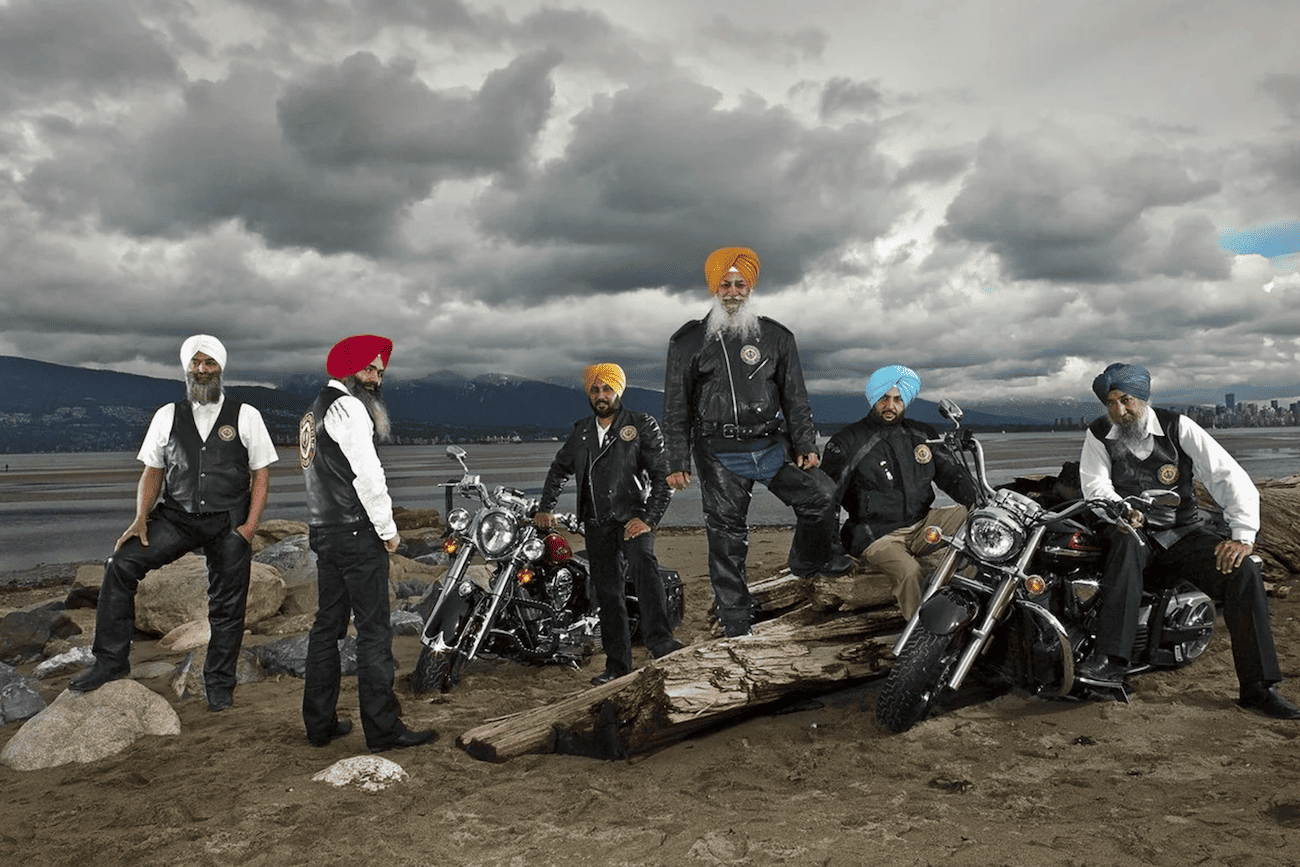
The first Sikh Motorcycle Club was established in British Columbia in 2002, according to the club’s website, after activist Avtar Singh Dhillon successfully campaigned for Sikhs to be exempt from mandatory helmet laws in the province. The exemption allows practicing Sikhs who wear turbans to ride without helmets for religious reasons.
“The club came into existence due to the former efforts of Mr. Avtar Singh Dhillon, who on July 7th 1999, after many years of campaigning and educating governmental organizations, earned the right for practicing Sikhs who wear Turban to be exempt from mandatory Helmet Laws in the Province of British Columbia,” according to the club’s official history.
Since then, Sikh motorcycle clubs have spread across Canada and the United States, organizing charity rides, participating in cultural parades and advocating for religious freedom. The clubs emphasize the Sikh principle of “Manas Ki Jaat Sabeh Ekey Pechchanbo” — “Recognize the Human Race as One.”
The legitimate Sikh Motorcycle Club of British Columbia now has more than 100 members across the province, according to its website. In 2025, the club received the King Charles III Coronation Award for significant contributions to communities and to Canada.
Similar clubs exist throughout North America. The Sikh Motorcycle Club USA, founded in 2019, describes itself as a nonprofit organization that promotes motorcycle safety, spreads awareness about Sikhism and organizes charitable events. Sikh Riders of America, based in California, bills itself as “the largest, and only, Sikh club in the USA.”
In 2022, members of Sikh Motorcycle Club USA rode 2,700 miles from Stockton to Oak Creek, Wisconsin, for a “Ride Against Hate” commemorating the 10th anniversary of a mass shooting at a Sikh temple that killed seven people, according to RideApart magazine.
BuzzFeed News profiled the Sikh Motorcycle Club of the Northeast in 2017, describing it as worlds apart from traditional outlaw motorcycle clubs.
“The reason clubs like the Hells Angels or the Bandidos exist is largely for those who don’t fit into society to find a path, a purpose, and a brotherhood in one another,” reporter Teresa Mathew wrote. “But that model of displaying loyalty — often through violence and a decidedly us vs. them mentality — is a world away from the ethos of the bikers who make up the Sikh Motorcycle Club of the Northeast.”
In 2022, members of Sikh Motorcycle Club USA rode 2,700 miles from Stockton to Oak Creek, Wisconsin, for a “Ride Against Hate” commemorating the 10th anniversary of a mass shooting at a Sikh temple that killed seven people.
Barninder Singh, one of that club’s founders, told BuzzFeed that for Sikh riders, faith comes first. When New York police told club members they couldn’t ride in the Sikh Day Parade without helmets, the riders chose to park their bikes and walk rather than remove their turbans.
“We wanted [the kids] to see us as Sikh bikers, not just bikers,” he said.
The Criminal Divergence
The Punjabi Devils, by contrast, represented something entirely different, according to federal authorities.
Court documents describe the club as a “1% motorcycle club” — a term that emerged in 1947 when the American Motorcycle Association stated that “99% of the motorcycling public are law-abiding; there are 1% who are not.” The “1%” designation has since been adopted by outlaw motorcycle gangs to signal their embrace of criminality, according to the criminal complaint filed against Singh.
A federal agent’s complaint stated that Singh founded the Punjabi Devils as a subsidiary “puppet” motorcycle group under the Hells Angels Motorcycle Club. According to the U.S. Department of Justice, puppet clubs operate under the protection and direction of larger criminal motorcycle organizations.
The designation is similar to how the Outlaws Motorcycle Club uses the Black Pistons as “a recruitment source for prospective Outlaws members” and to “conduct criminal activity, especially for the transportation and distribution of drugs,” according to DOJ documentation.
On June 6, 2025, Singh attempted to sell an arsenal of weapons to an undercover officer, including a short-barreled rifle, three assault weapons, three machine gun conversion devices and a revolver, according to the U.S. Attorney’s Office for the Eastern District of California.
A search of his Lodi residence uncovered additional illegal weaponry: another machine gun, a machine gun conversion device, a silencer, high-capacity drum magazines, a “pineapple”-style hand grenade, and what law enforcement identified as a military electronic “claymore” mine, according to court documents. The San Joaquin County Sheriff’s Department bomb team destroyed the explosive devices at the scene.
Singh initially faced state charges but failed to appear in court on July 21, 2025. Two days later, U.S. Customs and Border Protection alerted the FBI that Singh had purchased a ticket to India. FBI agents arrested him at San Francisco International Airport on July 26 before he could board the flight.
He remains in federal custody and faces up to 15 years in prison and $500,000 in fines when sentenced on May 11, 2026.
Organized Crime in Canada
The Punjabi Devils case reflects a broader pattern of criminal activity within some segments of North American Punjabi communities that legitimate Sikh organizations have long sought to distance themselves from.
According to a Wikipedia entry on Indo-Canadian organized crime, citing a 2004 Royal Canadian Mounted Police report, Indo-Canadian criminal groups rank third in organization and sophistication in British Columbia, behind outlaw motorcycle clubs and Chinese Triads.
“Some of the young men involved today in crime may come from first-generation backgrounds but the majority are second and third-generation Punjabi-Canadians,” the report noted. “These individuals were initially involved in petty street crimes, but older and more calculating criminals from the community quickly saw opportunities to make a profit from the situation.”
The report found that during 2006 to 2014, 34 South Asians made up 21.3 percent of gang-related deaths in British Columbia.
Some criminal elements emerged from the Khalistani separatist movement of the 1980s, according to historical accounts. After the Indian Army’s 1984 assault on the Golden Temple in Amritsar — Sikhism’s holiest site — some Sikh activists in Canada engaged in both political activism and organized crime to fund their cause.
“Though the intention was initially political, some of the activists also started to engage in organized crime as a way to raise money for the struggle,” according to the Wikipedia entry.
ThePrint, an Indian news outlet, reported in February 2025 that ethnic-Punjabi criminal groups continue recruiting young asylum-seekers from India for drug trafficking operations in the United States and Canada.
In California, journalist Lisa Fernandez reported in 2008 on violent gangs like the Santa Clara Punjabi Boys, Aim to Kill and the All Indian Mob drawing members from low-income migrant families.
More recently, an investigation into a 2023 shooting at the Sacramento Sikh Society Gurdwara led to arrests involving members of two gangs known as Minta and the AK-47 Group, according to ThePrint.
Community Response
Legitimate Sikh motorcycle clubs have worked to build positive relationships with law enforcement and the broader public, emphasizing their commitment to charity, safety and religious values.


Vancouver Magazine profiled the Sikh Motorcycle Club of British Columbia in 2022, quoting member Harinder Singh Deol: “Luckily, there are no accidents I have ever heard of. No accidents, no nothing, because everybody just follows the law, they know what they’re doing. Safe ride, safe season. When the season starts, we do a prayer in the Gurdwara, our Sikh temple. That’s for the safety of all the riders across the world — not only for us.”
The club has raised substantial funds for charity. Member Rachhpal Singh Dhaliwal told the magazine about a charity ride for the Canadian Cancer Society that collected $115,000 while traveling nearly 12,000 kilometers from Vancouver to Ottawa, Montreal and Toronto.
YouTuber Peter Santenello, who documented a ride with Sikh Motorcycle Club USA in Stockton in 2022, asked members about potential conflicts with outlaw motorcycle gangs.
“No, actually we have friends everywhere,” one member told him. “They do really good causes too. It’s a persona that is attached with the motorcycles … Something bad. Which is entirely not true.”
Another member emphasized: “Everybody (has) their own perceptions about bad and good. You can’t really say someone is doing bad unless you really, really know them. Other than that, everybody’s trying to do something good and we love doing food drives, charity runs, toy runs on Christmas.”
After the Punjabi Devils arrest, Khalsa Vox, a Sikh community publication, published an opinion piece calling the case “a betrayal of Sikh sacred values.”
“The overwhelming majority of Sikhs in California and beyond live peacefully, contributing positively to society through hard work, charity, and community service,” the publication wrote on Feb. 4, 2026, calling on Sikh community leaders to ensure gurdwaras “remain true to their spiritual purpose — free from criminal exploitation and extremist propaganda.”
Challenges of Cultural Identity
The case highlights challenges faced by immigrant and minority communities when criminal elements adopt cultural symbols and community structures for illegal purposes.
For Sikh Americans, the issue is particularly sensitive. Since 9/11, Sikhs have faced persistent discrimination and violence from Americans who mistake turbans for symbols of terrorism rather than expressions of faith.
The first victim of a hate crime after 9/11 was Balbir Singh Sodhi, a Sikh man killed by someone who mistook him for a Muslim. In 2012, a gunman entered the Oak Creek gurdwara and killed six people. At least three other Sikh men have been killed in apparent hate crimes since 2017, according to BuzzFeed News.
“Wearing a turban in the United States means living with the weight of its fabric, and recognizing that it can all too often be turned into a target,” BuzzFeed’s Teresa Mathew wrote in 2017.
For legitimate Sikh motorcycle clubs, the Punjabi Devils case threatens to undermine years of community-building and positive representation.
The Sikh Motorcycle Club’s stated goals include promoting fellowship among riders, organizing charitable events, and improving “the relationship between the local community and the Sikh motorcycle riders through discussions, social events, seminars and similar events,” according to the club’s website.
The clubs also work to educate the public about Sikh faith and culture. As one member told Vancouver Magazine: “The club grew substantially over the years and the people who used to give us the middle finger and yell at us, now wave at us instead.”
The Punjabi Devils case serves as a reminder that symbols of culture and faith can be exploited, and that communities must remain vigilant against those who would use cultural identity as cover for criminal activity.
Top image, Sikh motorcycle gang in Vancouver. Source Reddit. This story was aggregated by AI from several news reports and edited by American Kahani’s News Desk.