




Book Review: ‘The Robe and the Sword’ — Sonia Faleiro’s Unflinching Look at Buddhist Extremism Holds a Mirror to India

- Historian Pankaj Mishra praised Faleiro for describing "one of nationalism's most insidious and least-noticed mutations" with "intellectual resourcefulness and rigor.”
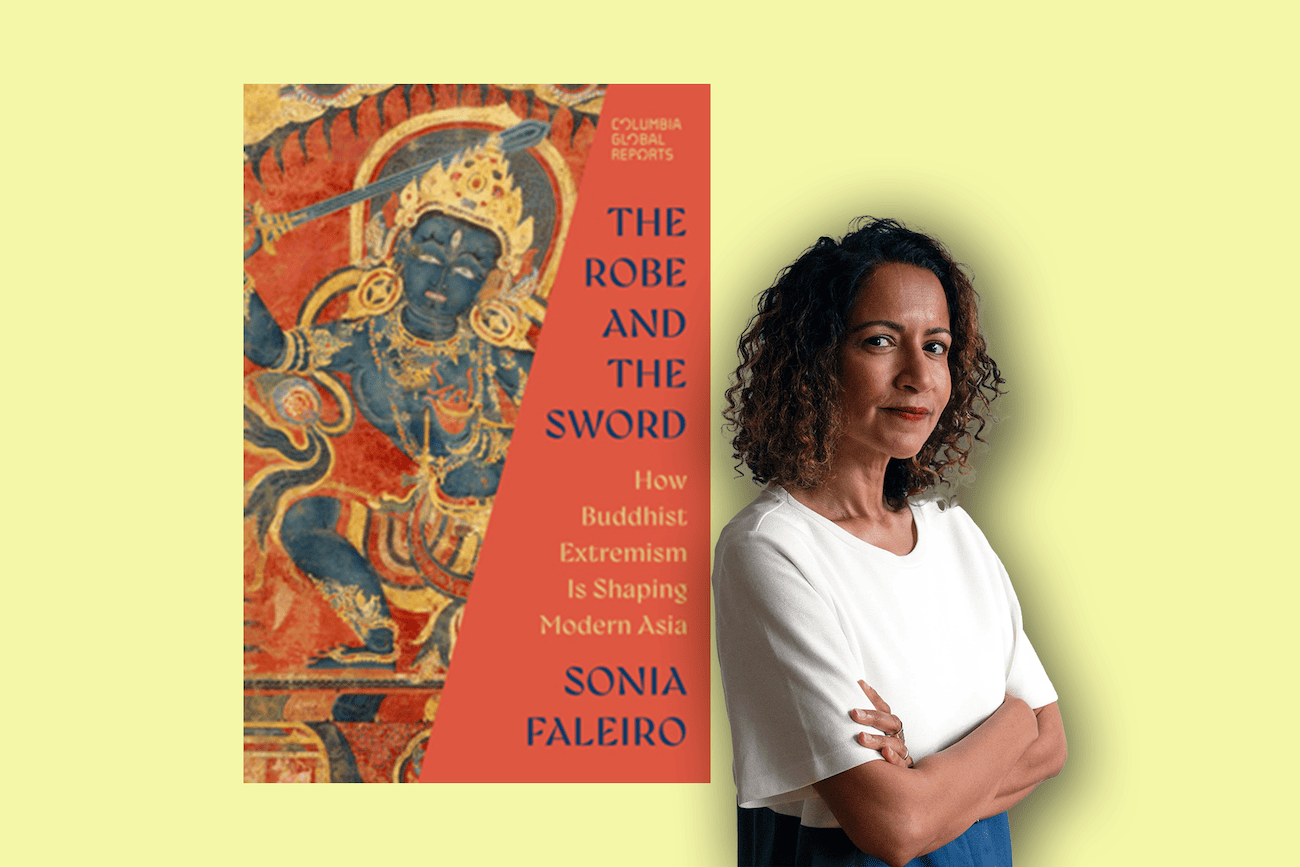

In an age when the West still clings to romanticized images of Buddhism as an inherently peaceful faith—think meditation apps, mindfulness retreats, and the serene smile of the Dalai Lama—Sonia Faleiro’s “The Robe and the Sword: How Buddhist Extremism Is Shaping Modern Asia” arrives as a necessary corrective. Published by Columbia Global Reports in November 2025, this slim yet powerful work of narrative nonfiction shatters what has been termed “the West’s kitschification of Asian faiths” while exposing uncomfortable parallels with India’s own treatment of religious minorities.
A Journey Through Buddhist Nationalism
Faleiro, an acclaimed journalist whose previous works include the New York Times Editor’s Choice “The Good Girls: An Ordinary Killing,” takes readers on a harrowing journey through three countries where Buddhist nationalism has turned violent: Sri Lanka, Myanmar, and Thailand. Through meticulous on-the-ground reporting, she documents how monks have transformed a tradition historically associated with nonviolence into what she calls “a tool of terror.”
The book’s power lies in its unflinching specificity. In Sri Lanka, Faleiro profiles Galagoda Aththe Gnanasara, the charismatic and dangerous leader of the Bodu Bala Sena (BBS), who has incited mobs against Muslims and Hindu Tamils, according to The Federal. She recounts the 2018 Digana riots with meticulous detail: over 300 homes destroyed, more than 200 shops looted, 20 mosques desecrated, and a young Muslim journalist, Abdul Basith, burned alive as police stood idle, according to a review published on Tsamtruk.com.
In Myanmar, she traces the rise of Ashin Wirathu and his 969 movement, which gained massive momentum after his release from prison in 2012 and helped ignite genocide against the Rohingya. Through interviews with Abbot Zero, a dissident monk who once followed Wirathu and now flees him, Faleiro reveals how nationalist Buddhist rhetoric creates what Tsamtruk.com described as “a logic of existential threat that justifies mass violence.”
The Colonial Wound That Won’t Heal
What sets Faleiro’s analysis apart is her insistence on tracing these contemporary horrors back to their root cause: colonialism. In an interview with Tricycle: The Buddhist Review, she was explicit about this connection.
“The trauma of occupation created this violent nationalism that we are seeing right now. Occupied people tend to inherit a sense of humiliation,” Faleiro told Tricycle. “And in every country that I’ve reported from, the community or individual that caused the greatest damage hasn’t been the Muslims in Sri Lanka, the Rohingya in Myanmar, or the Christians in India. It was always the British.”
Tricycle reported that Faleiro pinpoints the unhealed trauma of colonialism as the source of much of the religious violence, noting how the British introduced systems of grading people based on skin color, religion, language, and ethnicity in every society they entered. According to Faleiro, when you start grading people who otherwise thought of themselves as one community, they devolve into warring factions.
The book documents how, in Sri Lanka, the British favored Ceylon Tamils, who learned English and secured civil service jobs. When the British withdrew in 1948, a baseless rumor began to circulate among the Sinhalese majority that a Tamil takeover was imminent, backed by Tamils from India. “The claim had no basis in fact, but it stoked paranoia among the Sinhalese majority,” Faleiro writes, according to The Federal.
Echoes in India’s Corridors
While Faleiro’s reporting focuses primarily on Sri Lanka, Myanmar, and Thailand, the parallels with contemporary India are impossible to ignore—and reviewers have not been shy about drawing them.
The book challenges readers to confront how sacred traditions—whether Buddhist, Hindu, or any other faith—can be twisted to serve nationalist politics and justify violence against vulnerable populations.
The Federal’s review notes that the book discusses how the 1921 colonial census became a flash point in India when it reported that Muslims, while remaining a minority, were growing at a faster rate than Hindus and Buddhists. The census finding provoked fear among extremist Hindu groups like the Arya Samaj, “an influential ideological precursor to the Hindu nationalist Rashtriya Swayamsevak Sangh,” according to The Federal’s account of Faleiro’s research.
The Federal’s reviewer draws explicit parallels between Buddhist extremism in Sri Lanka and Hindu nationalism in India, particularly regarding the role of economic anxiety in fueling bigotry. The review notes that in several instances of communal violence in independent India, a “counter-intuitive phenomenon” has been observed: Dalits and other lower-caste Hindus at the frontlines of organized anti-Muslim violence and even pogroms.
“Economic anxiety gives struggling, angry people the license to unleash widespread bigotry against those who are perceived to be doing well economically,” The Federal explains, citing Faleiro’s analysis of this pattern across Buddhist-majority nations.
In her Tricycle interview, Faleiro explicitly mentioned “the Christians in India” alongside Muslims in Sri Lanka and Rohingya in Myanmar as religious minorities being scapegoated for colonial trauma inflicted by the British.
Not a Blanket Condemnation
Importantly, Faleiro’s book is not an attack on Buddhism itself. As the Tsamtruk.com review emphasizes, “The Robe and the Sword is not a blanket condemnation of Buddhism. Instead, it is a documentation of a moral crisis unfolding across Asia, with specific implications for different communities.”
The book’s final section, set in Dharamshala, India—home to the Tibetan government-in-exile—offers a crucial counternarrative. Here, Faleiro documents Tibetan Buddhism’s non-violent resistance against Chinese occupation, including the abduction of the Panchen Lama in 1995 and Beijing’s strategy to control reincarnation lineages. The Tsamtruk.com review notes that Faleiro draws “a sharp, necessary distinction between violent nationalist monks in Sri Lanka and Myanmar, and the non-violent resistance of exiled Tibetans facing a different crisis entirely: the world’s silence.”
Faleiro’s final reflections in Dharamshala point to a growing realization within Buddhist communities that “merely refraining from harm is no longer enough,” according to the same review.
Critical Acclaim and Controversy
The book has received widespread praise from major literary and political figures. Author and activist Fatima Bhutto called it “the story of our broken world,” according to Columbia Global Reports. Historian Pankaj Mishra praised Faleiro for describing “one of nationalism’s most insidious and least-noticed mutations” with “intellectual resourcefulness and rigor,” according to the same source. Historian Thant Myint-U lauded the book’s “sharp insight and deep humanity” in tracing “the long and uneasy bond between Buddhism and political power,” according to multiple sources.
The Federal called it “a brilliantly written treatise on a decidedly modern problem,” praising Faleiro for “sacrificing neither rigor nor readability.”
However, the book has also sparked debate. According to Tsamtruk.com, the publication of an edited excerpt in The Guardian in November 2025 sparked significant discussion about how the book has been packaged in the press, with some critics concerned about potential misrepresentation of Buddhism as a whole.
A Slim but Substantial Achievement
At just 160 pages, according to The Federal, “The Robe and the Sword” is remarkably concise for the ground it covers. Yet reviewers consistently describe it as substantial and thought-provoking. The Federal predicts it will become “a staple of university curricula” while remaining “a highly recommended read for the lay reader.”
ThePrint describes Faleiro’s approach as combining “fieldwork with historical and political analysis,” noting that her work “typically foregrounds lived experience while situating it within larger institutional and ideological frameworks.”
V.V. Ganeshananthan, author of “Brotherless Night,” called it “a must-read piece of the puzzle of rising religious and ethnonationalism worldwide,” according to Columbia Global Reports. She praised Faleiro’s “meticulous reporting and analysis” as offering “a sorely needed broad take on Buddhist extremism’s impact on some of the world’s most vulnerable people.”
An Uncomfortable Virtue
Perhaps the most apt description comes from The Times: “The Robe and the Sword is an uncomfortable book, and that is its virtue.”
For Indian readers, the discomfort may be particularly acute. While Faleiro’s primary focus is on Buddhist-majority nations, her analysis of how colonial trauma, economic grievances, and the weaponization of majority faith create systems of oppression against minorities provides an uncomfortably clear framework for understanding similar dynamics at home.
The book challenges readers to confront how sacred traditions—whether Buddhist, Hindu, or any other faith—can be twisted to serve nationalist politics and justify violence against vulnerable populations. It asks whether “merely refraining from harm” is enough in an age of rising religious nationalism, or whether engaged resistance is required.
As Faleiro told Tricycle, the people being blamed for societal problems are “religious minorities who have been there long before the British showed up.” This observation resonates far beyond the specific countries she profiles.
Why It Matters Now
Published at a moment of rising ethno-nationalism worldwide, “The Robe and the Sword” offers what Columbia Global Reports calls “a searing and indispensable work of narrative nonfiction, urgently needed to understand how sacred traditions are being weaponized—and what is at stake for the future of our interconnected world.”
For readers in India grappling with questions about majoritarianism, minority rights, and the intersection of faith and politics, Faleiro’s book provides both a warning and a call to action. The parallels she draws—whether explicit or implicit—between Buddhist extremism in South and Southeast Asia and Hindu nationalism in India are impossible to ignore.
The book validates what Tsamtruk.com calls “the ‘engaged Buddhism’ championed by Tibetan activists and supporters of other persecuted minorities,” demonstrating that solidarity across contexts is not only morally necessary but strategically important.
As The Times noted, Faleiro “brings moral clarity to terrain that is usually tiptoed around” and “delivers a bracing wake-up call.” For those willing to sit with its discomfort, “The Robe and the Sword” offers essential reading for understanding the forces reshaping faith, power, and identity across Asia—including in our own backyard.
The Robe and the Sword: How Buddhist Extremism Is Shaping Modern Asia
By Sonia Faleiro
Columbia Global Reports / HarperCollins India
160 pages
Published November 2025
This story was aggregated by AI from several news reports and edited by American Kahani’s News Desk.