




Minnesota Nice and Strong: When Minneapolis Became the Cold Front of a Moral Uprising

- The city’s resistance is offering hope — hope that democracy, fragile though it may be, can be renewed in the courage of ordinary people.
Who knew Minneapolis would be the city where the revolution began. In the frozen heart of an American winter, Minneapolis has become a furnace of resistance, a crucible where the raw elements of state power, social justice, and moral reckoning collide. When federal agents launched “Operation Metro Surge” in Minneapolis, the city was thrust into a confrontation that went far beyond immigration enforcement. Thousands of arrests, the deaths of Renée Good and Alex Pretti, and even an attempted breach of the Ecuadorian consulate by an ICE agent have turned Minneapolis into a test case for how far federal power can reach—and how communities respond when their liberties are threatened.
What has unfolded since is not just protest, but a civic uprising. Minneapolis residents have shown the country that democracy is defended not only in courtrooms but in the streets, through solidarity that crosses race, class, and faith.
Operation Metro Surge was sweeping and relentless. Agents moved through neighborhoods, workplaces, and even airports, detaining thousands. For many, the operations felt less like law enforcement and more like occupation. The killings of Good and Pretti—both civilians—shattered any illusion that this was routine. Their deaths became symbols of unchecked federal force, sparking outrage not only locally but internationally.
Top these fatalities with the image of a barely covered old man taken forcefully out of his house by gun-toting agents in full battle fatigues and 5-year-old Liam being led into a squad car, detained along with his father – in both cases, the defendants were here legally. One was a citizen, the other legally entered and was awaiting asylum.
The attempted entry into the Ecuadorian consulate was a turning point. Suddenly, Minneapolis was not just a domestic battleground but a flashpoint in global diplomacy. Ecuador lodged formal protests, reminding Americans that the world was watching how the U.S. treated its immigrants and its laws.
One of the most striking features of the Minneapolis protests has been the visible role of the white residents. Business owners closed shops in solidarity, suburban families joined vigils, and clergy risked arrest alongside immigrant activists.
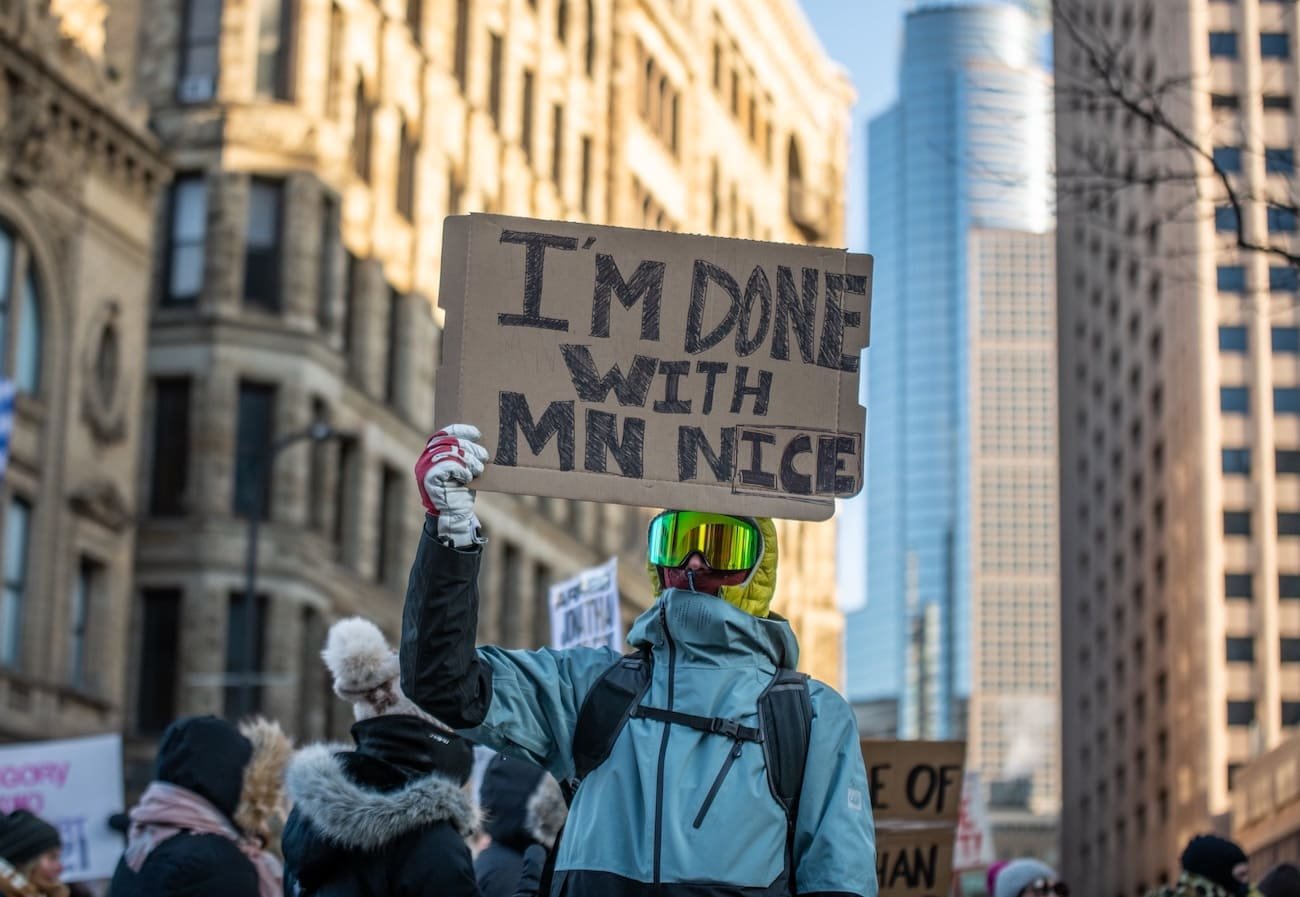
Minneapolis answered with defiance. Downtown streets filled with thousands of marchers, chanting and carrying signs that declared solidarity with immigrants – in sub-zero temperatures. Unions called strikes, halting work across industries. Small businesses shuttered their doors, not for lack of customers but as an act of conscience. At the airport, faith leaders staged a prayerful resistance in temperatures that plunged to –20°F. Over a hundred clergy were arrested, their bodies bundled against the cold but their voices unwavering. Their message was simple: defending immigrants is inseparable from defending the moral fabric of the city.
These protests were not orchestrated by outside forces, despite Trump administration’s claims of “paid agitators.” They were grassroots, voluntary, and deeply Minnesotan. They carried the authenticity of a community acting out of conviction rather than calculation.
One of the most striking features of the Minneapolis protests has been the visible role of the white residents. Business owners closed shops in solidarity, suburban families joined vigils, and clergy risked arrest alongside immigrant activists. This matters. Too often, immigrant rights are framed as the concern of immigrant communities alone. In Minneapolis, white Minnesotans have made clear that this fight belongs to everyone. Their participation amplifies the message that civil liberties are not divisible—that when one group is targeted, the freedoms of all are at risk. By stepping forward, white residents are helping dismantle the narrative of division. They are showing that solidarity can cross racial and class lines, and that defending immigrants is a civic responsibility, not a niche cause.
The protests in Minneapolis are remarkable not only for their scale but for their diversity. Immigrant families march alongside union workers. Clergy kneel beside students. White suburbanites stand shoulder-to-shoulder with Black and brown activists. This multi-racial, multi-faith coalition is what gives the movement its power. It is harder to dismiss when it is not confined to one demographic. It is harder to ignore when it represents the conscience of an entire city. In this coalition, Minneapolis is modeling what democracy looks like when communities refuse to be divided. It is showing the nation that solidarity is possible, even in times of fear and repression.

The struggle in Minneapolis is not just local. It is shaping national debates about federal power, civil liberties, and the role of communities in resisting overreach. If ICE can operate with lethal force in Minneapolis, what prevents similar actions elsewhere? If federal agents can breach consulates, what does that say about respect for international law? If communities remain silent, what happens to democracy itself?
Minneapolis is answering these questions with action. It is refusing silence. It is insisting that civil liberties are not abstract ideals but lived protections, defended in the streets when institutions falter. In the face of intimidation, Minneapolis has chosen defiance. Its residents are teaching America that democracy is not preserved by passivity but by courage. When immigrants are targeted, the whole city rises.
This rising is not only resistance—it is hope. Hope that solidarity can prevail over division. Hope that communities can defend their freedoms even against overwhelming power. Hope that democracy, fragile though it may be, can be renewed in the courage of ordinary people.
Minneapolis is offering that hope—not just for itself, but for the country. I am a proud Minnesotan and stand tall with my fellow residents.
Kuhu Singh is a writer with interest in social justice, cultural and political matters, in the U.S., India, and beyond.