


Hindutva’s Strategy in the U.S. of Pitting Hindus Against Indian Americans of Other Faiths is Stalling

- Its failure to stop Hindu Americans from voting for Mamdani and the deluge of anti-India/anti-Hindu hate online from the far right, have unnerved Hindutva leaders in the U.S.


I have lived in America for over five decades and have always identified myself as part of the diverse, vibrant, multi-faith “Indian American” community. I don’t recall ever having to wear my Hindu faith on my sleeve, except on explicitly religious occasions. For decades, “Indian American” federations looked out for our political and business interests; cultural groups kept us connected with our linguistic and regional roots; and local faith groups catered to our religious and spiritual needs.
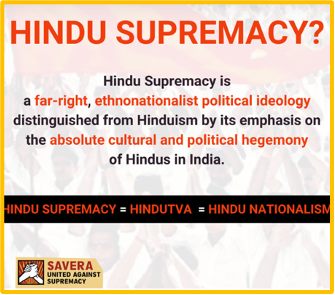
All that began to change in the nineties, when Hindutva (aka Hindu supremacist/Hindu nationalist) organizations emerged from the shadows, proclaiming that their mission was to unify and serve ‘Hindu interests’ in America. In reality though, their work amounted to pitting Hindus against other Indian Americans at every possible opportunity, in consonance with the ongoing mission of Hindutva in India to establish an exclusive Hindu Rashtra (Hindu Nation), where other communities would at best be second class citizens.
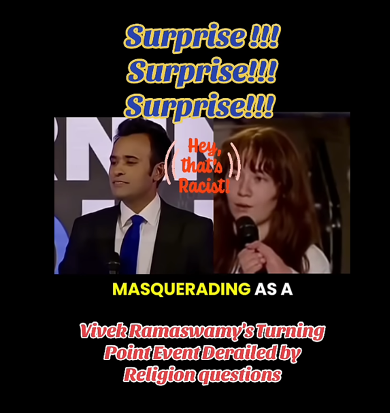
Vice President J.D. Vance responds to HAF
Today, many U.S. politicians view “Hindu Americans,” which includes Hindu immigrants from many countries, as a well-heeled national constituency, worthy of cultivating. As a result, the U.S. Congress now has a “Hindu Caucus,” primarily representing the priorities of Hindutva organizations, while the “India Caucus,” started in 1993, is the largest in the U.S. Congress, and it continues its focus on strengthening U.S.-India relations and helping Indian Americans.
In my opinion, the presence of two India-centric caucuses in Congress, supporting potentially conflicting ideologies, plays right into Hindutva’s mission of dividing the Indian American community. Also, In the highly vitiated public space today, any airing of differences of opinion on India/Diaspora policy could feed into the hate campaigns of the far right (White/Christian supremacy and MAGA).
Hindu American Foundation (HAF)

Hindu American Foundation (HAF) was founded in the U.S. in Sep 2003, roughly 19 months after the gruesome anti-Muslim pogroms in the state of Gujarat, India, led by Hindutva masses. A large part of HAF’s work over the years has been to support the interests of Hindutva politics in India and to act as a defensive shield for Hindutva leaders accused of major human rights violations.
Unfortunately, successive U.S. administrations, obsessed with ‘countering’ China and looking to India as a potential partner, have refused to hold the Modi government accountable for its atrocious human rights record: For five years in a row, they have rejected the recommendation of the U.S. Commission on International Religious Freedom (USCIRF) to designate India as a Country of Particular Concern (CPC). It’s notable that HAF has consistently sided with the Modi government in its accusations of bias against the USCIRF.
HAF often claims to speak for all Hindu Americans, which, taken at face value, would tacitly implicate the entire community in their unholy mission. But in reality, only 50% of Hindu Americans explicitly support Hindutva. And, given that Hindus are about 50% of the Indian American population, that would mean that nearly three-quarters (75%) of Indian Americans do not necessarily endorse Hindutva politics or Prime Minister Modi. That might explain why Mamdani was able to garner nearly 87% of the South Asian votes, despite the massive hate campaigns launched against him by Hindutva organizations and the far right.
Personally, I have always believed that a majority of Hindus in India and in the diaspora do not see themselves in the image of Hindutva. Instead, their voices have either been silenced or manipulated by the relentless disinformation campaigns by Hindutva’s social media. Other voices have muted themselves out of fear of running afoul of a vindictive Modi government.
These were the ground realities when a few like-minded Hindus and I decided that if we wanted to effectively counter the hate and violence being perpetrated in our names, then it is our duty to publicly speak out and oppose Hindutva with a Hindu voice. That was the genesis of Hindus for Human Rights (HfHR), founded in 2019, soon after Modi was elected for a second five-year term.
Keeping Hate Alive
From its very inception, HAF has portrayed Hindus as perpetual victims, and has fancied itself as the ‘cavalry’ riding in at the last moment to save them. This is consistent with Hindutva’s dangerous and baseless slogan “Hindu khatre mein hai” (Hindus are in danger) in India deployed to incite hate and violence against the minorities. Such a farcical claim by the majority community is a classic case of what Jessie Barton Hronešová et. al. describe as “hijacked victimhood.”
Although Hindutva organizations in the U.S. largely do not endorse violence, they do spend a better part of their day vilifying other Indian Americans — Muslims, Christians, Dalits, progressive Hindus, scholars, and others, often labeling them Hinduphobic, anti-Hindu, anti-India, etc. HAF is also known to threaten its critics with defamation lawsuits, notwithstanding the fact that its SLAPP lawsuit against me and four others in 2021 was unceremoniously thrown out by an Indian American Federal Judge in DC.
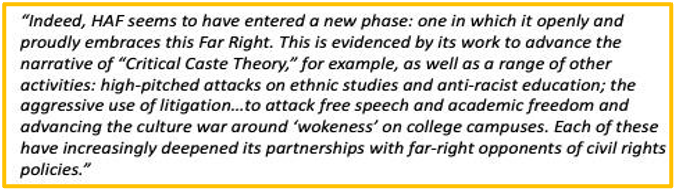
Savera – United Against Supremacy is a diverse coalition of Indian American groups, which has published a comprehensive research report on HAF (Oct 2024), which shines the light on its narrow sectarian and paranoidal world view. It also highlights HAF’s greatest folly: Treating Indian Americans of other faiths as its adversaries, while courting the far right which poses the real threat to all immigrant communities of color (See page 24 of the report):
The dangers that Savera warned us about became an overnight reality on Jan 20, 2025, with the incoming Trump administration quickly embracing “Project 2025,” the far right manifesto for his second coming. Today, the whole world can openly see the raw display of racism and religious bigotry unleashed by MAGA supporters, sometimes exacerbated by ‘holier-than-thou’ retorts from Hindu leaders: e.g. Vivek Ramaswamy’s viral post on H1B visas, which opened up the floodgates for on-line hate against Indians and Hinduism, and unsolicited advice from HAF to J.D. Vance regarding his wife Usha’s faith, which the Vice President called “disgusting” and elicited even more hateful responses from the far right..
To me, it’s interesting that HAF, which often invokes the constitutional rights of Hindus, has opposed every initiative by other Indian American communities to secure legal protections for their own rights: Dalits seeking protection against caste discrimination in the workplace, and Sikhs seeking protection from transnational repression, are two notable examples. In each case, HAF made the dubious claim (see page 14 of the Savera report) that the proposed legislation would impinge upon the rights of Hindus.
Unfortunately, HAF has shown no inclination to engage in a dialogue with its critics, instead attacking every attempt by scholars to organize open conversations on these topics. In my mind, that can only mean one thing: Keeping ‘wedge issues’ alive is an essential part of HAF’s survival strategy, similar to the way in which Zionists kept their conflicts with the Palestinians and their neighboring countries simmering for decades, in order to guarantee its annual largesse from U.S. taxpayers and U.S. vetoes of pro-Palestinian resolutions in the UN Security Council.
The ‘Pivot’ That Wasn’t
Given that history of HAF, I was surprised to read a comment in theprint.com (Oct 6, 2025), by HAF’s Suhag Shukla, asserting that “Indian Americans do not exist to serve as proxies for the Government of India.” I happen to agree with that sentiment, but coming from an organization that consistently supports Hindutva’s priorities in India and attacks other Indian American groups, I thought it was presumptuous and insincere.


A few days later, HAF endorsed “H.Res.819– Recognizing the contributions made to the United States by the Indian American diaspora and condemning recent acts of racism against Indian Americans.” The resolution was welcome news considering the huge spike in anti-India hate online; however, HAF didn’t bother to explain how this endorsement squared with its earlier championing of the narrower, sectarian H. Res 69, which seemed to target Indian Americans of other faiths.
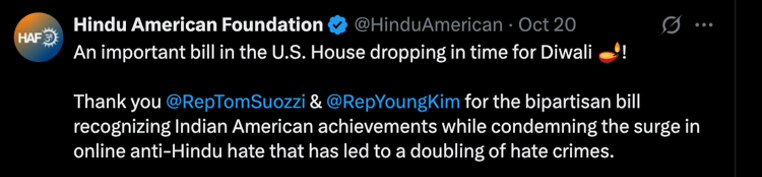
The more I think about it, the pretense of speaking for all Indian Americans may just be an opportunistic attempt by HAF to obfuscate its long record of marching lockstep with the Modi government, before any possible scrutiny by the DOJ for non-compliance with the Foreign Agents Registration Act (FARA).
The theprint.in article reminded me of this exchange with Shukla in Dec 2024:

Setting aside the hubris and ill humor in Shukla’s response, she maliciously distorts my words misreads my mind: I am myself a Hindu American, and it would never occur to me to broad-brush my fellow Hindus as “non-inclusive.” I was merely acknowledging that her description of Trump’s AI nominee Sriram Krishnan as an “American citizen of Indian origin” aptly identified him by his ethnicity/national origin, not by his presumed faith. That such a casual observation should evince a frontal attack on HfHR and me only goes to show that HAF is actually quite concerned about the rising influence of HfHR, their favorite “fringe group.”
A Hindu American “Ghar Vapsi”?
Of course, HfHR doesn’t purport to represent the entire Hindu community, but it does represent a large and growing number of Hindus who believe that we must stand for the rights of all minority communities in distress, guided by a set of universal values grounded in the Hindu faith: shanti, nyaya, and satya (peace, justice, and truth). HfHR sees the noble Upanishadic thought, Vasudaiva Kutumbakam (“The world is one family”) as a call to action, not merely a slogan to adorn flyers and web sites.
*********
A recent poll found that nearly 8% of those who voted for Trump in 2024 regret doing so, and 19% of them are seriously concerned about his administration. As the situation in the White House gets worse, I’m sure that these numbers will go up; and with it, the number of Indian Americans disillusioned by the Trump India policy.
As we enter 2026, it’s my hope that more and more “everyday” Hindu Americans will have the wisdom and the courage to reject the far right as well as Hindutva, and will “come back home” to their traditional political homes. We need all hands on deck in 2026 and beyond to defeat the unprecedented existential threat faced by all immigrant and minority communities in the US. More broadly, the world needs massive mobilization to defeat the unholy triad of White/Christian supremacy, Hindutva, and Zionism.
Raju Rajagopal is the Co-founder of Hindus for Human Rights.
Just one point of fact to be corrected here (there are so many, but let’s start here): HAF is perfectly willing to engage in dialogue with our critics. In fact I personally asked one of the most prominent of them, at a recent event at Rutgers University, if she would/why didn’t she want to engage with critics, implying us. Her response was “Goodbye Mat” before turning and walking away. If the author would like to have a genuine public debate, rather than continuing to smear us from afar in print using the same tired accusations, our contact info is on the website. I suspect he will not take us up on the offer.
But Islamism is not a problem? Hindus whether Hindutca types or not, don’t need lectures on tolerance. Go lecture those who.oppose Hindu temples or who call Hinduism a false pagan religion. So called right wing Hindus wish each other merry Christmas! Do Moslems and Christians wish Hindus happy Janmashtami, let alone each other!
Thanks for sharing this piece. Is there a reason why the stripping of Kashmir and Ladakh’s autonomy is not mentioned as one of their platforms to promote the Hindu nationalist project by HAF? Unfortunately, HAF seems to be in the business of harming their own people instead of actually addressing the main issues impacting Hindu Americans and those in solidarity with them. I just hope the people that gave HAF money get their money back. It is scary how embedded this org is in state, federal and local govt.