




Romila Thapar at 94: A Tribute to India’s Preeminent Historian Whose Life’s Work is a Testament to the Power of Scholarship

- She has been described as “virtually the only living historian of ancient and pre-modern India who has risen to the rank of world-class historians.”
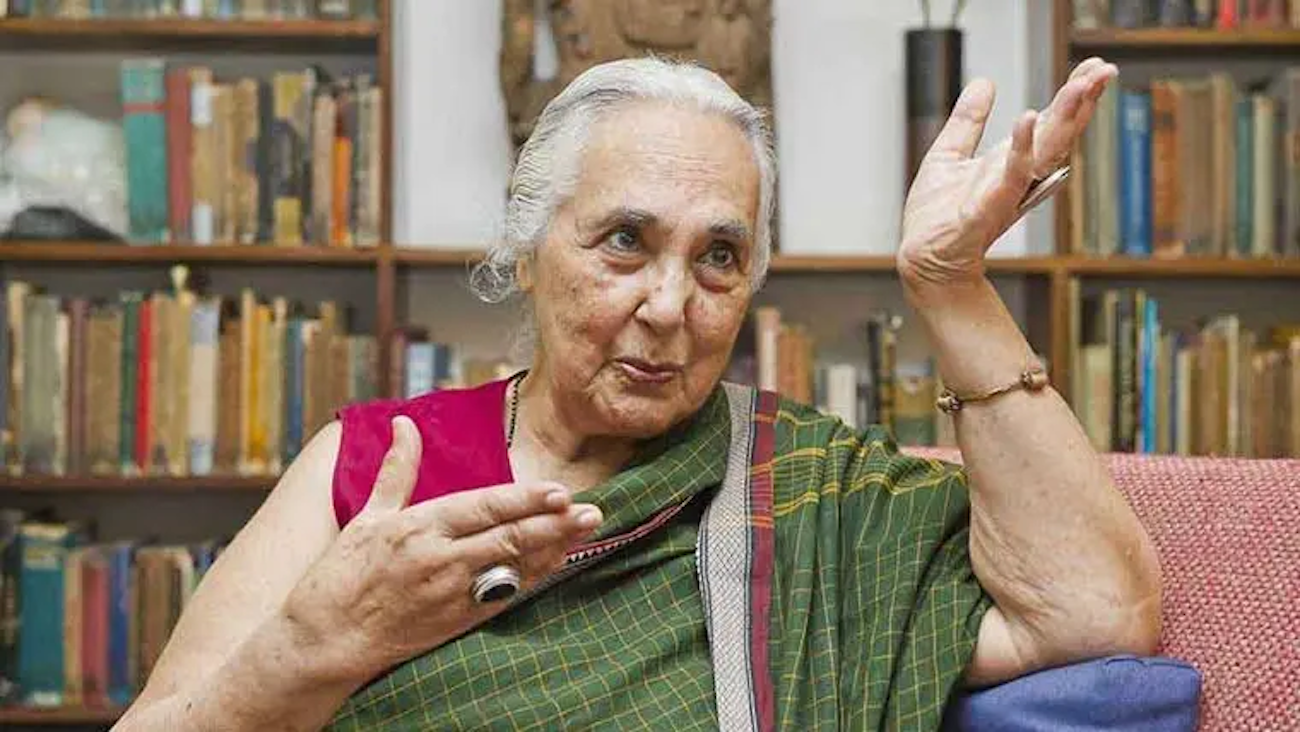

Romila Thapar, born on 30 November 1931, turned 94 years old this Saturday. Over more than six decades, Thapar has fundamentally transformed how the world understands ancient India, making her one of the most influential historians of the modern era.
The preeminent historian of early India, Romila Thapar opened the study of its rich, ancient civilization to habits of inquiry and conceptual frameworks arising out of the modern social sciences, according to the Library of Congress. She formulated new questions about the social development of nearly 2,000 years of Indian history and challenged existing historical paradigms from both the colonial era and the more recent nationalist period.
Early Life and Education
Romila is the daughter of Lieutenant-General Daya Ram Thapar, CIE, OBE, who served as the Director-General of the British Indian Armed Forces Medical Services. Her father told her that he could either pay for her dowry or send her to London for further studies and asked her to choose between the two, and Romila chose to study.
As a child, she attended schools in various cities in India depending on her father’s military postings and is an alumna of St. Mary’s School, Pune. Later she attended intermediate of arts at Wadia College, Pune, and after graduating from Punjab University in English literature, Thapar obtained a second bachelor’s honors degree from London University in 1955 and a doctorate in Indian history under A.L. Basham at the School of Oriental and African Studies (SOAS), the University of London in 1958.
Academic Career
After spending a few years in England, she decided to return to India and joined as a reader in the Ancient Indian History at Kurukshetra University in 1961, then moved to Delhi University in 1963 where she held the same position. She worked at Delhi University until 1970 and then moved to Jawaharlal Nehru University (JNU) in New Delhi, where she served as a professor of Ancient Indian History till 1991.
Thapar is now a Professor of Ancient History, Emerita, at JNU. She has been a visiting professor at Cornell University, the University of Pennsylvania, and the College de France in Paris.
Revolutionary Approach to History
At the beginning of her career, Thapar challenged the conventional historiography in her History of India published in 1966, breaking from the predominant view of an unchanging India characterized by a past and static Golden Age, according to the Library of Congress. This work accelerated the adoption of the social sciences in Indian universities and quickly became a teaching text in Indian schools.
Thapar’s special contribution is the use of social-historical methods to understand change in the mid-first millennium BCE in northern India. As lineage-based Indo-Aryan pastoral groups moved into the Gangetic Plain, they created rudimentary forms of caste-based states, and the epics Ramayana and the Mahabharata, in her analysis, offer vignettes of how these groups and others negotiated new, more complex, forms of loyalty in which stratification, purity, and exclusion played a greater if still fluid role.
Professor Thapar has researched more varied materials, including oral sources, and has sought to interpret economic and political documents in their cultural context, according to the Fukuoka Prize website. Using methodologies from the fields of cultural anthropology and sociology, in addition to historical theories, she successfully rebuilt the historical study of India in the context of world history.
Major Works
Thapar’s major works are “Aśoka and the Decline of the Mauryas,” “Ancient Indian Social History: Some Interpretations, Recent Perspectives of Early Indian History” (editor), “A History of India Volume One,” and “Early India: From the Origins to AD 130.”
Thapar is critical of what she calls a communal interpretation of Indian history, in which events in the last thousand years are interpreted solely in terms of a notional continual conflict between monolithic Hindu and Muslim communities.
In “Asoka and the Decline of the Maurya” published in 1961, Thapar situates Ashoka’s policy of dhamma in its social and political context, as a non-sectarian civic ethic intended to hold together an empire of diverse ethnicities and cultures, according to the Nehru Trust. She attributes the decline of the Maurya Empire to its highly centralized administration which called for rulers of exceptional abilities to function well.
Her 2004 book on Somnath examines the evolution of the historiographies about the legendary Gujarat temple, according to Wikipedia. More recent works include “Voices of Dissent: An Essay” published in 2020, and “The Future in the Past: Essay published in 2023,” according to Kafila.
In “Just Being,” Thapar invites us into her illustrious world—a rich, extensive memoir from a scholar who has profoundly shaped our understanding of India’s past and present, according to BiblioVault. From her childhood growing up in British India, through her years of education in London, her extensive travels to archaeological sites across Asia and beyond, and her trailblazing role in shaping the Centre for Historical Studies at Jawaharlal Nehru University, Thapar reflects on a life lived in the service of inquiry and education.
Awards and Recognition
In 2008, Romila Thapar shared the U.S. Library of Congress’s Kluge Prize for Lifetime Achievement in the Humanities and Social Sciences. Reviewers such as Indian studies scholar Indira Peterson have described her as the preeminent interpreter of ancient Indian history today and virtually the only living historian of ancient and pre-modern India who has risen to the rank of world-class historians, according to Richard Salomon of the University of Washington, as reported by The Washington Post.
Commenting on Romila Thapar, Librarian of Congress James H. Billington said she has used a wide variety of ancient sources and of languages, and introduced modern social science perspectives to help us better understand the richness and diversity of traditional Indian culture, according to the Library of Congress.
She was awarded the Jawaharlal Nehru Fellowship in 1976. Thapar is an Honorary Fellow at Lady Margaret Hall, Oxford, and at the School of Oriental and African Studies (SOAS), University of London, and holds honorary doctorates from the University of Chicago, the Institut National des Langues et Civilisations Orientales in Paris, the University of Oxford, the University of Edinburgh (2004), the University of Calcutta (2002) and from the University of Hyderabad (2009).
She was elected a Foreign Honorary Member of the American Academy of Arts and Sciences in 2009 and was also elected an Honorary Fellow of St Antony’s College, Oxford, in 2017. She was elected General President of the Indian History Congress in 1983 and a Corresponding Fellow of the British Academy in 1999.
Principled Stands
In January 2005, she declined the Padma Bhushan awarded by the Indian Government. In a letter to President A P J Abdul Kalam, she said she was astonished to see her name in the list of awardees because three months ago when she was contacted by the HRD ministry and asked if she would accept an award, she made her position very clear and explained her reason for declining it.
Thapar had declined the Padma Bhushan on an earlier occasion in 1992, explaining that she only accepts awards from academic institutions or those associated with her professional work, and not state awards.
Championing Evidence-Based History

Thapar’s work has reached beyond the academy and into primary and high school textbooks, and her perspective on Indian history has placed her in the midst of contentious debates, according to the Library of Congress.
Thapar is critical of what she calls a communal interpretation of Indian history, in which events in the last thousand years are interpreted solely in terms of a notional continual conflict between monolithic Hindu and Muslim communities. Thapar says this communal history is extremely selective in choosing facts, deliberately partisan in interpretation and does not follow current methods of analysis using multiple, prioritized causes.
In 2002, the Indian coalition government led by the Bharatiya Janata Party changed the school textbooks for social sciences and history on the ground that certain passages offended the sensibilities of some religious and caste groups. Thapar, who was the author of the textbook on Ancient India for class VI, objected to the changes made without her permission that, for example, deleted passages on eating of beef in ancient times and the formulation of the caste system.
Thapar has persistently championed a history grounded in evidence drawn from multiple sources in multiple languages from all levels of society across time and has consistently sought to counter simplifications not supported by the evidence and foster appreciation for a pluralistic view of India, according to the Library of Congress.
Continuing Influence
Her research has profoundly changed the way India’s past is understood both at home and across the world, and Thapar has written or coauthored 15 substantial books.
In January 2024, Thapar delivered a lecture as part of the Democracy Dialogues Series examining the link between history and particular kinds of nationalism. At 93, she remained intellectually engaged, discussing how nationalism can be a process bringing together communities or how it can be divisive.
It is noteworthy that Thapar presents a broad historical description, written in a lively, animated style, skillfully and convincingly weaving together closely correlated facts derived from disparate sources to paint a coherent historical picture, according to the Fukuoka Prize citation.
Legacy
Thapar has made an enduring contribution to India and the world that lies with her role in innovating methodologies for historical research and her transforming our knowledge of Indian history, according to the Library of Congress.
As Romila Thapar celebrates her 94th birthday, her legacy extends far beyond her scholarly achievements. She has inspired generations of historians to approach the past with rigor, intellectual honesty, and a commitment to evidence over ideology. Her insistence on a pluralistic understanding of Indian history and her courage in defending academic integrity against political pressure have made her not just a great historian, but a guardian of truth in an age when history is often weaponized for narrow political ends.
Her life’s work stands as a testament to the power of scholarship to illuminate the past and, in doing so, help us better understand the present and imagine a more informed future.
This story was aggregated by AI from several news reports and edited by American Kahani’s News Desk.